Address
Henneberg Castle Ruins
Burgweg 1
98617 Meiningen, Henneberg
Friends’ Association
Club Henneberg e.V.
Website
Opening hours
Open to the public all year round

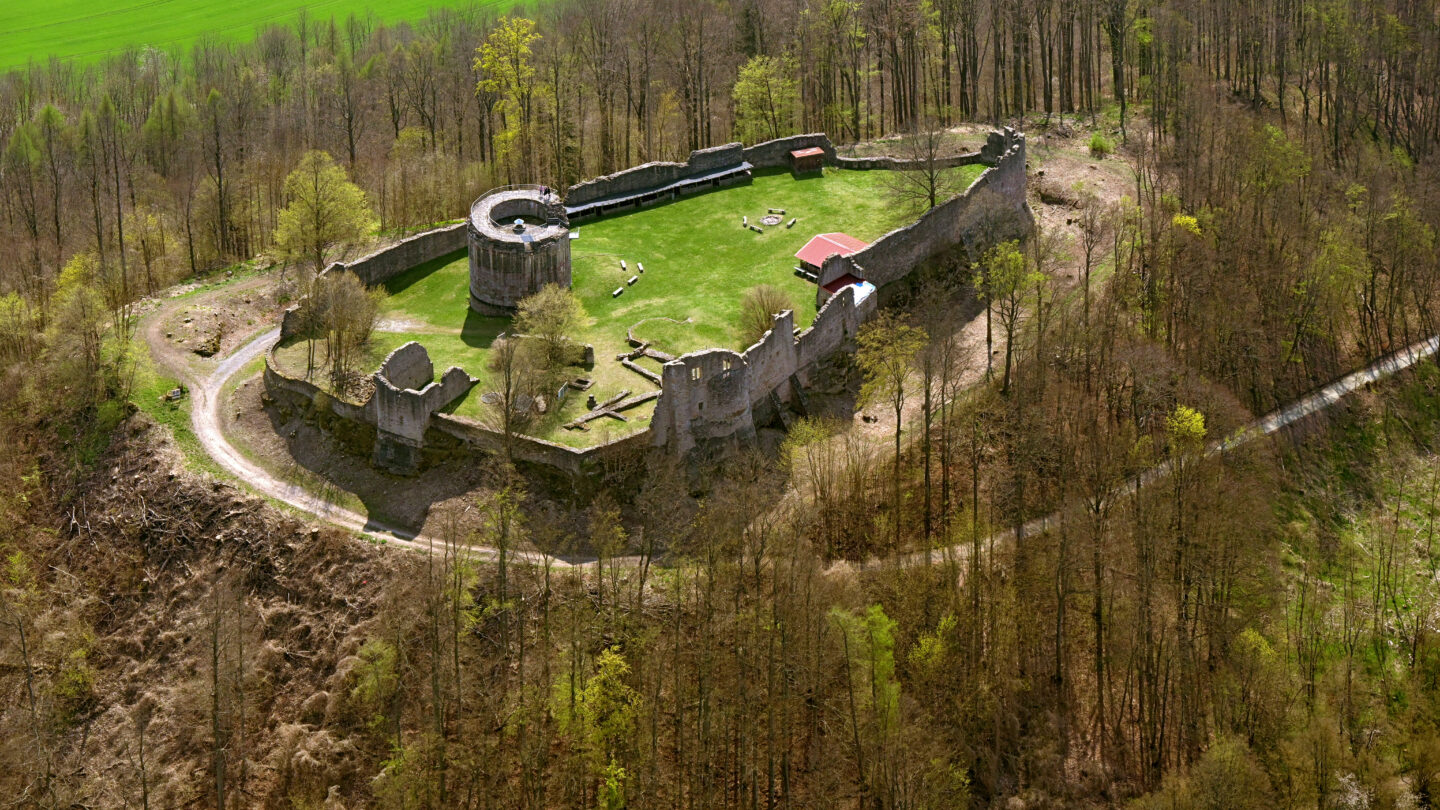
Not far from the Thuringian-Bavarian border stands the Henneberg, with its castle ruins of the same name. The isolated conical hill is visible even from a distance. The ancestral castle of the Counts of Henneberg, from which the hill takes its name, once stood on its plateau. The significance of the complex, which survives as a ruin, can be gauged from the imposing keep, which measures 14 metres in diameter. The restored tower is now open to visitors and offers unobstructed views across the Henneberg region.
Henneberg Castle Ruins
Burgweg 1
98617 Meiningen, Henneberg
Friends’ Association
Club Henneberg e.V.
Website
Open to the public all year round
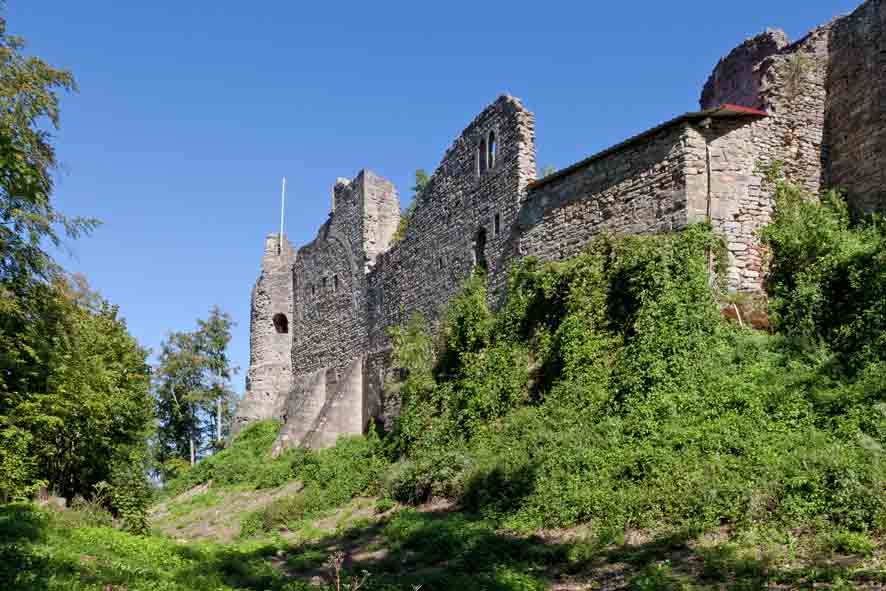
‘A gentleman of noble birth travelled through Germany, seeking peace and a suitable spot on which to build; he came to a place in Franconia and found a mountain in the countryside that took his fancy. As he rode up to inspect it, a female black grouse, which had chicks, flew up before him; he adopted it as his coat of arms, named the mountain Hennenberg, and built a beautiful castle upon it, as can still be seen today.” If one is to believe the legend, this is how the Counts of Henneberg came to establish their ancestral seat in the Franconian region of Grabfeld. However, it may simply have been the strategically favourable location that tipped the balance. For the Henneberg rises as an isolated hill some 130 metres above the surrounding countryside. In the Middle Ages, the important trade route from Würzburg to Meiningen ran very close by. At first glance, the present-day ruins of Henneberg Castle may seem like just one of many. Yet it was the eponymous ancestral seat of a noble family that once ruled Thuringia.
The complex dates back to the 11th century. It once formed the centre of the Henneberg region, which still bears the hallmarks of Franconian culture today. This domain, situated in the north of what was then the Diocese of Würzburg, encompassed large parts of what is now Lower Franconia, southern Thuringia and eastern Hesse – and, due to its location, was repeatedly the subject of fierce political, cultural and economic rivalry. The Counts of Henneberg have left their mark on the region to this day. This is clearly evident, for example, in the coats of arms of several towns and districts, which feature the black hen, the heraldic animal of the Henneberg family.
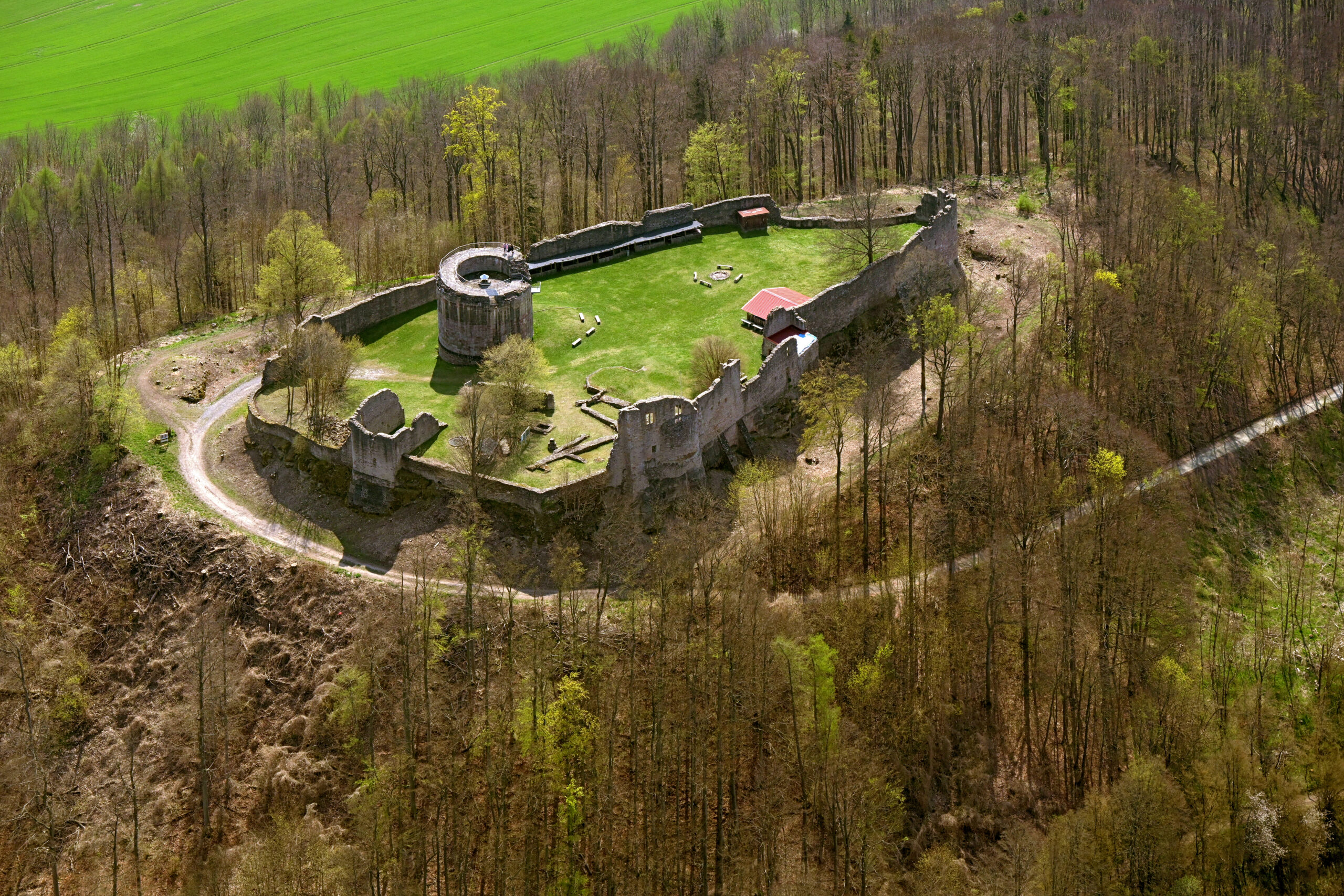
The castle complex covers an area of around 160 by 20 metres and is completely surrounded by a curtain wall. It has always been regarded as one of the most extensive fortifications in Thuringia. The first documented mention of it as a ‘castrum’ dates back to 1221. It was probably during this period that the counts had the castle extensively rebuilt. On the one hand, this was to meet their new requirements for a stately residence. On the other hand, the reconstruction had probably also become necessary due to a rockfall that had destroyed the original entrance. The remains of a great hall, the ladies’ quarters and a chapel have survived to this day.
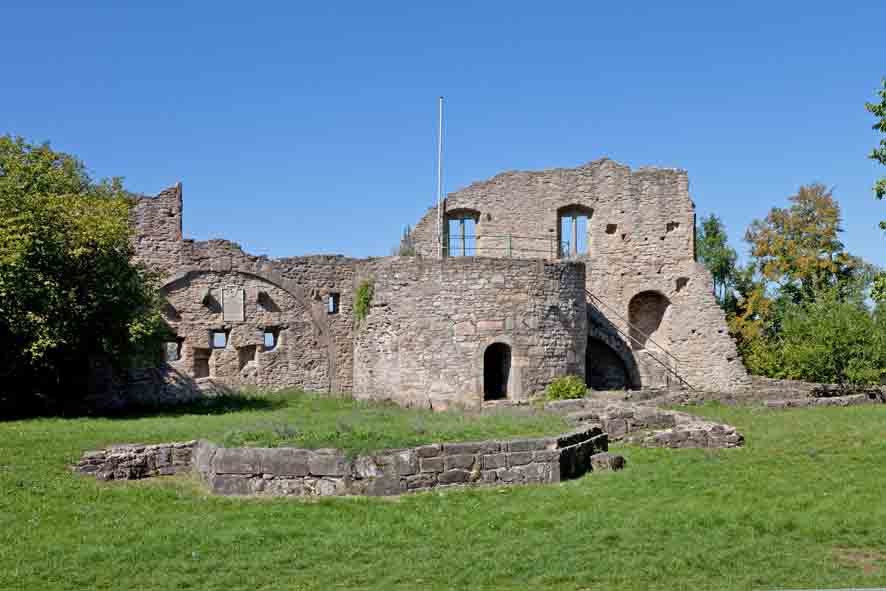
After the family had split once again in 1274, the newly formed branches each established their own residences. Despite the family and political divisions, the individual members of the Henneberg family continued to feel a sense of loyalty to their ancestral seat, and so extensive building works were carried out time and again. During the Peasants’ War, however, the castle was pillaged and subsequently fell into disrepair. In 1784, the castle was briefly given a new lease of life when Duke Georg I of Saxe-Meiningen (1761–1803) took it under his wing. Conservation and restoration work saved the castle from complete ruin. During the period of German division, the castle lay within a military restricted area; the inner-German border was only about two kilometres away, and the mighty keep housed a watchtower manned by East German border troops. Today, the ruins are freely accessible to visitors.
Castle Administration: Bertholdsburg Castle, Veßra Monastery and Henneberg Castle Ruins
Burgstraße 6
98553 Schleusingen
Tel: +49 173 576 98 71
Email