Welcome to the Stiftung Thüringer Schlösser und Gärten
The palaces and gardens, monasteries and castles of Europe offer educational experiences and enjoyable education. Thuringia is part of this rich treasure and offers a particularly dense network of historical monuments – a treasure trove of courtly culture. Opening up the fascinating world of Thuringia’s castles to you and unfolding their history before you is a central task of the Thuringian Palaces and Gardens Foundation.
We look after 31 of the most important cultural monuments in Thuringia. The spectrum ranges from Romanesque monasteries and ruins of once defiant castles to stately Renaissance and Baroque residences and pleasure palaces and secondary residences, often with preserved original interior design in the halls and room sequences. 12 gardens and parks from different eras show that Thuringian princes also measured themselves against European standards in garden design and engaged experienced artists on a grand scale.
We introduce ourselves.
Stiftung Thüringer
Schlösser und Gärten
Tasks of the Stiftung Thüringer Schlösser und Gärten
In 1994, our Foundation was established with the mandate to care for, restore, and make accessible to visitors the monuments entrusted to us. The selection of monuments belonging to the Foundation was based on their significance for the history of the state and their dynastic connections to the former ruling princely houses and their residences. At present, we are responsible for 31 of Thuringia’s most culturally and historically significant palaces, castles, parks, and monastic complexes.
We develop concepts for the functional and heritage‑conservation‑oriented development of the buildings and gardens. We are responsible for the preservation, restoration, and refurbishment of the historic ensembles. Another core task is the interpretive and tourist presentation of these distinguished sites. In this work, we cooperate closely with our local museum partners. A considerable number of the museums in our properties remain under their traditional legal sponsorship and are linked to our Foundation through the estates concerned. We also rent out rooms and open‑air areas in our palaces and gardens for events.
The Thuringian Palace Landscape embarked on its journey towards UNESCO World Heritage status in 2021. Although the proposal did not make it onto the current German tentative list for UNESCO World Heritage, as decided by the Standing Conference of the Ministers of Education and Cultural Affairs in December 2023, work on the project is continuing.
Thuringia is characterised by an unusually high density of princely residences belonging to various dynasties - a pattern typical of the Holy Roman Empire of the German Nation. From the Middle Ages until its dissolution in 1806, the Empire comprised a multitude of such centres. Its residences housed judicial and administrative buildings such as bailiffs’ offices, chanceries, and ministries. This federal, small‑scale state structure has been preserved in comprehensible form only in Thuringia.
As a guarantor of legal security and internal stability, the Holy Roman Empire had, since the Early Modern period, ceased to be capable of waging offensive wars. Within its territories, the arts and sciences flourished. The Empire’s cultural pluralism also left its mark on Thuringia. Into the early 20th century, its princes pursued politics primarily through culture and scholarship: with libraries and art collections, with music and theatre. Architecture and landscape design benefited greatly from this patronage. Artists and architects worked for multiple dynasties, contributing to the development of an overarching character in the Thuringian Palace Landscape.
Magnificent and imposing palace complexes dominate it, bearing witness to the status of their former owners as Imperial Princes. Their prominent towers rise high above relatively small residence towns. Architectural elements from earlier eras were preserved as emblems of age and continuity, expressing the Thuringian princes’ claim to authority. In their sequences of rooms, state and great halls, staircases, and palace chapels, the ceremonial life of princely residences is vividly reflected.
Nine Residences in Eight Residence Towns
The nine selected palace complexes of Thuringia, taken together, exemplify the finely divided structure of governance within the Holy Roman Empire. All contain the typical functional elements of the residences of independent yet less powerful Imperial Princes, and are located in eight residence towns:
Altenburg Residence Palace
Perched on a porphyry outcrop in north‑eastern Thuringia, the Altenburg Residence Palace was first mentioned in the 10th century as a hilltop castle. Under Emperor Friedrich I Barbarossa, it was developed in the 12th century into an Imperial Palace (Kaiserpfalz). Owned by the Wettins since 1307, it was continually developed until the early 20th century. Altenburg, as both residence town and palace, is a prime example of the evolution of a princely seat from the Middle Ages to the end of the monarchy: from a medieval castle and Kaiserpfalz through a Baroque palace to the modern residence of a constitutional monarchy with a parliament. From 1603 Altenburg was the seat of the Dukes of Saxe‑Altenburg.
Following the extinction of the Altenburg line in 1672, the Duchy of Saxe‑Gotha‑Altenburg was created with Gotha as its capital. The Duchy of Saxe‑Altenburg regained independence in 1826 and retained it until 1918. As a ring‑shaped palace, Altenburg encompasses elements from the Middle Ages - Romanesque to Late Gothic - as well as Renaissance, Baroque, Neo‑Gothic, and Neo‑Renaissance. Between 1705 and 1712, it was expanded into a palace with state apartments and living quarters. The imposing Corps de Logis (residential building) was added to the west of the medieval ring, on steeply sloping ground, and contains a great hall designed in Neo‑Renaissance style by the Prussian court architect Friedrich August Stüler.
Weimar City Palace
Located in the heart of the Thuringian Basin, Weimar has been under Wettin ownership since 1299. Elector Johann Friedrich I of Saxony developed it as his main residence after 1531. From this period dates the “Bastille” palace gateway, with its electoral imagery; it housed the chancery, council chamber, and consistory. The Bastille was preserved in all later alterations as a testimony to the lost electoral dignity.
After the abdication of the Grand Duke in 1918, the first Republican government convened in the palace; in 1919, the National Assembly of the Weimar Republic met in the former court theatre. Thus, the transformation from princely residence to modern democracy can be traced in the palace and city of Weimar.
Around 1800, Weimar became a cultural centre of European significance. Under Duke Carl August of Saxe‑Weimar‑Eisenach, a new palace complex was begun after 1789, with Johann Wolfgang von Goethe playing a major role on its building commission. In this era of tolerance and diversity, the physical closeness of palace and town fostered an increasingly close relationship between sovereign and citizens. Since 1998, Weimar City Palace has formed part of the “Classical Weimar” UNESCO World Heritage Site.
Friedenstein Palace, Gotha
Dominating the southern Thuringian Basin from a slightly elevated plateau, Friedenstein Palace was built on the site of Grimmenstein Palace, demolished in 1567. From 1640 to 1894, it served as the main residence and administrative seat of the Duchy of Saxe‑Gotha. Its vast size resulted from incorporating all the functions of a residence under one roof: administration, economic offices, armoury, mint, archives, and theatre. As the largest palace of its time anywhere in the world, Friedenstein became a prototype of palace architecture within the Holy Roman Empire.
Gotha, Friedenstein Palace, courtyard from the north
Its Baroque gardens and orangery give way to one of continental Europe’s earliest English landscape gardens, designed by John Haverfield from Kew Gardens. When the House of Saxe‑Gotha‑Altenburg became extinct in 1825, Gotha passed to Saxe‑Coburg; building activity continued, with Duke Ernst II commissioning the Neo‑Renaissance Ducal Museum and establishing a conifer garden as an extension of his natural history collections. Ernst II’s family ties to the British royal house were reinforced through his brother, Prince Albert.
Elisabethenburg Palace, Meiningen
In the forested hills of south‑west Thuringia lies Meiningen, whose Baroque Elisabethenburg Palace, like Friedenstein, contained all the functions of a residence. The opulent state and private rooms occupied the west wing of its four‑wing layout; the semi‑circular east wing housed the ducal administration, which still accommodates the municipal offices today. The “Round Building” and projecting stair tower represent innovative, space‑saving solutions to the growing demands of a residence.
The oldest section is the “Bibrabau” (Bibra Building) of 1511, part of the former episcopal Würzburg “Meininger Castle”. When Duke Bernhard received the Duchy of Saxe‑Meiningen in 1680, he used it as the foundation for Elisabethenburg Palace. The south wing contains the palace church, above which lies a great hall later used as a theatre. In the liberal era of Duke Georg II, Meiningen became a centre for music and theatre, illustrating the transformation of a Baroque princely seat into a modern regional hub.
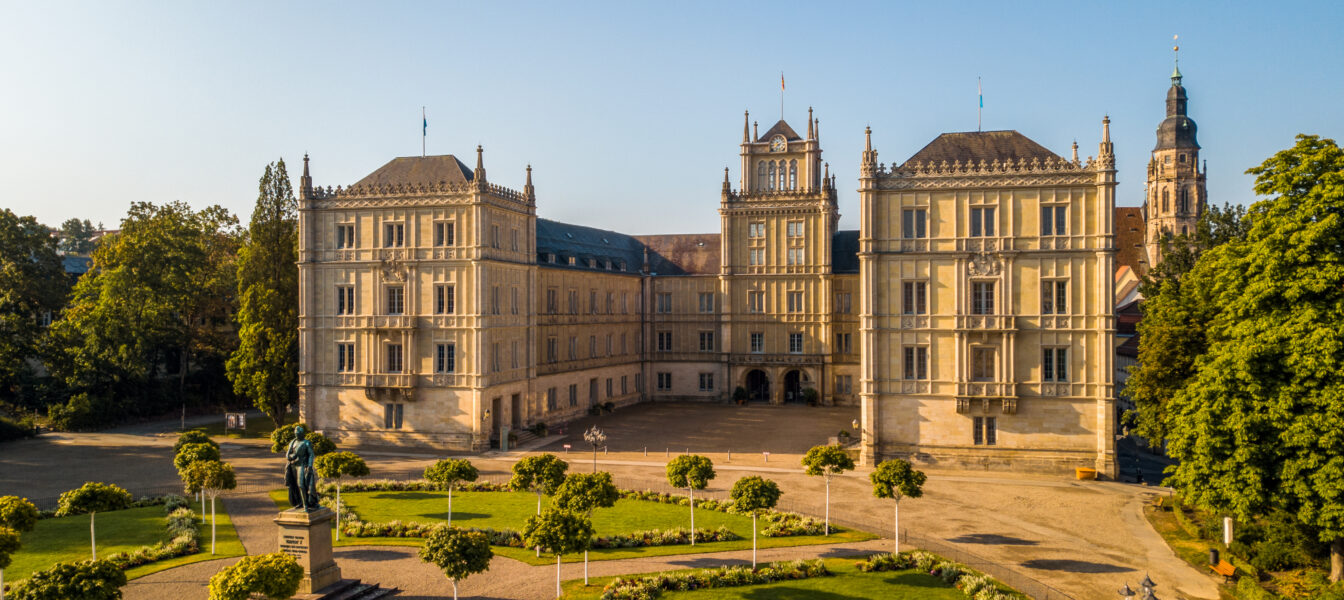
Ehrenburg Palace, Coburg
South of the Thuringian Forest in present‑day Bavaria, Coburg’s Ehrenburg Palace stands in the town centre. Tradition has it that Emperor Karl V gave it its name because Johann Ernst of Saxe‑Coburg built it without forced labour. Major works under Duke Ernst I from 1810 onwards transformed it into a neo‑Gothic palace of English character, retaining parts of the earlier structure. It became the first residence in the historicist style.
From 1825, architect Karl Friedrich Schinkel and landscape designer Peter Joseph Lenné created the circular palace square, flanked by the neo‑classical Coburg State Theatre and Palais Edinburgh. East of Ehrenburg Palace lies the Hofgarten (Courtyard Garden), landscaped in the English style and extending to Coburg Fortress. Ernst I’s close family ties to Queen Victoria and Prince Albert are reflected in the Anglo‑German exchange of architectural and garden design. Ehrenburg Palace also preserves the earliest extant Napoleonic throne room, created in 1816 to the model of the Paris Tuileries Palace (destroyed in 1871).
Sondershausen Palace
Overlooking the town in north‑west Thuringia, Sondershausen Palace is an unusual, almost triangular complex dominated by a massive medieval tower and adjoining Renaissance wings. Later wings meet at acute angles at the north‑west corner, where the main entrance and open stairway are located. Its layers of building styles underline the significance of preserving older elements as symbols of dynastic legitimacy.
First recorded in 1287 as a castle of the Thuringian Landgraves, it passed to the Counts of Schwarzburg in 1356 and, from 1571, became the seat of the Schwarzburg‑Sondershausen line. Elevated to princely status in 1697, they carried out extensive works. The palace complex included chancery and administrative rooms, stables, and the octagonal pavilion in the park, whose interior housed a wooden horse carousel, reflecting the princes’ role as Arch‑Stablemasters of the Empire.
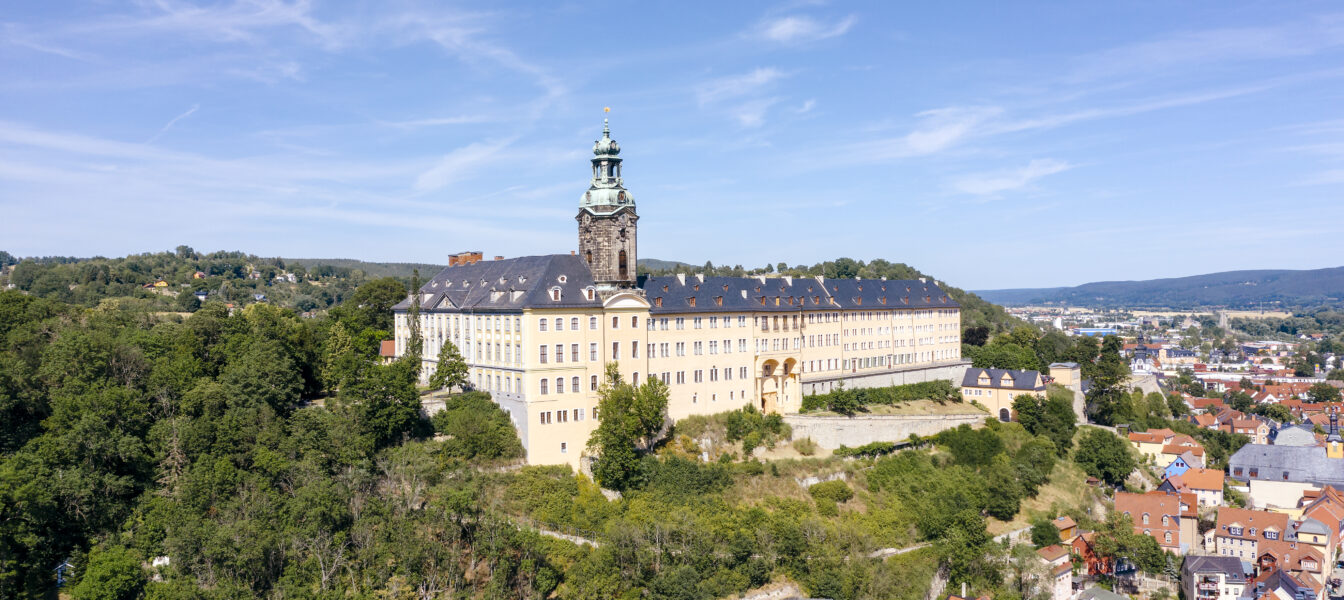
Heidecksburg Palace, Rudolstadt
In the south‑east of Thuringia, perched atop a steep rock above Rudolstadt, stands Heidecksburg Palace, first mentioned in records in 1264. Since 1364, the palace belonged to the Counts of Schwarzburg. Their elevation to the rank of Imperial Princes in 1710 brought about extensive structural alterations. The north wing, in Renaissance style, was retained, housing the princely ministries. The striking palace tower was designed in 1744 by the Weimar master builder Gottfried Heinrich Krohne.
The riding school, horse‑swimming baths, and manège bear witness to the Schwarzburgs’ function as Arch‑Stablemasters of the Holy Roman Empire. Ramps and horse stairways lead from the inner courtyard down to the lower terraces. On the lower level, amid the trees of the former English landscape garden, lies an exceptional architectural gem: the Rudolstadt Sound House. Its interior comprises several floors - the sound hall, gallery, and sound chamber - together forming a remarkable resonating body. These distinctive acoustic features hark back to the “Himmelsburg” Palace Phapel in Weimar, destroyed by fire in 1774.
Residences in Greiz
In the east of Thuringia, amid the hilly, wooded Thuringian Vogtland, lies the residence town of the House of Reuss. The Reuss family carried out numerous territorial partitions, resulting in the continual emergence of new residences, although the individual territories legally remained under a single rule. For around 200 years, until 1768, two lines of the House of Reuss governed in parallel from Greiz: for 150 of those years from Upper and Lower Greiz. Nowhere is the spatial fragmentation of the Thuringian residence landscape - as a reflection of the territorial structure of the Holy Roman Empire - more clearly manifested than in Greiz.
Upper Palace, Greiz
Rising in the north‑west of the old town, the Upper Palace stands as a hilltop palace upon a narrow peak about 50 metres high. Its slender bergfried (main tower) is elevated and visible from afar atop a rocky outcrop. Erected before 1189, the hilltop palace has been in the possession of the House of Reuss since the late 13th century. The elliptical palace complex includes the medieval great hall (palas) and double chapel, a Renaissance wing, and the Baroque “High House”. From the late 18th century, when the more modern Lower Palace became the principal residence, the Upper Palace housed the regional administration.
Lower Palace, Greiz
Within sight of the Upper Palace, the Lower Palace stands some 200 metres to the south‑east. The Younger Line of the House of Reuss, which resided here, became extinct in 1768 after almost two centuries of rule. When the Elder Line of Reuss was elevated to the rank of Imperial Princes ten years later, they chose the more modern Lower Palace as their principal residence. On its north‑east side, the classical three‑wing complex is bounded by the parish church of St Mary, which, together with the Lower Palace, forms an ensemble. Following a devastating town fire in 1802, the Lower Palace was rebuilt in the classical style and, in 1884/85, extended with the Gründerzeit-style‑era Ida Palace, complete with winter garden and onion dome.
Summer Palace and the Princely Park of Greiz
West of the palace hill, along the banks of the River White Elster, extends the nearly 50‑hectare Princely Park of Greiz. The originally Baroque pleasure garden was transformed from 1800 into an English landscape garden. In the middle of the park, the classical Summer Palace was built after 1768, when the extinction of the Younger Line of Reuss brought the two branches together again. Located barely 300 metres from the Upper Palace and clearly visible from it, the Summer Palace became the court’s seasonal residence, occupied each year during the summer months.