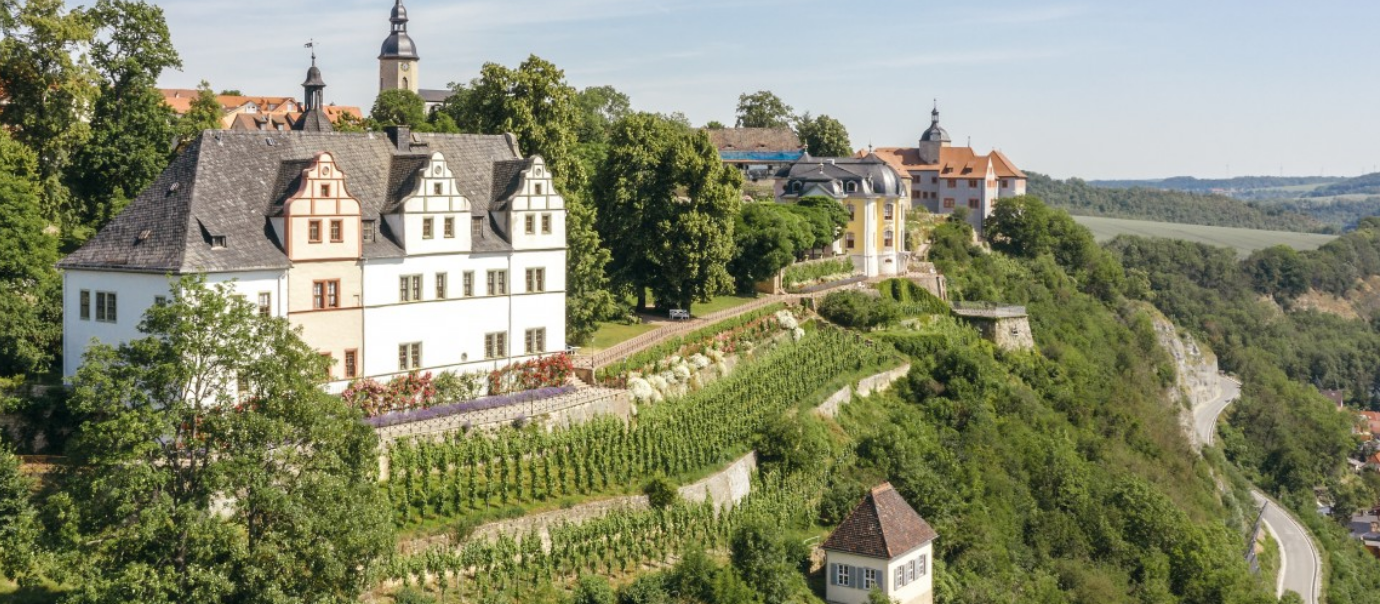
The Dornburg castles are enthroned on a rugged cliff high above the Saale valley, connected by gardens of different styles that extend into the steep slope. In the 19th century, the ensemble was the favoured summer residence of the Grand Dukes of Saxe-Weimar-Eisenach and a favourite haunt of Johann Wolfgang von Goethe. All important epochs since the High Middle Ages have left their mark here, creating a unique combination of diversity and harmony.
The palaces were created as individual complexes and were brought together from 1824 under Grand Duke Carl August through the garden design. From around 1870, his grandson Carl Alexander ensured careful remodelling in the spirit of historicism, which still characterises the image of the complex today. After 1918, the Renaissance and Rococo palaces became museums.
Three castles, three characters - the unique ensemble of Dornburg castles is enthroned on a rock above the Saale valley. The Dukes of Saxe-Weimar-Eisenach treasured the "Balcony of Thuringia" as a summer residence. More than 800 years of history are united here. The Old Palace harbours the remains of a medieval castle. The Rococo Palace is a gallant 18th century pleasure palace with a porcelain collection. The Renaissance palace is closely associated with Johann Wolfgang von Goethe. He raved about the lovingly tended castle gardens - they are a delight for strollers and rose lovers. The wine from the Dornburg Schlossberg is as popular today as it was then.
Three castles - one ensemble
The origins of the Dornburg castles lie in a castle complex from the High Middle Ages at the northern end of the castle rock. In the 16th century, the Old Castle took its place, followed almost simultaneously by the Renaissance castle to the south. In the 18th century, the rococo palace was built in the centre of the castle - the imposing triple backdrop was perfect. Initially, however, the palaces served completely different purposes and did not even belong together. It was not until 1824 that Grand Duke Carl August of Saxe-Weimar-Eisenach purchased the Renaissance palace in addition to the other two palaces and had them connected by a variety of terraced gardens. Today, the Renaissance and Rococo palaces and gardens are open to the public. The Old Palace is used as a conference centre.
Pleasure, hunting and military - the rococo castle
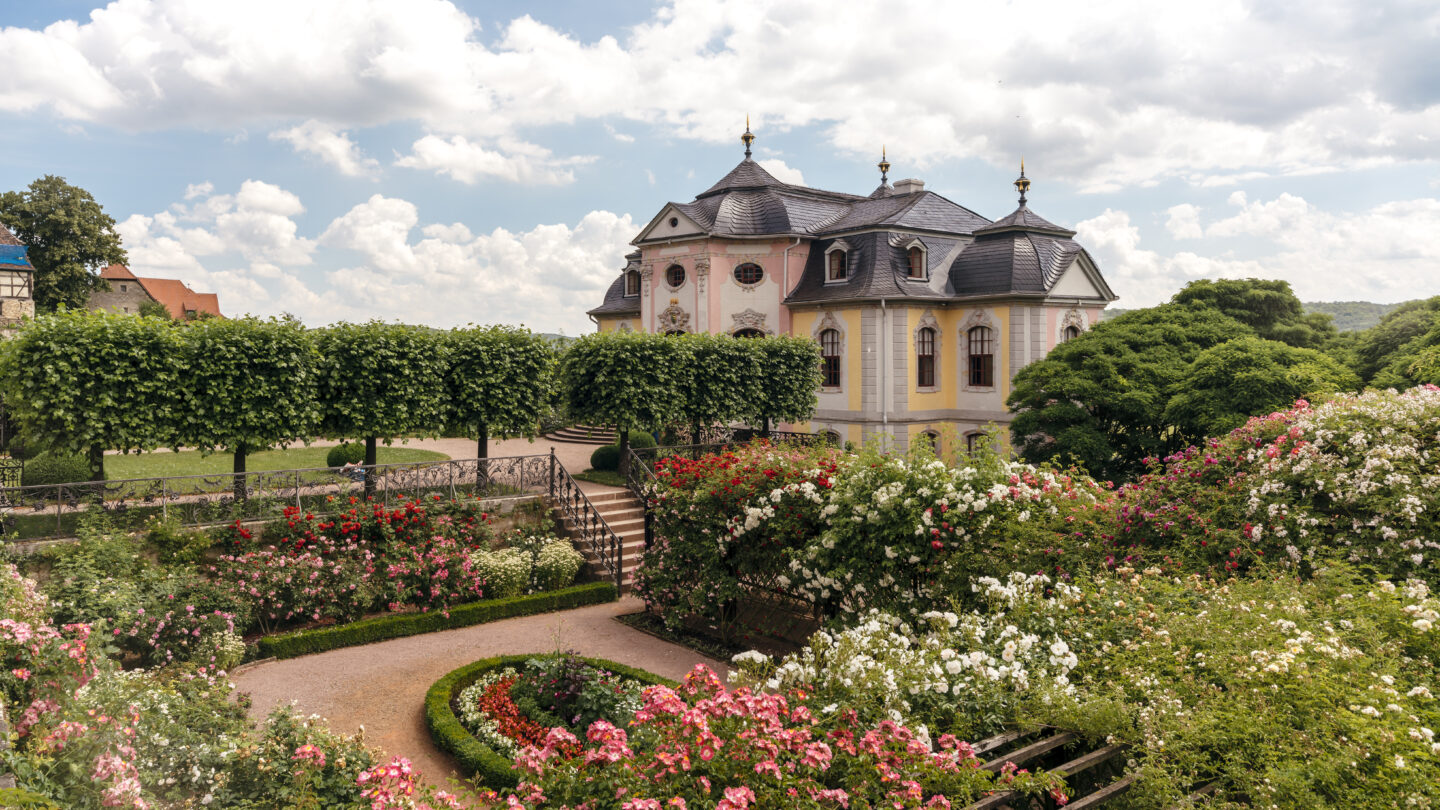
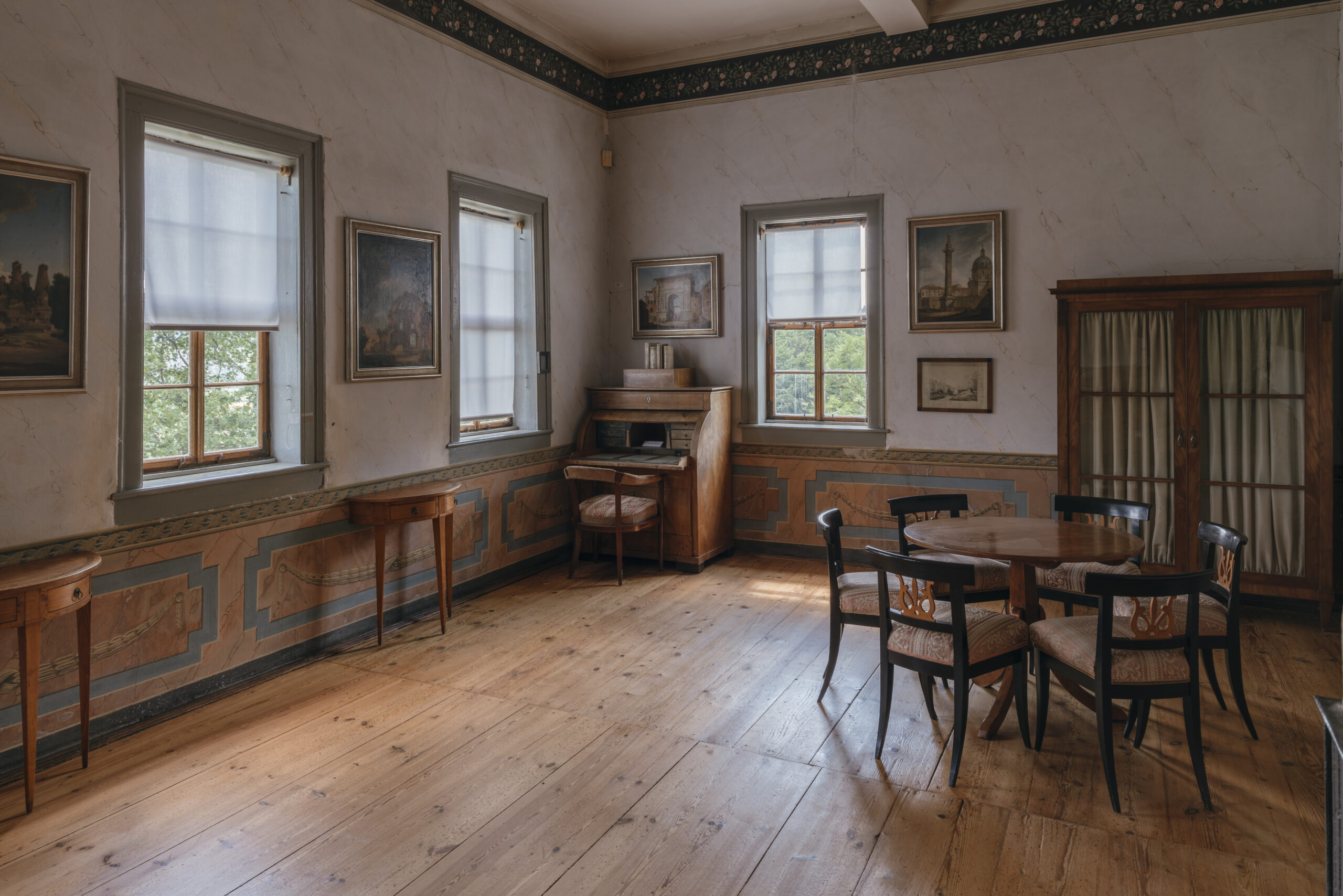
Around 1740, Duke Ernst August I of Saxe-Weimar-Eisenach had the rococo palace confidently placed at the centre of the Dornburg ensemble. It was one of many building projects of the absolutist ruling prince. He valued Dornburg above all for its nearby hunting grounds. He also wanted to emulate Elector Augustus the Strong and organise a military display modelled on his famous Zeithain encampment. Although this never materialised, the bastion-like terraces on the steep slope are reminiscent of this idea. The pleasure palace makes imaginative use of the hillside location. The floors are directly accessible from the garden terraces - the upper floor via an elegantly curved staircase. There, the banqueting hall with its stucco marble in bold colours reflects the baroque ruler's ambitions. The more modest ideas of classicism were later reflected in the flats to the side. Grand Duke Carl Alexander put the finishing touches to the palace in 1875. He consistently orientated himself towards the style of the period in which it was built and furnished the dining room in rococo forms, which many of his contemporaries avoided. Here he assembled a collection of porcelain from China, the Netherlands and Thuringian manufactories.
From castle to conference centre - The Old Castle
The Old Palace took on its current appearance in the middle of the 16th century. It combines four buildings of different ages, which were given a uniform appearance through the colour of the façade and the shape of the windows. The keep, for example, dates back to the 12th century. A late medieval bower was also incorporated into the castle building. The south wing, on the other hand, was rebuilt in the Renaissance style and houses two large halls. In addition to the imposing wooden ceilings, painted Renaissance ornamentation has been preserved. Various uses characterised the building until the 20th century. Since 2004, the extensively renovated castle has served as a modern conference centre.
Goethe was here - the Renaissance castle
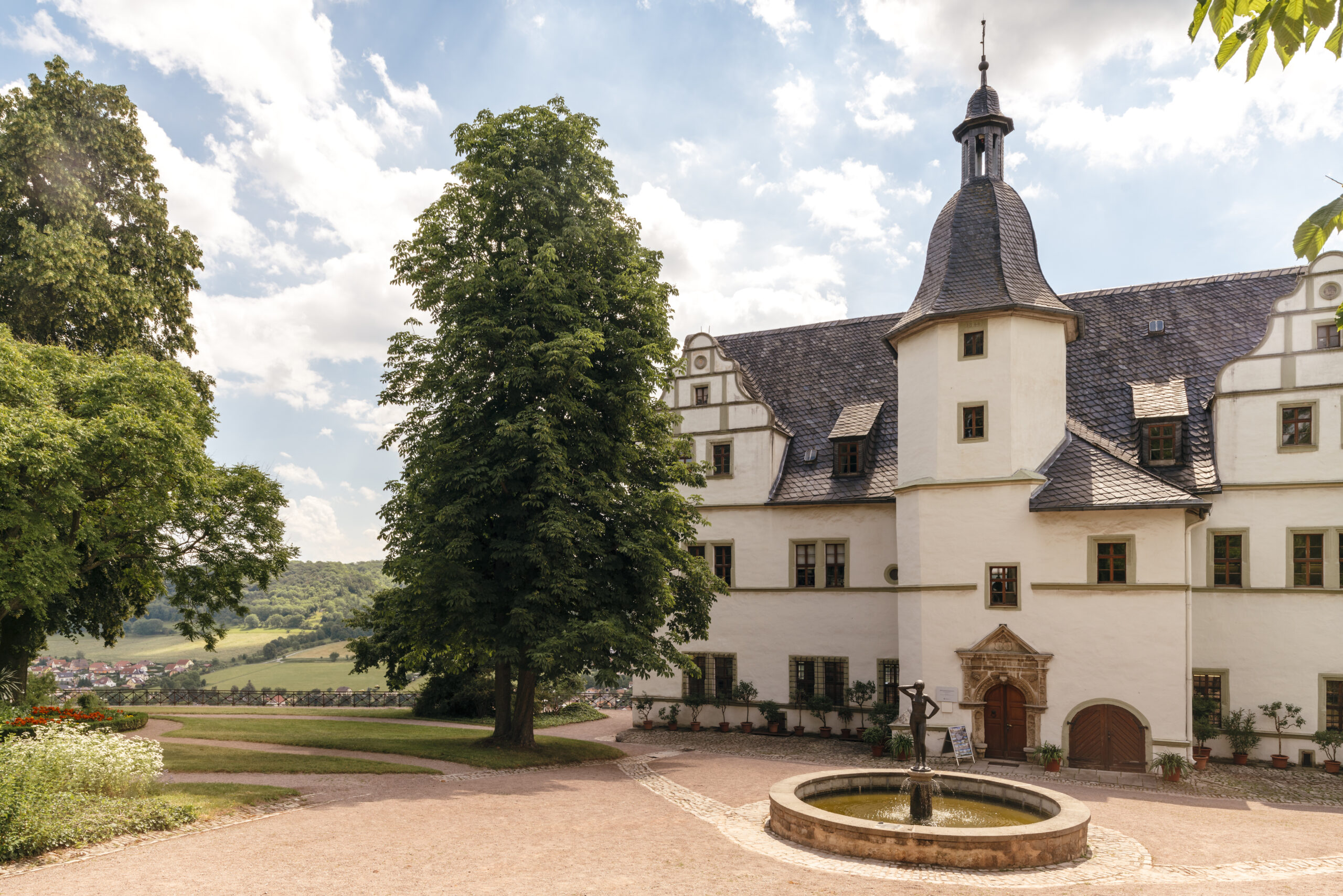
Strictly speaking, it was not a castle at first - the Renaissance castle was built in the middle of the 16th century as a manor house. It was given its current striking appearance with dwarf houses and niche portal a few decades later. In 1824, Grand Duke Carl August bought the building and incorporated it into the ensemble of his Dornburg summer residence. Renovations made it more comfortable and the regent himself stayed here in the summer. The palace became famous above all through his friend and Privy Councillor Johann Wolfgang von Goethe. After Carl August's death, he retired to Dornburg in the summer of 1828 and lived in the Bergstube for several weeks. In addition to many letters and research notes, he wrote atmospheric poems here.
Dornburg Castles Museum
Two of the Dornburg castles can be visited as museums. In the rococo castle, the tour leads through 18th and 19th century works of interior art. In the Renaissance castle (currently closed due to building work), the focus is on Johann Wolfgang von Goethe's stay in 1828. The neighbouring stables are home to the Bauhaus Workshop Museum.
"The view is marvellous and cheerful, the flowers bloom in the well-maintained gardens, the grape railings are richly hung, and below my window I see a well-grown vineyard (...)", Johann Wolfgang von Goethe described the palace gardens in 1828. A few years earlier, Carl August had commissioned his court gardener Carl August Christian Sckell to combine the three palaces of different character into one ensemble by designing the gardens. The garden artist created intimate garden spaces in different styles, including the Landscape Park, the Ash Walk and the Tea Square. The gardens became famous for their abundance of roses, which lushly entwine a pergola and accompany the terraced paths in large numbers and varieties. The vineyards admired by Goethe are still cultivated and the wine is available in the museum shop.
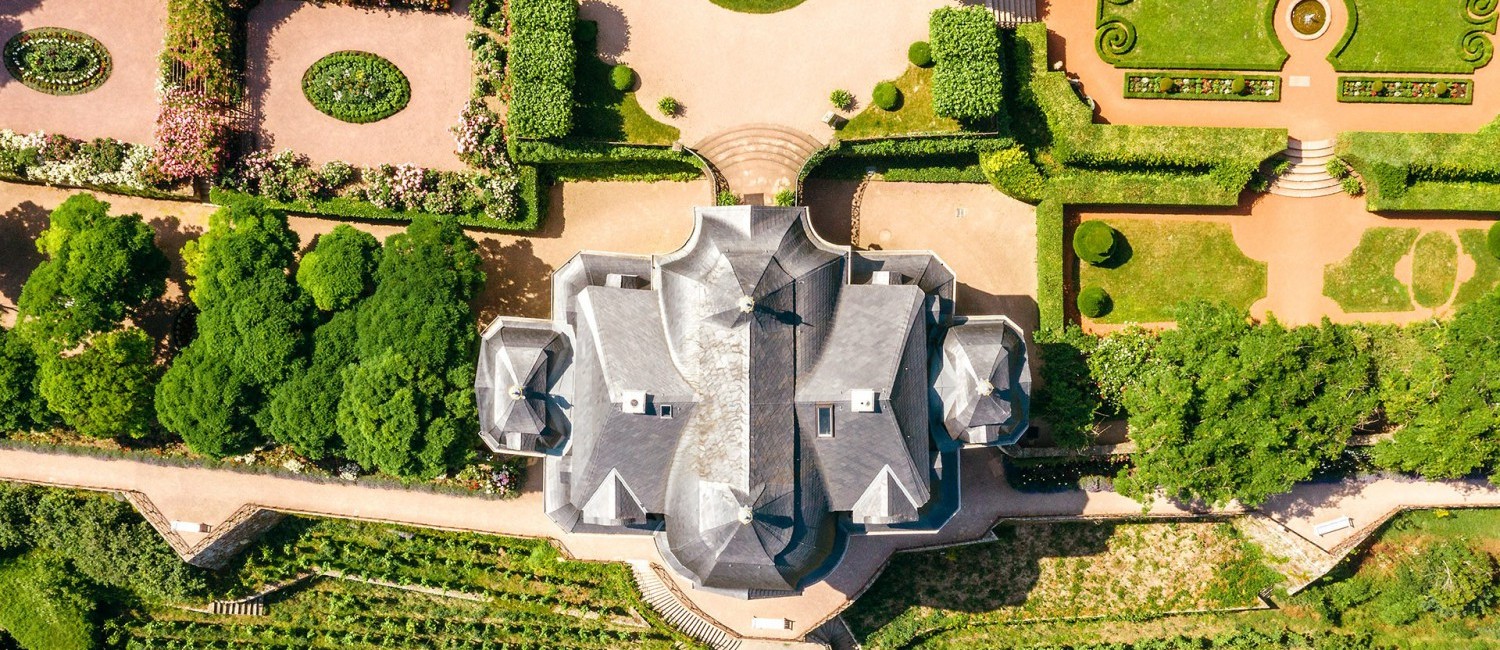
The Dornburg Palace Gardens comprise several gardens covering around 4 hectares: the landscape garden at the Renaissance palace, the geometrically designed garden in front of the Rococo palace and the fruit and grass garden at the Old Palace. The steep slopes facing the Saale below the palaces were transformed into vineyards from 1736.
The first designs for the garden at the Rococo palace date back to 1735/36, and at the beginning of the 19th century, the ash tree walk, the tea square with the "Acacias", the rose arbour walk and numerous rose trellises were added. From 1824, Carl August Christian Sckell laid out the small landscape garden at the Renaissance palace with winding paths, groups of trees and flowerbeds for Grand Duke Carl August of Saxe-Weimar-Eisenach.
After initial restoration work by the Goethe Society from 1926-28, large-scale renovation and reconstruction work followed from the 1950s onwards. The garden parterre to the north-east of the rococo palace was redesigned in 1966 according to the baroque design of garden architect Hermann Schüttauf.
Gardens as a connecting element
With the acquisition of the Renaissance palace, the merging of the three palaces became a task for garden design. Carl August commissioned Carl August Christian Sckell, who came from a family of garden artists active throughout Germany, with this task. He created a small landscape park on the grounds of the former manor and interwove it with the intimate garden spaces around the Rococo palace and the Old Palace.
The gardens are connected by terraced paths on the steep slope with sweeping views of the Saale valley. The parterres at the rococo palace were given a detailed design with flowerbeds and arcades. Today, the northern parterre is a new creation from the 1960s that harks back to Baroque forms.
At the Old Palace, the modern design takes up the garden ideas of the Renaissance. The Dornburg Castle Gardens are famous for their countless roses in historical and newer varieties, but also for the vineyards cultivated below the terraces.
Goethe and the palace gardens
Shortly after his arrival, Goethe wrote to his friend Carl Friedrich Zelter: "The view is marvellous and cheerful, the flowers are blooming in the well-maintained gardens, the grape railings are richly hung, and below my window I see a well-grown vineyard, which the deceased had planted on the most barren slope three years ago and which he still had the desire to enjoy during the last days of Pentecost. On the other sides, the rose arbours are decorated to the point of being fairy-like and the mallows and what not are blooming and colourful, and to me it all appears in heightened colours like the rainbow on a black-grey ground."
Barrier-free paths through the Dornburg Gardens
To help you plan your visit, you will find a map here with paths that are suitable for wheelchair users or visitors with pushchairs.
The Renaissance palace is temporarily closed due to renovation work. The rococo palace and the neighbouring Bauhaus Workshop Museum are open from April to October.
Dornburg Castles Museum
Season from April to October
02 April to 01 November 2026
daily except Wednesdays 10 am to 5 pm
Also open on Wednesdays on public holidays