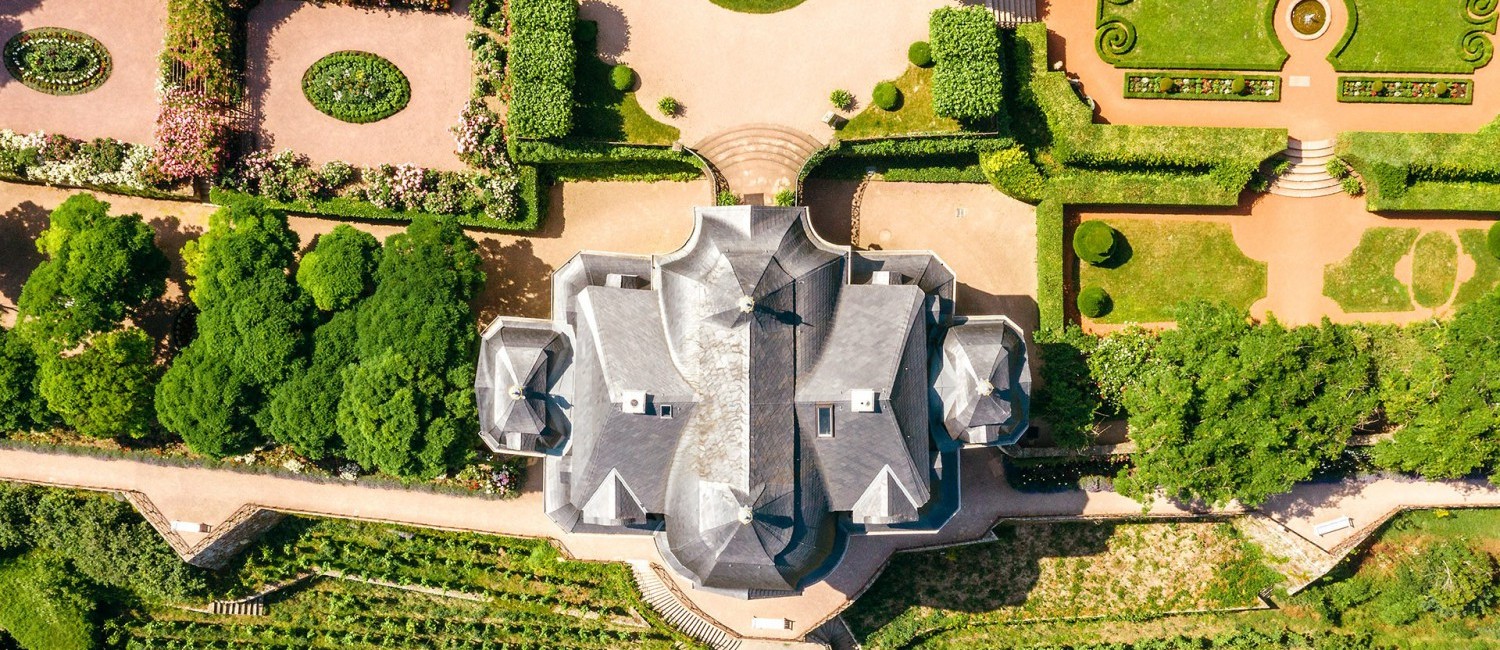
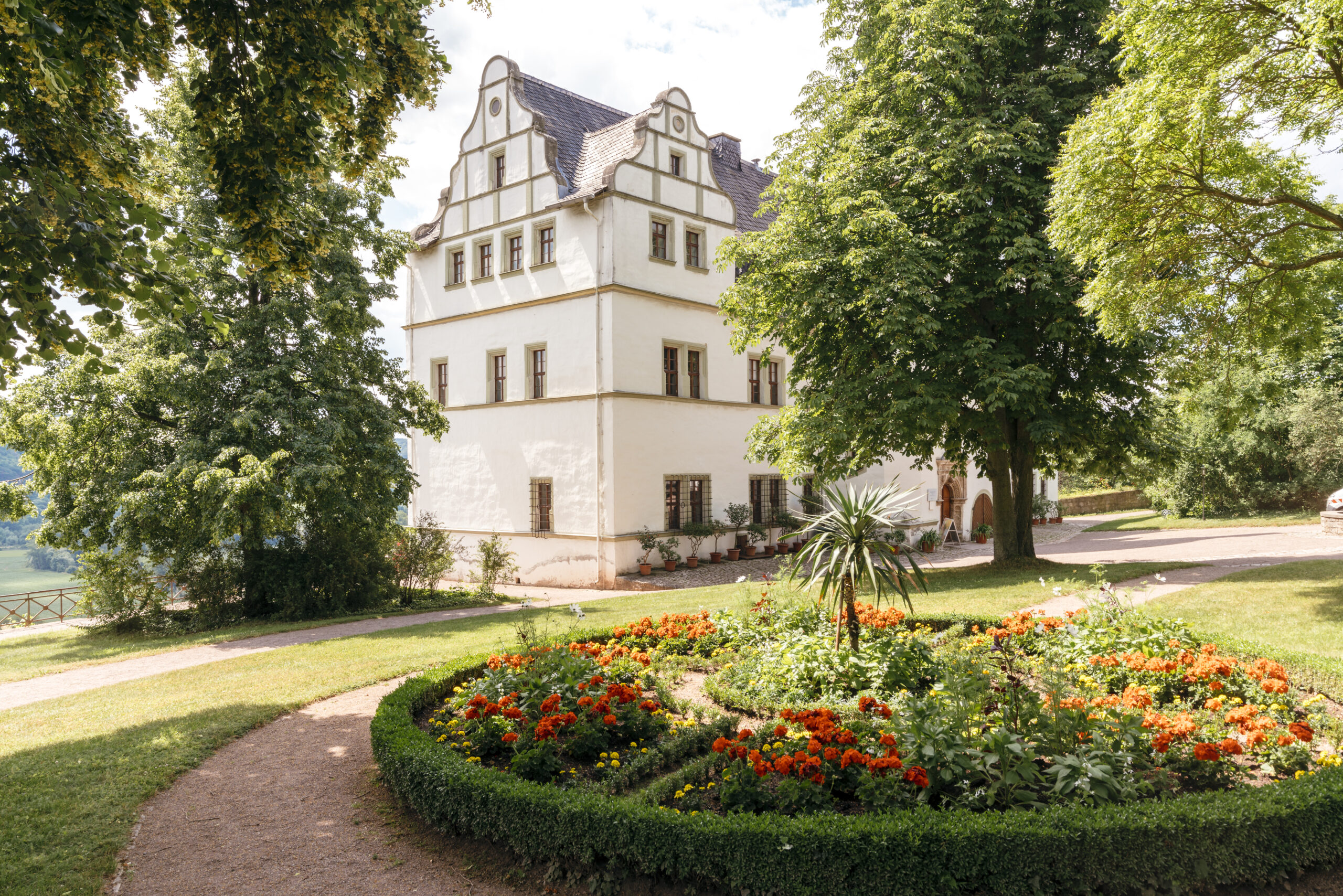
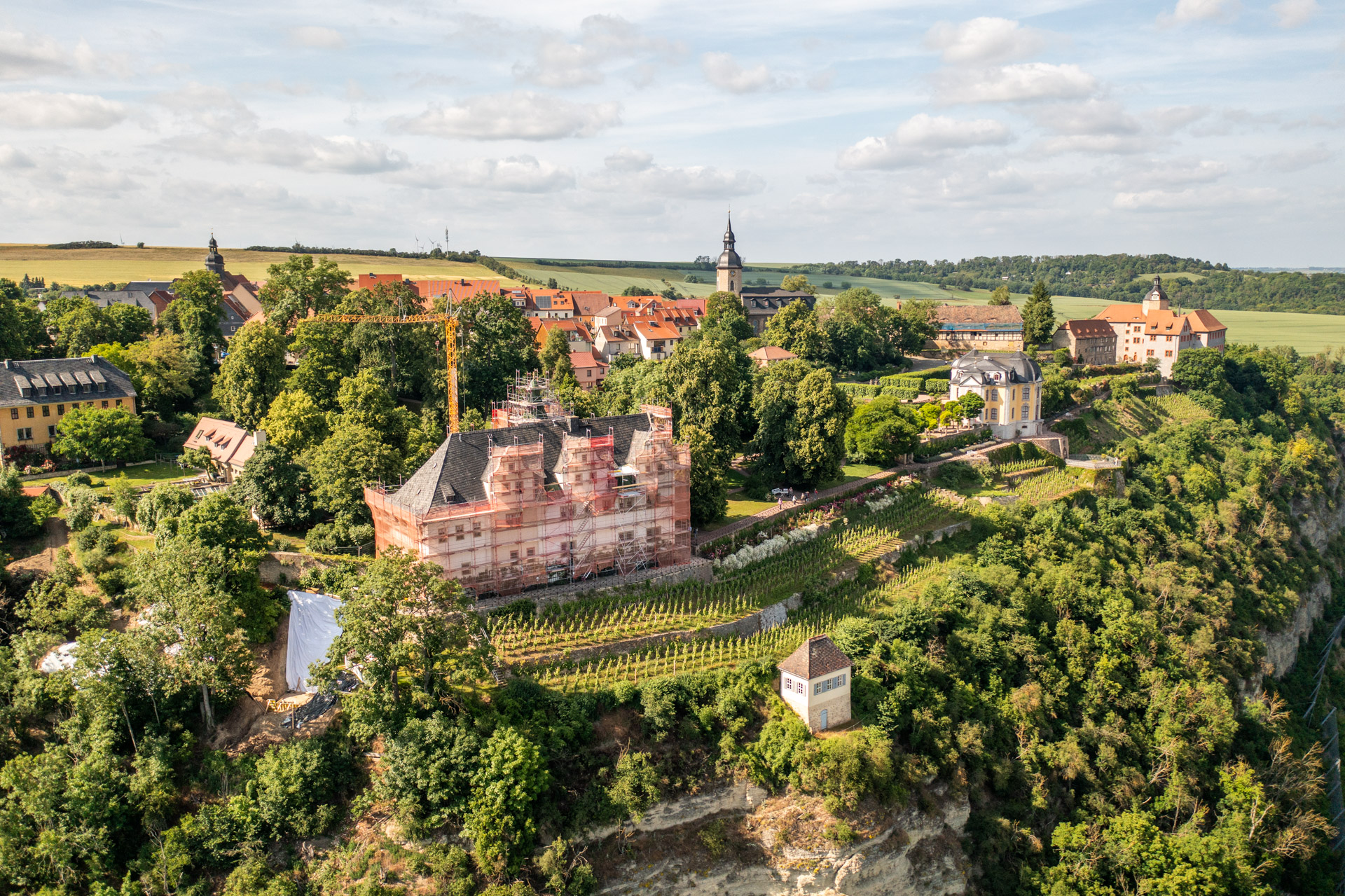
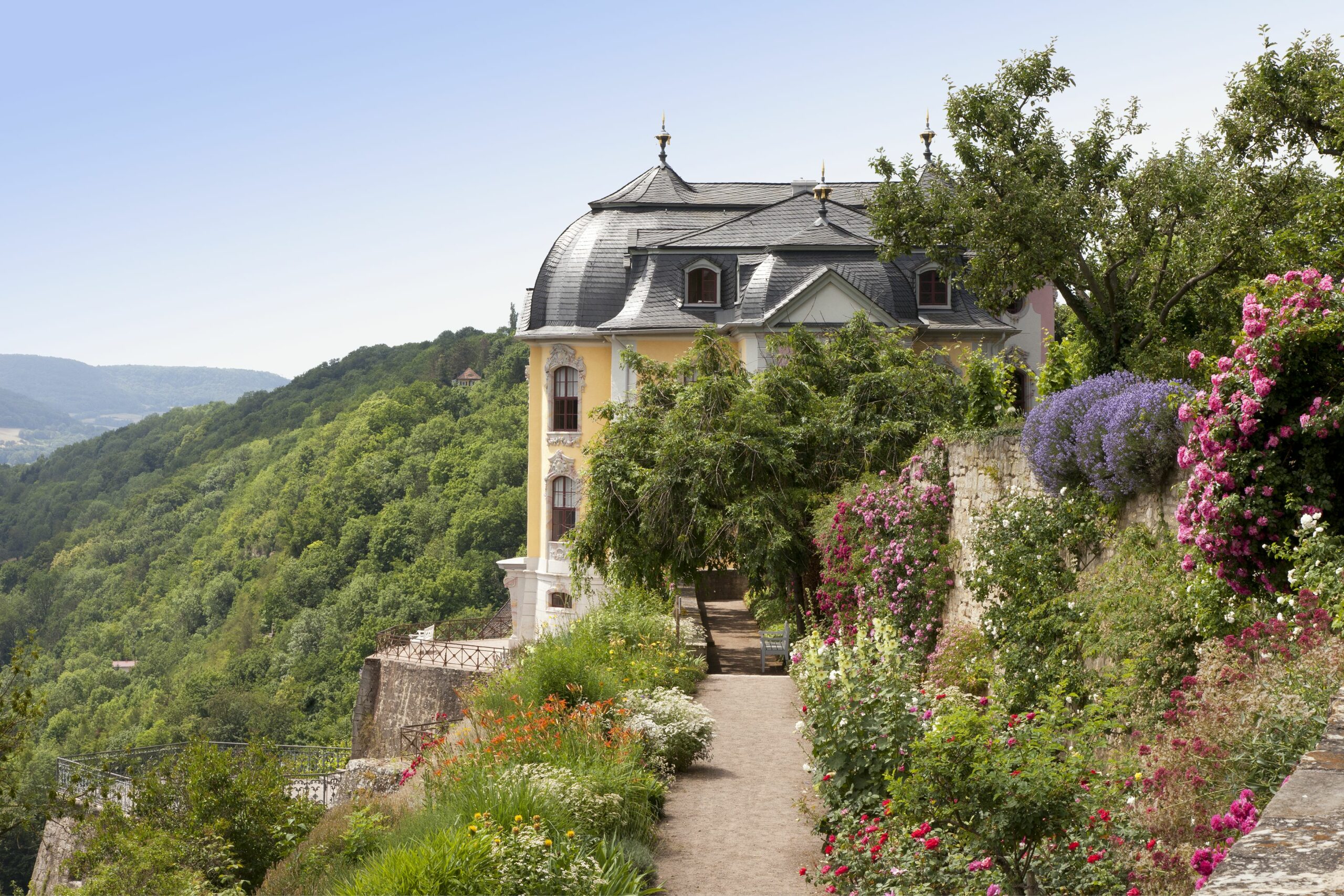
The Dornburg Palace Gardens comprise several gardens covering around 4 hectares: the landscape garden at the Renaissance palace, the geometrically designed garden in front of the Rococo palace and the fruit and grass garden at the Old Palace. The steep slopes facing the Saale below the palaces were transformed into vineyards from 1736.
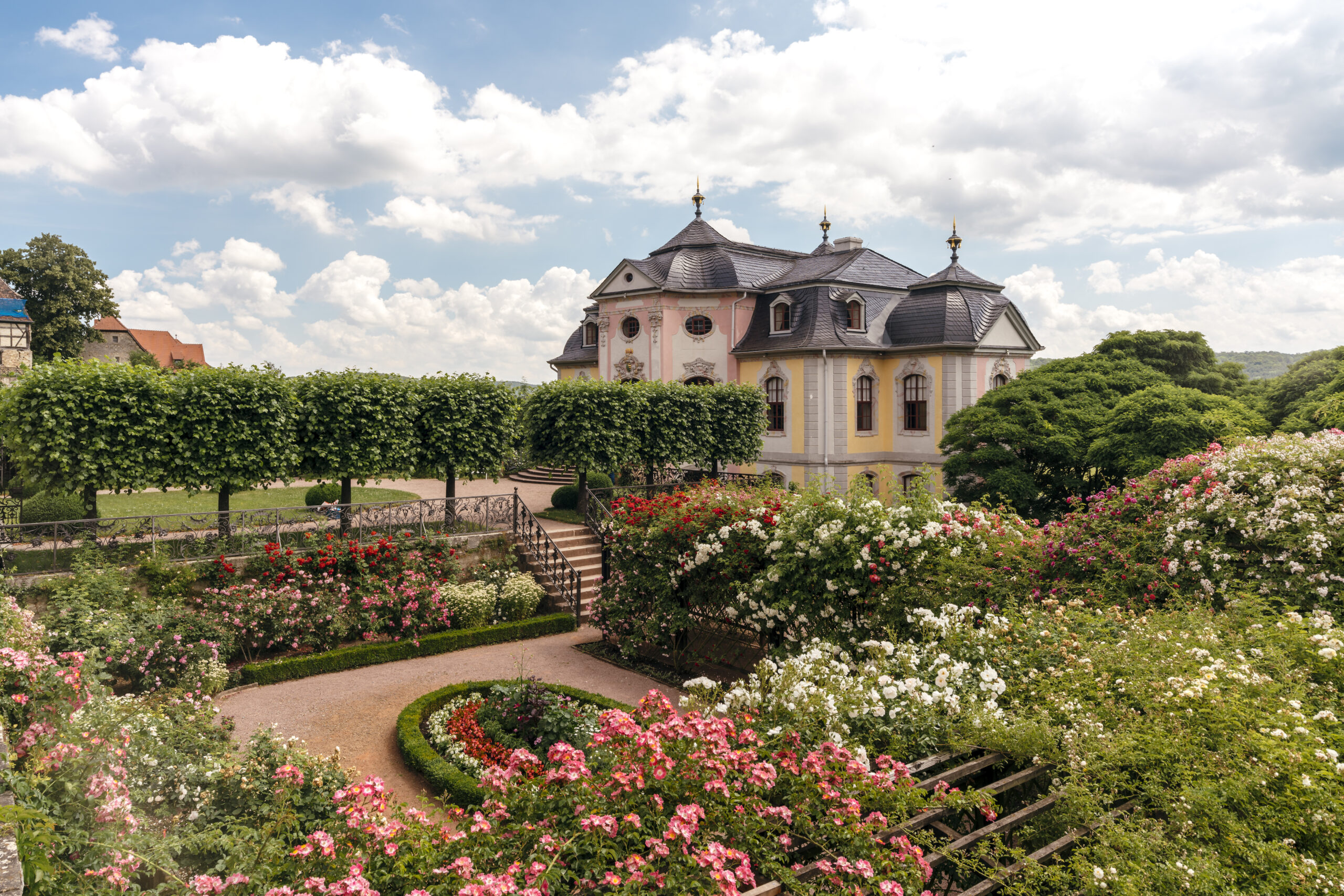
The first designs for the garden at the Rococo palace date back to 1735/36, and at the beginning of the 19th century, the ash tree walk, the tea square with the “Acacias”, the rose arbour walk and numerous rose trellises were added. From 1824, Carl August Christian Sckell laid out the small landscape garden at the Renaissance palace with winding paths, groups of trees and flowerbeds for Grand Duke Carl August of Saxe-Weimar-Eisenach.
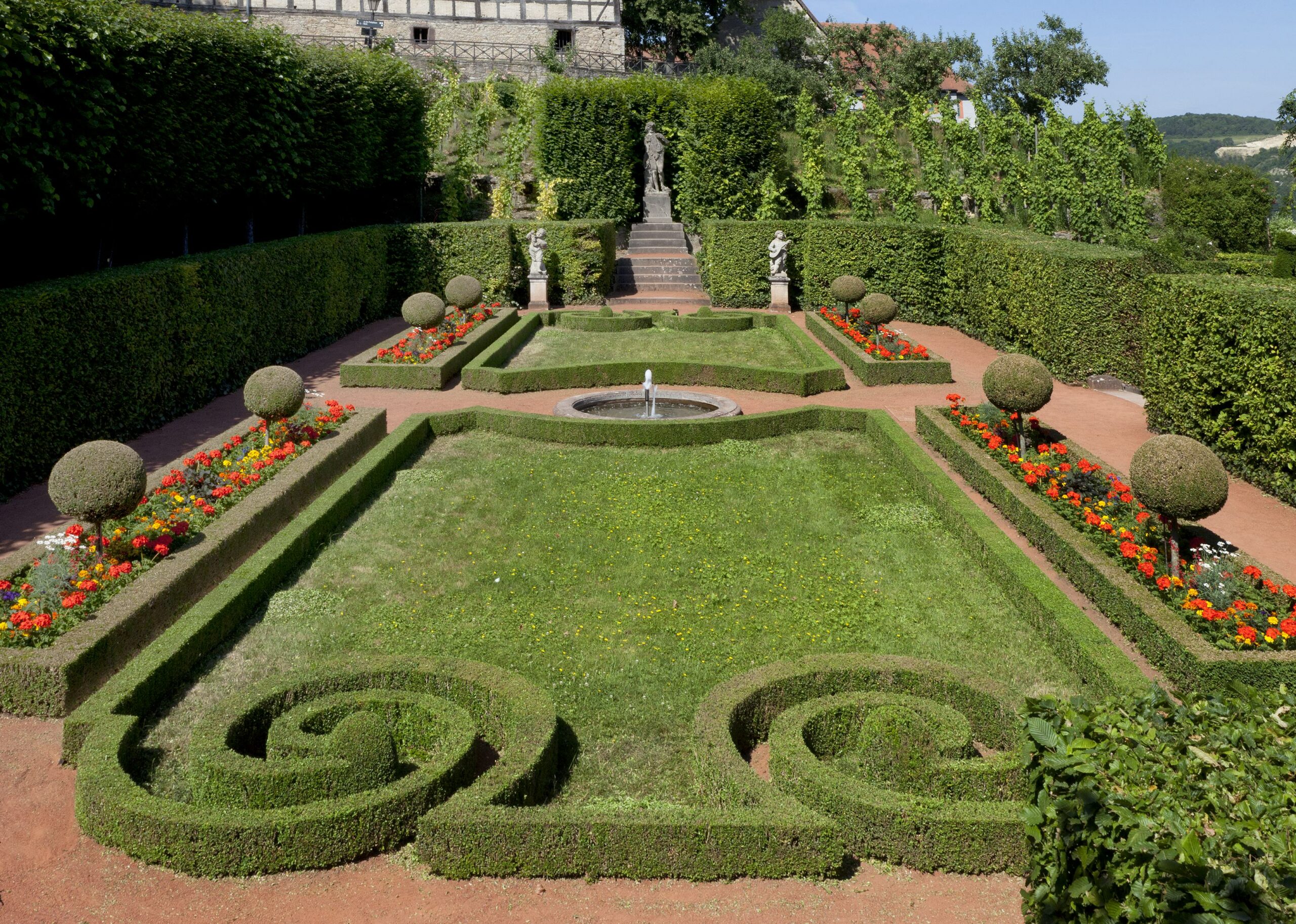
After initial restoration work by the Goethe Society from 1926-28, large-scale renovation and reconstruction work followed from the 1950s onwards. The garden parterre to the north-east of the rococo palace was redesigned in 1966 according to the baroque design of garden architect Hermann Schüttauf.
At a glance
Construction work
The Renaissance castle is closed due to renovation work.
Dornburg Castles Museum
Season from April to October
02 April – 01 November 2026
daily except Wednesdays 10 am – 5 pm
Also open on Wednesdays on public holidays
Park and garden
Open all year round from 9 a.m. until sunset
Free admission
Dogs allowed on a lead
Gardens as a connecting element
With the acquisition of the Renaissance palace, the merging of the three palaces became a task for garden design. Carl August commissioned Carl August Christian Sckell, who came from a family of garden artists active throughout Germany, with this task. He created a small landscape park on the grounds of the former manor and interwove it with the intimate garden spaces around the Rococo palace and the Old Palace.
The gardens are connected by terraced paths on the steep slope with sweeping views of the Saale valley. The parterres at the rococo palace were given a detailed design with flowerbeds and arcades. Today, the northern parterre is a new creation from the 1960s that harks back to Baroque forms.
At the Old Palace, the modern design takes up the garden ideas of the Renaissance. The Dornburg Castle Gardens are famous for their countless roses in historical and newer varieties, but also for the vineyards cultivated below the terraces.
Goethe and the palace gardens
Shortly after his arrival, Goethe wrote to his friend Carl Friedrich Zelter: “The view is marvellous and cheerful, the flowers are blooming in the well-maintained gardens, the grape railings are richly hung, and below my window I see a well-grown vineyard, which the deceased had planted on the most barren slope three years ago and which he still had the desire to enjoy during the last days of Pentecost. On the other sides, the rose arbours are decorated to the point of being fairy-like and the mallows and what not are blooming and colourful, and to me it all appears in heightened colours like the rainbow on a black-grey ground.”
Barrier-free paths through the Dornburg Gardens
To help you plan your visit, you will find a map here with paths that are suitable for wheelchair users or visitors with pushchairs.