
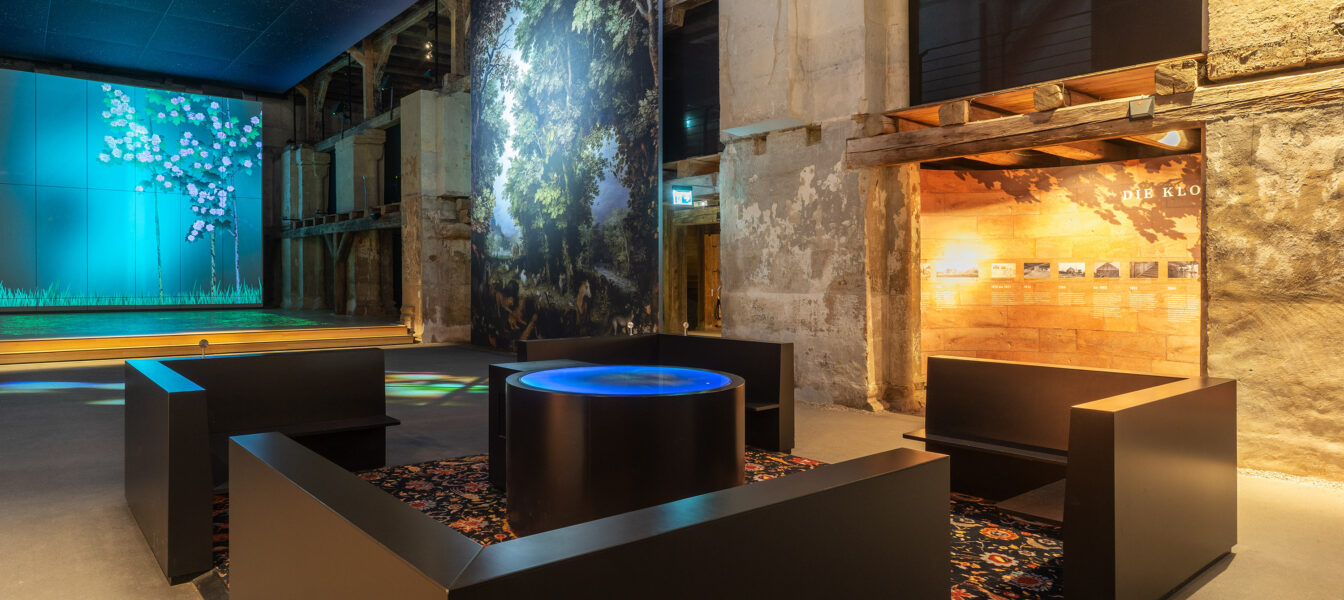
Paradise Gardens
Paradise Gardens – Garden Paradises
Myths and creation stories often depict gardens as realms of joy and bliss. The Bible describes the earthly paradise as a lush and enticing garden with fruit-bearing trees and life-giving springs. These archetypal notions of paradise have left their mark on the history of horticulture. On the other hand, people have always regarded gardens as personal paradises, where visions of an ideal world could come to life.
This exhibition invites you to delve into the history of fascinating gardens. Enjoy the rich diversity of ideas; marvel at the skilful creativity of the designs; and be inspired by the history that has unfolded within them over the centuries.
The historic parks and gardens managed by the ‘Thuringian Castle and Garden Foundation’ are more than just prominent witnesses to history: they are works of art of the highest calibre, havens of biodiversity and precious oases for all the senses. They are a living cultural heritage, constantly changing in tune with the rhythms of nature. Preserving them requires ongoing professional care – and climate change is now posing additional challenges.
The “Thuringian Castle and Garden Foundation” is dedicated to caring for, maintaining and developing our gardens. In accordance with the standards of historic garden conservation, we ensure that visitors can experience and enjoy these unique garden paradises – both today and in the future.
Molsdorf Palace Park – Cultural delights and joie de vivre
Molsdorf Palace Park dates back to the first half of the 18th century. Richly adorned with sculptures, it was one of the most distinguished Baroque gardens in Thuringia. Count Gustav Adolf von Gotter, a successful diplomat and hedonistic bon vivant, created this secluded idyll for himself and his guests. When the new English style of gardening arrived in Germany, the Baroque garden was redesigned and transformed into a landscape park from 1788 onwards. Many of the sculptures were sold. The remaining pieces were carefully restored. A selection of them can now be admired in the lapidarum garden, which was created in 1998.
Wilhelmsthal Palace Park – Restoring a ‘Pückler’ Park
Construction work on the hunting lodge and summer residence of the Dukes of Saxe-Weimar-Eisenach began in 1698 in a prime location on the edge of the Thuringian Forest. Its picturesque landscape park was transformed into a work of art in the 1850s by Prince Hermann von Pückler-Muskau, in collaboration with the court gardener Hermann Jäger. In the decades that followed, this horticultural masterpiece was meticulously maintained, but after 1941 it fell into increasing disrepair. When the ‘Thuringian Castle and Garden Foundation’ took over the park in 2009, decades of overgrowth, soil fillings and additions had rendered the original design unrecognisable. Since then, the Foundation has been striving to restore this lost paradise.
Sondershausen Palace Park – Stately park and public garden
The palace park was redesigned and extended in the 1830s to serve a dual purpose: it was intended to enhance the residence of the Prince of Schwarzburg-Sondershausen, whilst also serving as a public garden, offering all citizens an artistic experience that would “refine their tastes and manners”. The inspiration for the project came from Dr Tobias Ekart, who had been appointed garden inspector of the newly established garden administration. The park’s concept also included a cultural programme featuring regular concerts by the court chamber orchestra. Since 1801, its musicians had been performing in the park’s Loh Square and went on to gain prominence far beyond the region in the early 19th century.
Altenstein Palace Park – Turning rock formations into a work of art
Around 1800, the hilly terrain surrounding Altenstein Palace was largely bare, with just the occasional tree. The bizarre rocks of the Zechstein Reef rose prominently from the surrounding landscape, reminiscent of alpine scenery or Chinese landscape paintings. Count Georg I of Sachsen-Meiningen realised that ‘we have the most magnificent natural scenery at our fingertips and it is up to us to make use of it’. Over the course of the 19th century, several prominent garden architects helped to transform the rock formations into a vast landscape park: Prince Hermann von Pückler-Muskau, Carl Eduard Petzold and Peter Joseph Lenné. The transformed rock formations are impressive landmarks that still characterise the scenery today.
Princely Garden in Greiz – The fascinating world of plants
This summer palace of the older branch of the House of Reuß featured a Baroque garden which was destroyed by flood water in 1799. Carl Eduard Petzold redesigned it as a landscape garden with biodiverse wooded groves. The design was implemented from 1873 onwards by the court gardener Rudolph Reinecken, who spent 50 years of his working life tending the park. To maximise the visual impact, he selected trees and shrubs in a wide variety of colours, textures, leaf shapes, blossoms and fruit. As a result, the park offers pleasant views all year round.
The Garden of Kirms-Krackow House – A flourishing society salon
The Kirms family’s garden in the city of Weimar was a hive of social activity and well known for its lush blooms and exotic plants. Privy Councillor Franz Kirms often received rare plants as gifts from his employer, Grand Duke Carl August, who brought them back from his travels. Franz Kirms was fascinated by botany and floriculture, a passion he shared with Caroline Krackow, lady-in-waiting to Grand Duchess Maria Pawlowa, who became his wife in 1823. As a result, the garden was more than just a backdrop for social occasions. Guests at the house also came to study rare specimens or admire a plant’s first bloom.
Heidecksburg Palace Garden – Spatial art and banquet venue
The palace buildings and gardens of Heidecksburg Castle are laid out across three imposing terraces, the retaining walls of which were built in the 16th century. The flower and kitchen gardens were redesigned in the Baroque style in the 18th century. The centrepiece of the palace garden is the Schallhaus (Sound House), situated on the lower terrace. It serves both as a garden house and a concert venue, featuring special surround sound effects. Prince Ludwig Friedrich II incorporated it into his design when he redesigned the gardens and surrounding area in the landscape style from 1796 onwards. The gardens and the Sound House continue to be used for social events, concerts, brunches and dinners.
The Ducal Garden in Gotha – Four centuries of garden culture
In 1640, Ernst I chose Gotha as the capital of the newly founded Duchy of Saxe-Gotha. Soon a new castle was built, kitchen gardens and pleasure gardens were laid out, and the foundations were laid for a plant collection. In 1747, work began on creating the grand orangery garden, complete with impressive glasshouses for the plant collection, which had grown to almost 3,000 specimens. The English garden was designed from 1769 onwards in the style of the famous master of garden design, Lancelot Brown. It is one of the earliest landscape gardens on the continent. Although the park was expanded and redesigned in later years, these two gardens remained virtually untouched. Today, they are among the park’s absolute highlights.
Wilhelmsburg Palace Garden – Water features and floral displays
The southern slope of Wilhelmsburg Castle features one of the first terraced gardens in Germany. The ‘princely pleasure, kitchen, herb and tree gardens’ were originally laid out from 1602 onwards. In the late 17th century, they were lavishly enhanced and decorated with flowering plants. The simple design of the central water axis was replaced by a grand, lavishly decorated water feature staircase on the east side of the garden. In later periods, the garden fell into disrepair. When it was restored between 2000 and 2015, the terrace complex was reconstructed in accordance with the design principles and plant selection of the Renaissance era.
Schwarzburg Palace Garden – From monarchy to democracy
Built on a mountain spur overlooking the Schwarza valley, this impressive castle was the ancestral home of the Schwarzburgs, one of the most powerful aristocratic families in Thuringia. From 1699 onwards, their claim to power was reflected in the design of the Kaisersaalgebäude (Imperial Hall Building), which also housed the precious plants from the orangery. In 1710, the Schwarzburgs were finally granted the title of Princes of the Holy Roman Empire. More than two centuries later, the site became the birthplace of democracy in Germany when Friedrich Ebert, Germany’s first democratic president, signed the Weimar Constitution whilst on holiday in picturesque Schwarzburg.
Dornburg Castle Gardens – Work of art and memorial site
Built at different times in history, the three Dornburg castles and their gardens differ in style and function. In 1824, the court gardener Carl August Sckell began to merge them into a single entity without compromising their individual character. All these features come together to form a harmonious work of art in its own right: from the terraced gardens with their fragrant roses, to the landscaped areas and sunny vineyards, to the promenades offering spectacular views of the castles and the Saale valley. Johann Wolfgang von Goethe, the famous German poet, loved this place, as did Grand Duke Carl August and his grandson Carl Alexander, for whom Dornburg Castle was both a work of art and a site to commemorate their ancestors.
The monument on Peterberg – St Peter’s Church
When it was built, the pillar basilica with its three naves was one of the most innovative buildings of its time, renowned for its high-quality masonry. It was built between 1103 and 1147, using horizontal layers of precision-cut stone blocks. Construction work on the ‘paradise’ (the antechurch) and the four towers continued throughout the first half of the 13th century. Today, it still bears the marks of war damage and heavy-handed alterations: in the first quarter of the 19th century, the monastery church of St Peter and Paul was converted into a storage depot for the Prussian army. Despite the extensive structural damage it has suffered, the basilica remains the most monumental example of Romanesque ecclesiastical architecture preserved in Thuringia today. Now that the façades have been restored and the wooden floors of the former army depot have been removed from the central nave, this impressive Roman building has regained some of its former dignity and grandeur.
The monastery and its gardens – The garden as a place of prayer
The monastery complex on Peter’s Hill served as a Benedictine abbey for over seven centuries. Throughout this period, a series of different gardens enabled the monks to be self-sufficient, a rule that Saint Benedict of Nursia had laid down in his treatise on monastic life. They cultivated gardens containing fruit trees and shrubs (Pomarium), vegetables (Hortus) and medicinal plants (Herbularius). In addition, they managed vineyards (Vinetum) and other arable land outside the monastery grounds. The cloister garden was a place for spiritual meditation and silent prayer. Manual labour in the fruit and vegetable gardens was regarded as another ascetic contribution towards spiritual perfection. By living in the monastery and tending their gardens, the monks returned to the idea of a biblical paradise.