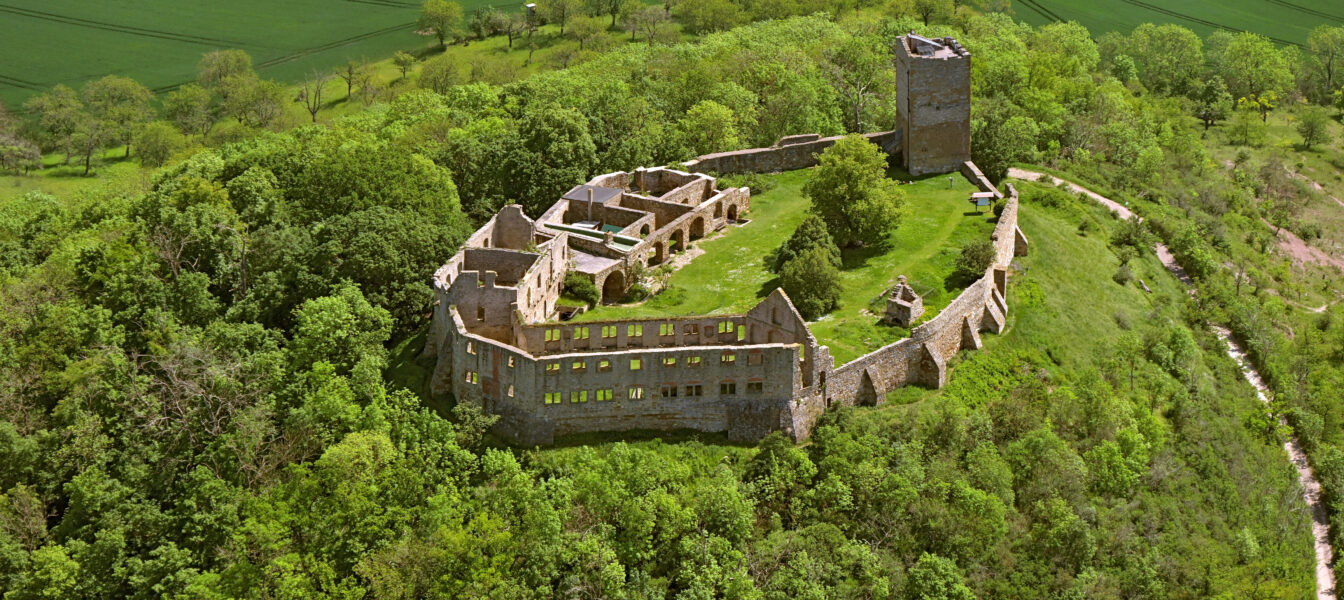
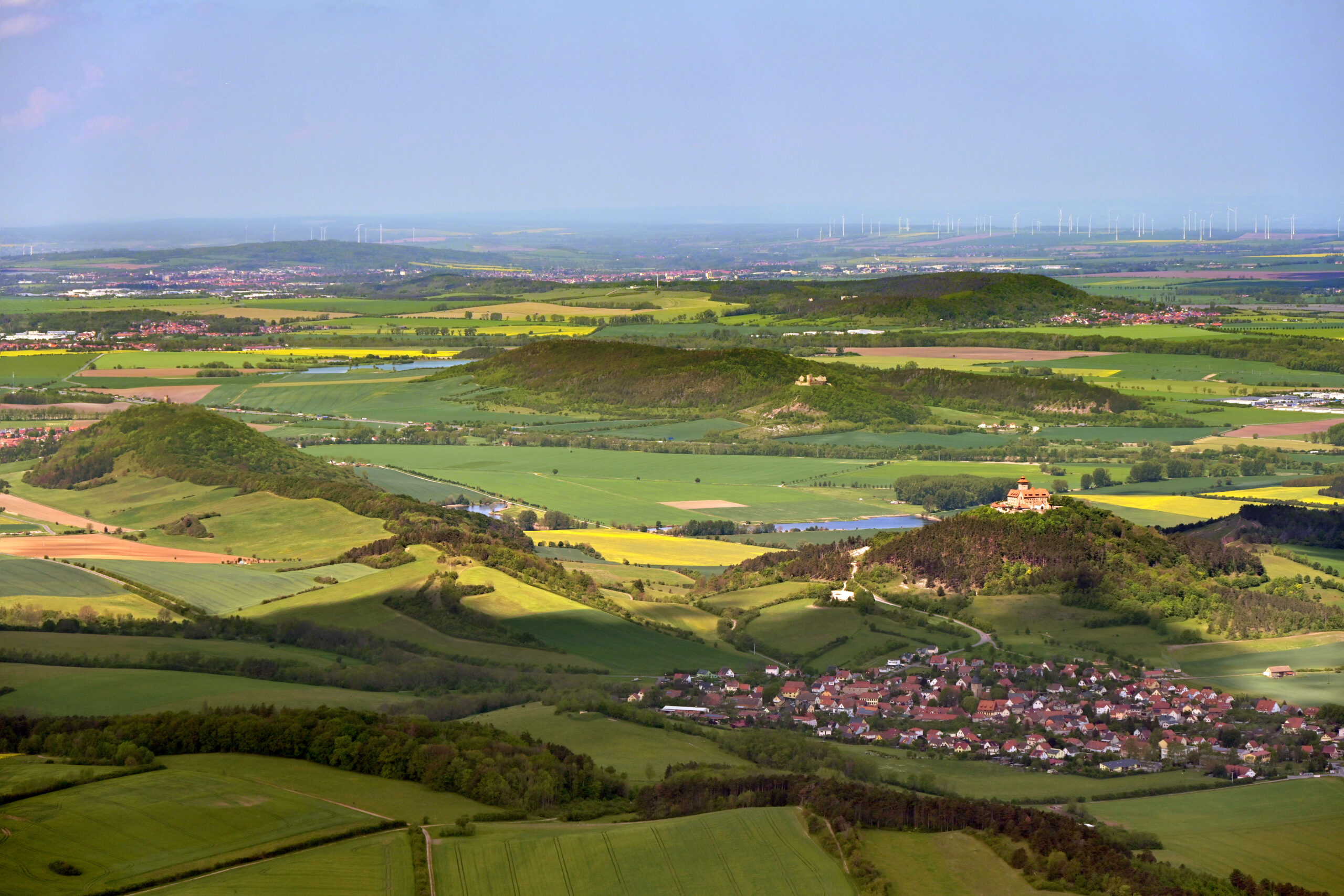
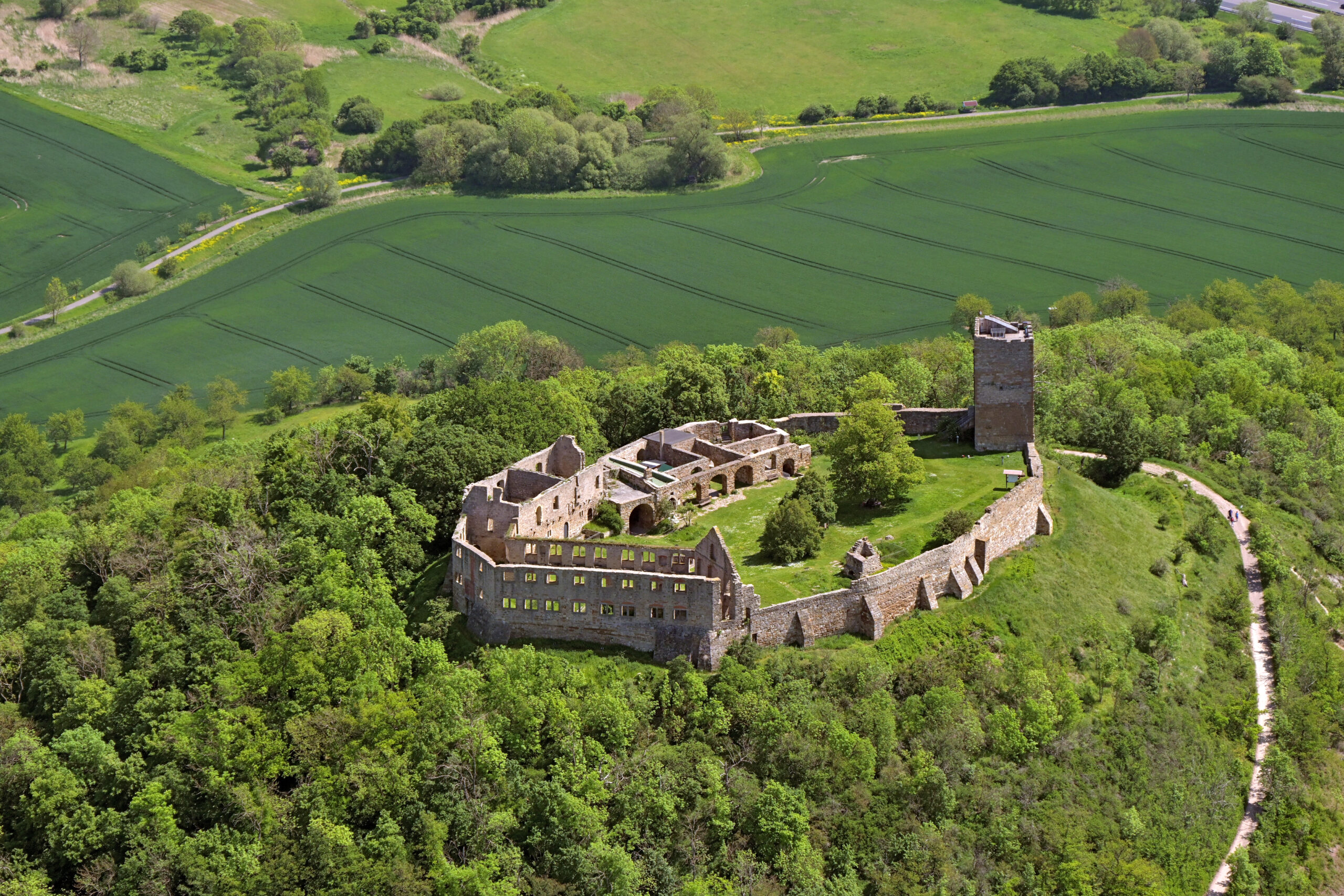
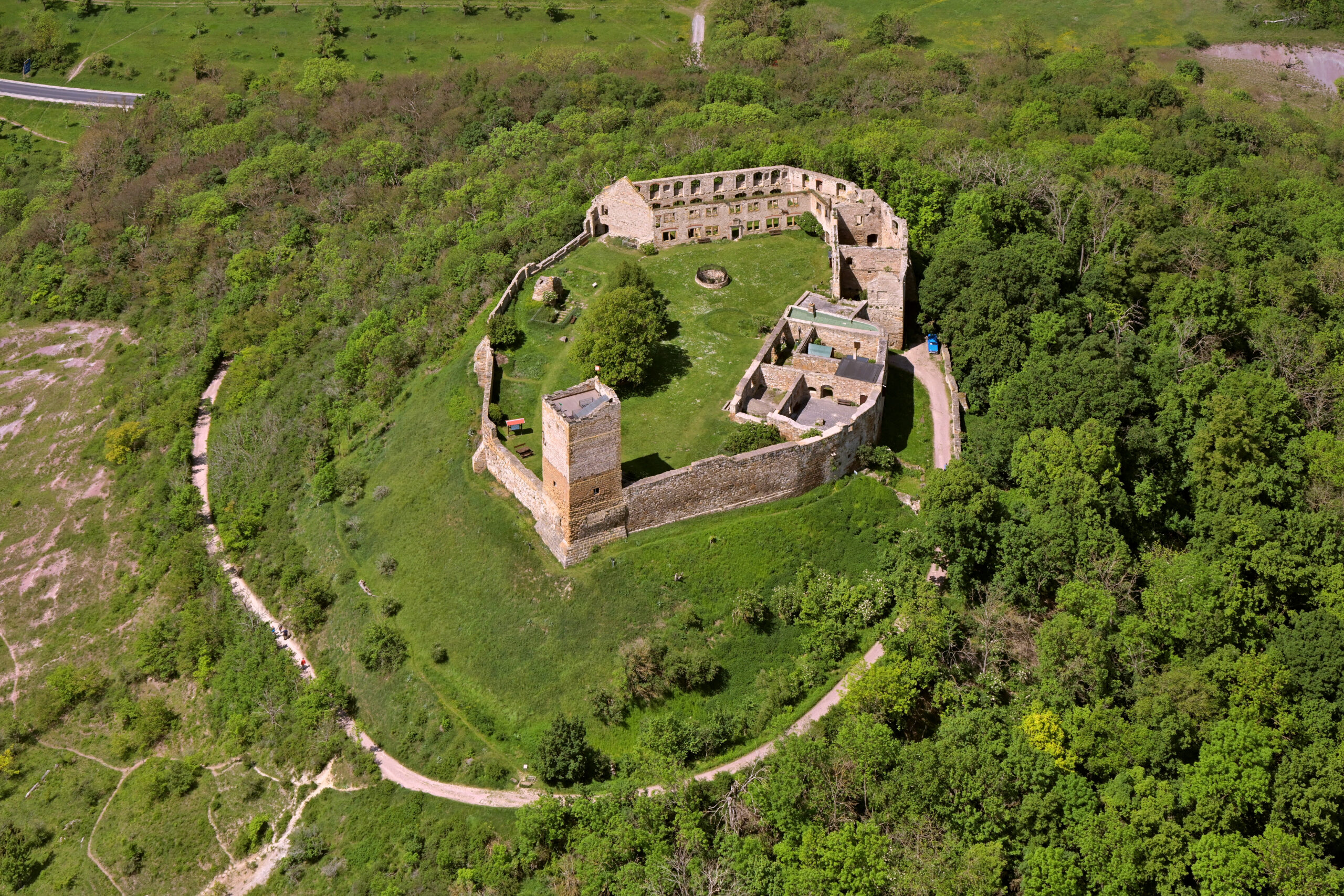
In the heart of the Thuringia-Inselsberg National Geopark, not far from Gotha and Erfurt, stand the ‘Drei Gleichen’. This ensemble of castles is renowned far beyond the borders of Thuringia. The Mühlburg, Veste Wachsenburg and Gleichen Castle can be explored via picturesque walking trails. The latter dates back to the 11th century and served as the ancestral seat of the Counts of Gleichen, from whom the area takes its name. A Romanesque residential building, the manor house and the keep have been preserved. The defensive tower houses an exhibition on the history of the castles and the natural landscape of the Drei-Gleichen area.
At a glance
Address
Gleichen Castle Grounds and Castle Museum Branch of the Erfurt Natural History Museum
Thomas-Müntzer-Straße 4
99869 Drei Gleichen Website
Opening hours
Gleichen Castle Grounds and Museum Branch of the Erfurt Natural History Museum
April to October: Mon–Sun 10.00–18.00
Last admission 17.30
Castle groundsand museum closed from November to March
The ‘onion-clad’ Count
In some stories he is called Ernst, whilst in others he is known as Ludwig. Either way, he is said to have been a Count of Gleichen. As part of the Emperor’s retinue, he set out for the Holy Land to recapture it for Christendom. But the count was taken prisoner. There, so the legend goes, the sultan’s daughter fell in love with the stranger. She helped him escape and fled with him to Thuringia – where, however, the count’s wife was already waiting.
This is said not to have been an obstacle for the Pope, and so he gave his blessing to this unusual three-way relationship. The story of the ‘double-married’ count may sound like a fairy tale, but there is a grain of truth in it. For a tomb slab in Erfurt Cathedral depicts precisely that count – flanked by two women. Goethe drew inspiration from this story for his play ‘Stella’.
The ancestral home of the Counts of Gleichen
Gleichen Castle has remained famous to this day thanks to the legend of the ‘onion-woven’ count. The complex was first mentioned in a document around the year 1089. The castle changed hands several times before it was granted to the Counts of Tonna in 1139, who began work on a new building. For them, Gleichen Castle was not merely a seat of power; it was to become the namesake of their noble family. Thus, after just a few years, the Counts of Tonna became the Counts of Gleichen.
They served the Archbishop of Mainz and acted as bailiffs of the city of Erfurt. Originally, Gleichen Castle stood on a steep mountain cone.
However, this was artificially levelled and extended to make way for the castle complex, which measured 105 by 60 metres. Due to its strategically favourable location near the medieval trade route ‘via regia’, the castle was repeatedly attacked and besieged. It was destroyed during a feud and was presumably severely damaged in a major fire in 1231. However, the counts rebuilt the castle time and again, modernising and extending it. As a result, the ring castle is characterised today above all by the juxtaposition of structures from different periods, primarily from the 12th and 16th centuries. These include the three-storey Romanesque residential building, parts of the curtain wall, the almost square keep, the gatehouse with its chapel, the chancellery building and the manor house.
“This curious antique”
The castle was to remain the permanent residence of the Counts of Gleichen until 1537. It was only then that they moved their seat of power to nearby Ohrdruf. In 1599, they abandoned the complex for good; much of the furnishings were moved to other buildings, and Gleichen Castle served merely as an administrative centre. In the years that followed, it changed hands several more times, yet a slow process of decay set in. In 1725, the ducal secretary and court lawyer Johann Zacherias Gleichmann referred to the castle as ‘this curious antiquity’. The keep is partly used as a museum and features a viewing platform. From there, visitors enjoy a magnificent view of the neighbouring castles, with which Gleichen Castle together forms the unique ensemble known as the ‘Three Gleichen’.