Transition from Baroque Garden to Landscape Garden
Molsdorf Palace Park
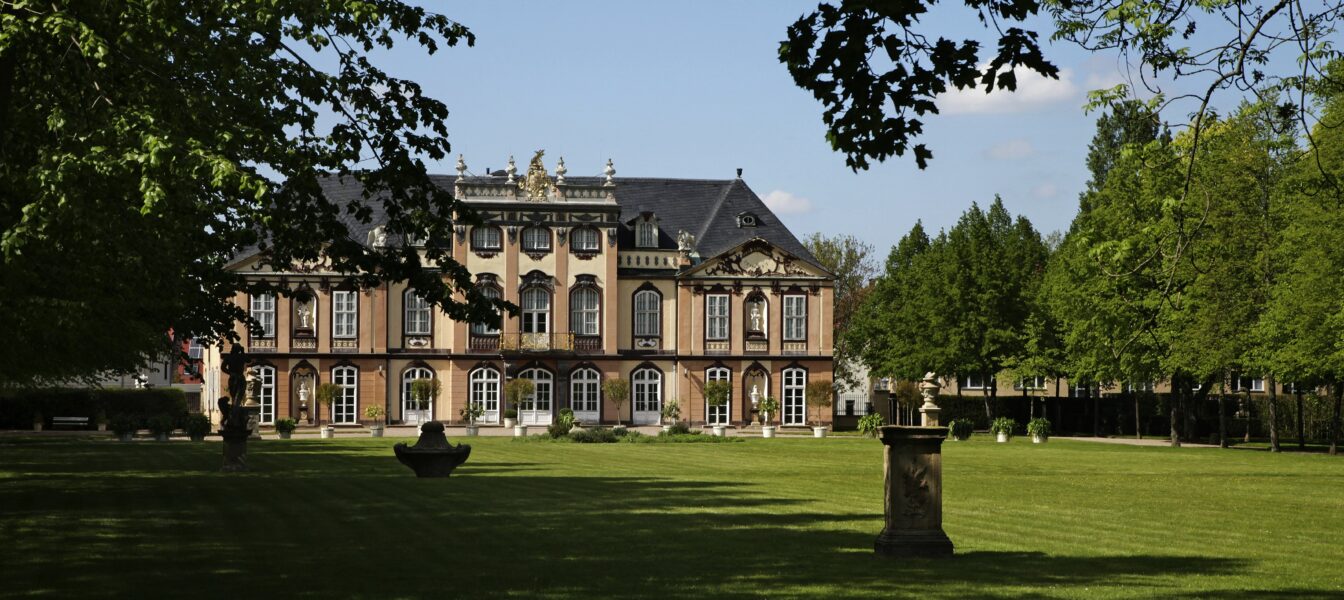
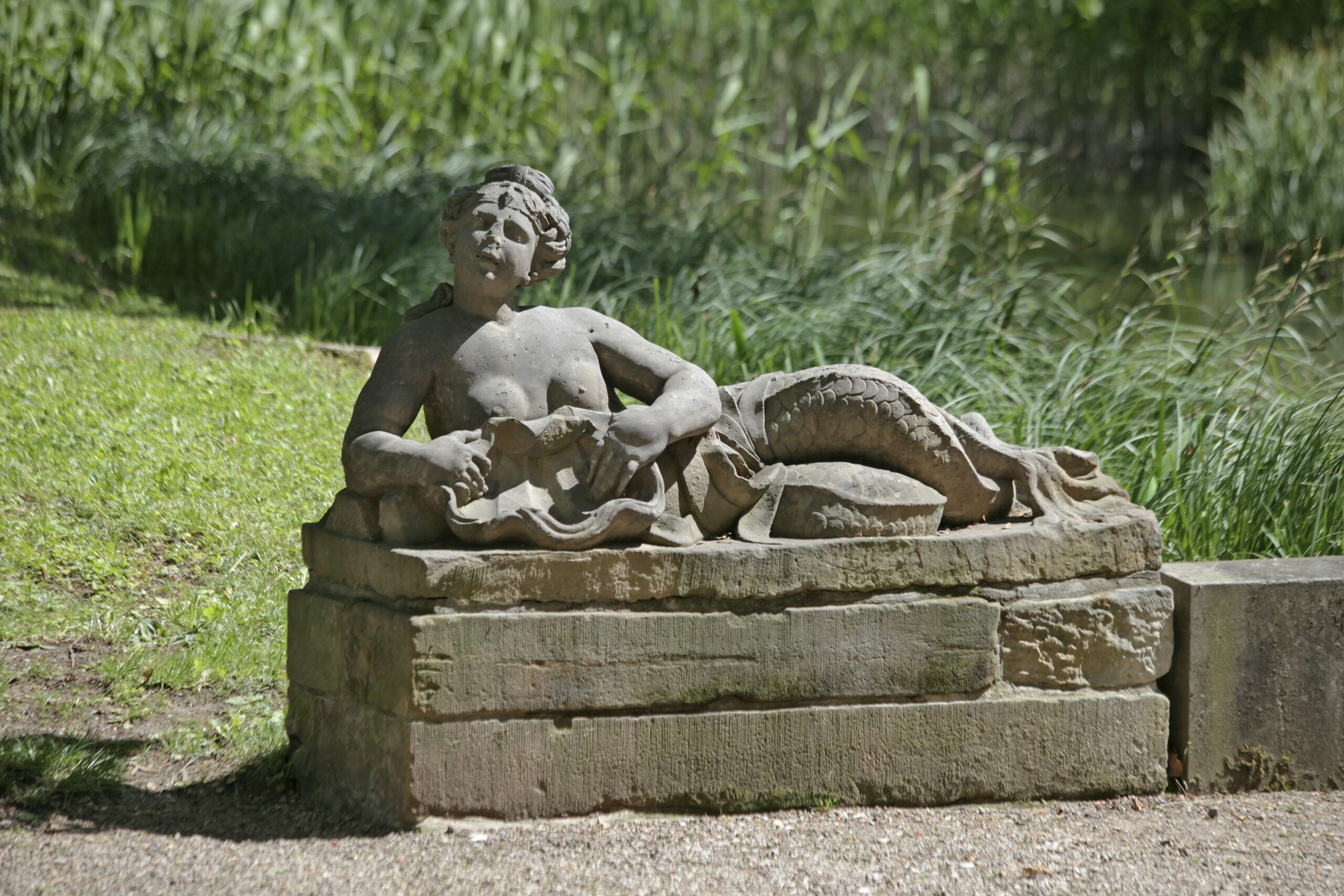
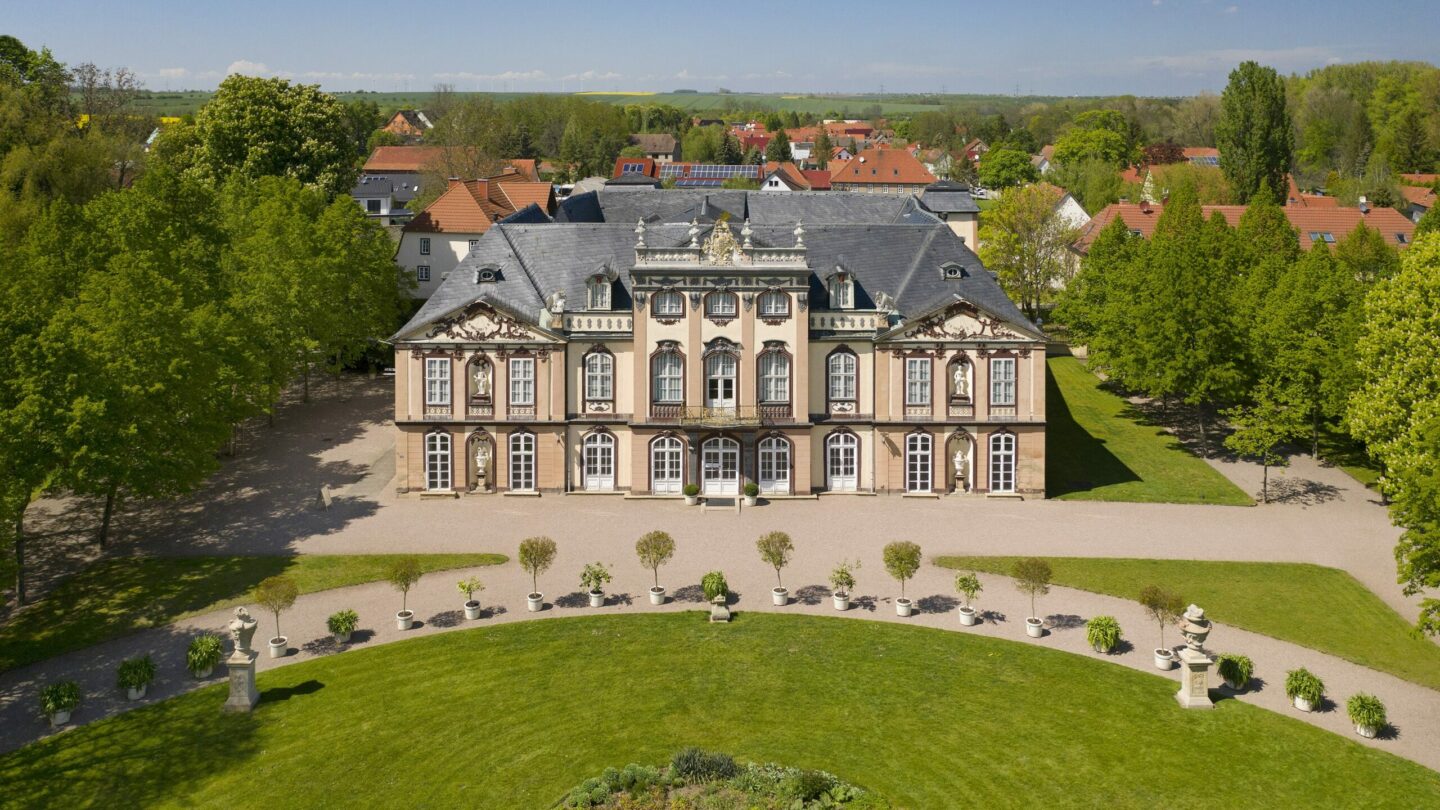
Traces of Baroque garden art can still be experienced at Molsdorf Palace Park. When the present‑day landscape park was designed towards the end of the 18th century, much of the elaborate layout from the 1730s was preserved. At that time, Gustav Adolf Count von Gotter – reputed to be something of a bon vivant – had acquired the Molsdorf moated palace and converted it into a pleasure palace. In keeping with the lavish design of the façade and interiors, Gotter also had the garden laid out with great extravagance. A long central axis with garden parterres was bordered by canals and adorned with countless sculptures. The basic forms of the Baroque parterre were integrated into the landscape park as symmetrical lawns; some of the sculptures also remained in their original positions and can still be encountered along the park paths.
The Baroque palace garden, which had already been created in the early 18th century, reached its artistic peak under Imperial Count Gustav Adolf von Gotter around 1748. Historical plans show the classical sequence: broderie (ornamentation by means of boxwood hedges) parterres laid out directly in front of the palace, followed by bosquet (small pleasure grove) rooms, each symmetrically arranged along the main axis extending from the palace into the surrounding landscape. The garden was equipped with water features and numerous garden sculptures. After being taken over by the ducal house of Saxe‑Gotha‑Altenburg towards the end of the 18th century, the grounds underwent a transformation into a landscaped design. As a result, the canals were filled in, the fountains and cascade destroyed, some avenues and hedges removed, and many sculptures sold. In their place arose picturesque groups of trees, lawns, and a pond with a gently curving shoreline. The redesign was carried out by Rudolph Eyserbeck, son of the renowned Wörlitz gardener Johann Friedrich Eyserbeck, and his successor, court gardener Friedrich Emil Wehmeyer. Molsdorf Palace Garden is an impressive example of the harmonious fusion of architectural and landscape garden art in Thuringia.
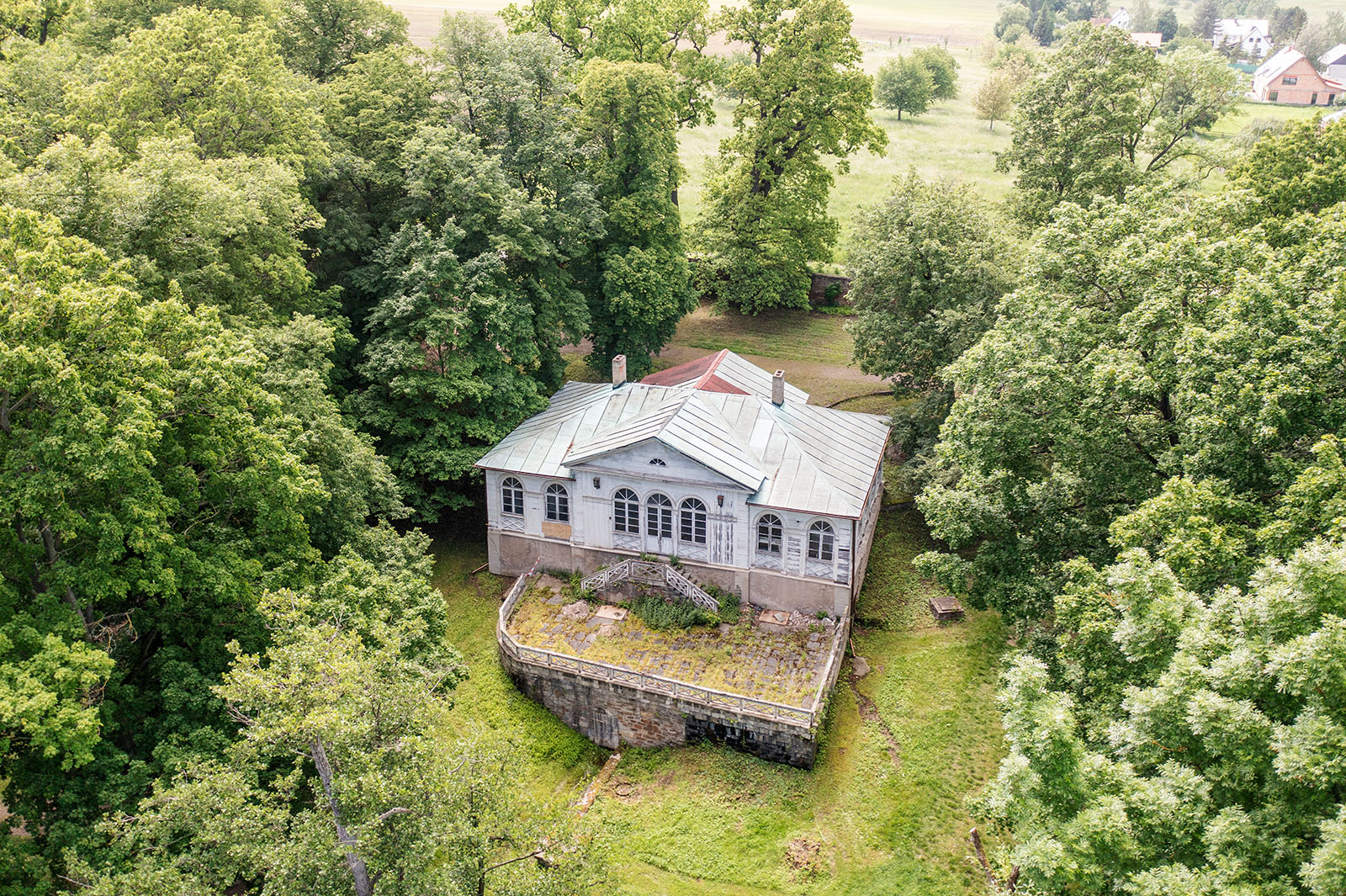
For 14 years, Count Gustav Adolf von Gotter called Molsdorf Palace his home. He had transformed a former moated palace into a picturesquely situated Baroque pleasure palace. However, the extravagant lifestyle of this diplomatic climber ultimately shattered the dream, and Gotter was compelled to sell the property. Visitors can explore the museum housed within the palace, including its historical rooms and special exhibitions, as part of a guided tour. The symmetrical Baroque garden from Gotter's era was later converted into a landscape park. Some original sculptures remain intact.
From Moated Palace to Pleasure Palace
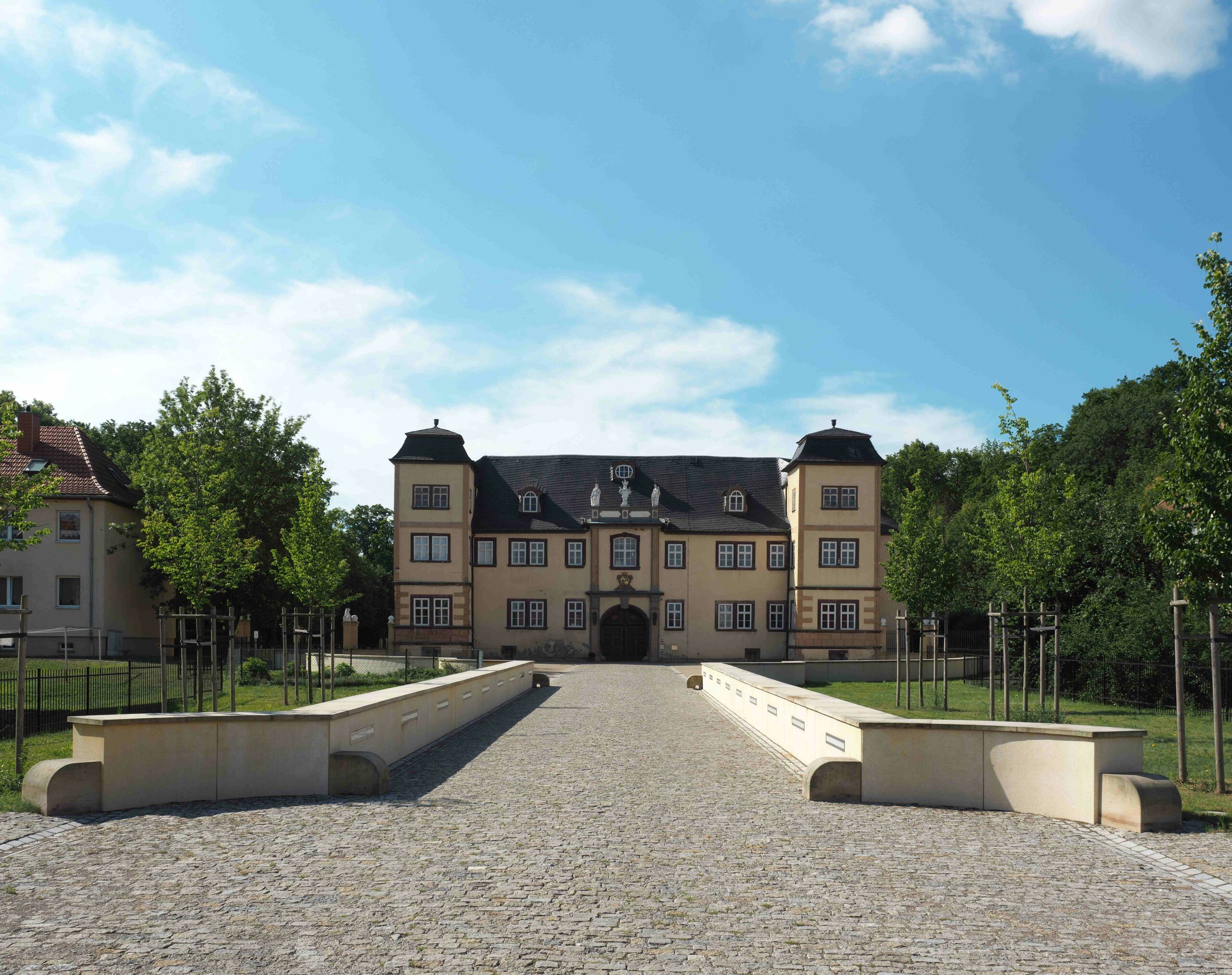
Located about ten kilometres southwest of Erfurt, Molsdorf Palace is a distinctive gem among Thuringia's palaces, largely due to its illustrious builder. Gustav Adolf von Gotter (1692–1762) led a remarkable career. Born in Gotha to a middle-class family, he entered the service of Duke Friedrich II of Saxe-Gotha-Altenburg, later becoming an envoy in Vienna, a court councillor, and a privy councillor. In 1724, the Emperor elevated him to nobility, naming him Baron and Imperial Count. Ten years later, Count Gotter capped his rise by purchasing Molsdorf Palace, transforming the former moated palace into a Baroque pleasure retreat. Thanks to his connections with leading European courts, he enlisted renowned artists for the project, including the Weimar court architect Gottfried Heinrich Krohne and the stucco artist Johann Baptist Pedrozzi.
"Long Live Joy"
Count Gotter adorned the lavish banqueting hall on the upper floor with oak panelling and 33 paintings. These portray two of his benefactors: Friedrich der Grosse (Frederick the Great) and Prince Eugen of Savoy, among others. The hall prominently features the motto “Vive la joie” (“Long live joy”), the creed of the Hermit Order of Joyous Recluses, of which Gotter was a member. In addition to being a shrewd and highly decorated diplomat, Gotter was a bon vivant known for his opulent lifestyle. His banquets became legendary - reportedly featuring curious offerings such as bowls filled with rings, chains, and watches, from which guests could select a keepsake. The splendid marble hall served as a reception space and introduced guests to his parade apartments. A painting in the hall depicts the count in hunting attire. After 14 years, he was forced to sell the estate, which then passed into the hands of Duke Friedrich III of Saxe-Gotha-Altenburg. The palace was converted into a chamber estate, and its moat was filled in. The Palace's elegant marble bath, dating from 1910, remains one of the few surviving private luxury baths from the early 20th century. Commissioned by Countess von Gneisenau, it was crafted using green-veined marble.
The Park - Curves over Geometry
Molsdorf Palace is surrounded by an eight-hectare landscaped park. Originally laid out in strict Baroque geometry and adorned with numerous sculptures, the grounds were redesigned between 1822 and 1826 by Gotha court gardener Johann Rudolph Eyserbeck. While preserving the garden’s main axis, he introduced meandering paths, an irregularly shaped pond, and removed most of the sculptures, some of which are now displayed in the lapidarium, a collection of works in stone. In place of the original parterre beds, a large lawn with flowerbeds was created as a pleasure ground in front of the palace.
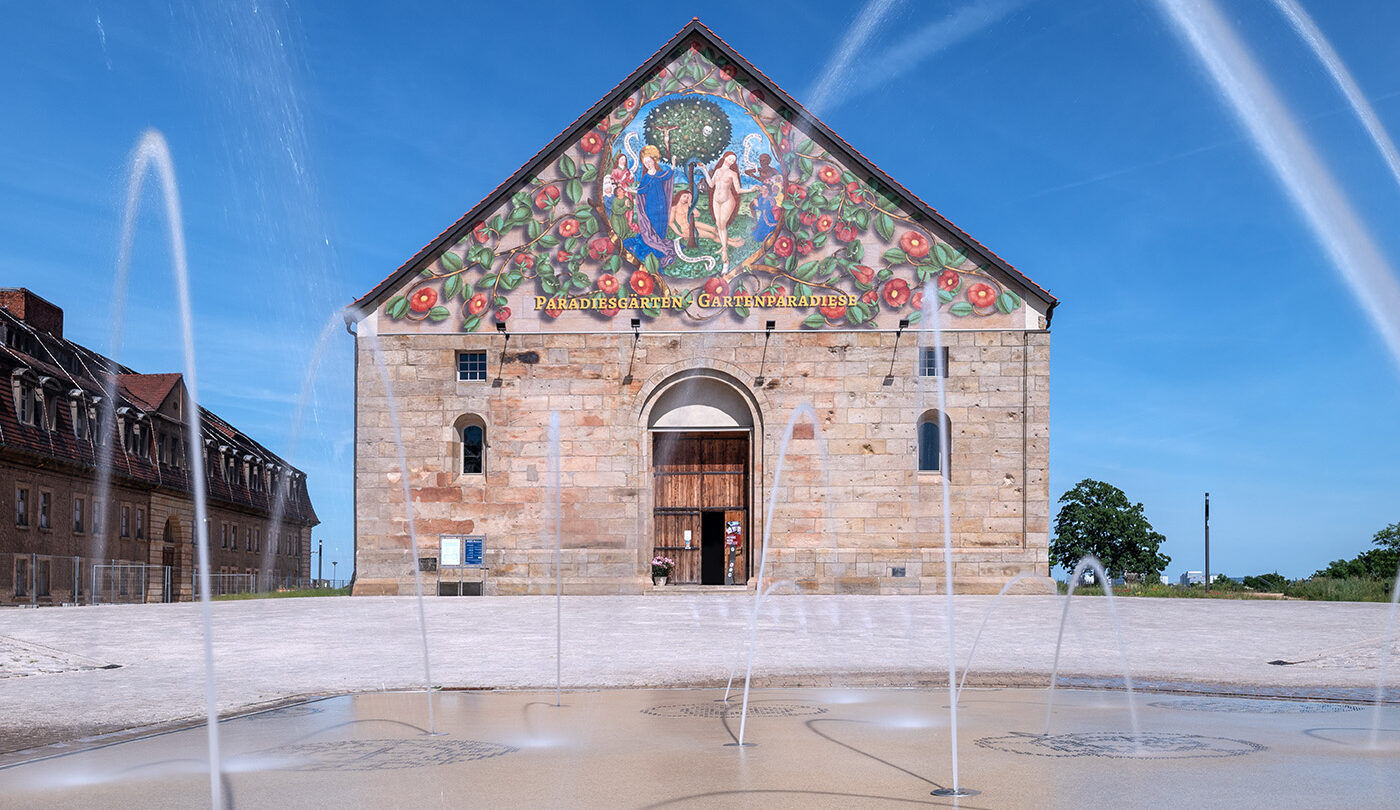
It was destroyed, misused, and stripped of its dignity - the Monastery Church of St Peter and St Paul. Following secularisation, in 1820 Prussian troops converted it into a provisions store. In recent times, the former house of worship has regained something of its former dignity through the partial removal of the storage floors. The church was built some 900 years ago upon the then highest elevation within the Erfurt city walls – the Petersberg (Peter’s Mountain). The pillar basilica of the former Benedictine monastery followed the model of the Hirsau School. Inside, some of the oldest wall paintings in Thuringia are preserved.
Gardens in the monastery church
Where monks once walked, Thuringian garden art has now taken root. The exhibition ‘Paradise Gardens – Garden Paradises’ offers a journey through the historic parks and gardens of the Thuringian Castles and Gardens Foundation. This atmospheric exhibition also provides insights into St Peter’s Monastery itself and monastic garden culture.
A “sight that shakes one’s inmost feeling”. Thus wrote Constantin Beyer in his 1821 city chronicle. What so unhinged the writer was the burned‑out Monastery Church of St Peter and St Paul. At the end of 1813, in the midst of the Wars of Liberation, it had been caught between the lines. French troops had entrenched themselves in the citadel on the Petersberg. The fortress had been erected some 150 years earlier and completely enclosed the monastery - a fatal location, as events would show.
The Prussians opened fire. Although they ultimately succeeded in driving out the French, they inflicted grievous damage upon the church. Reconstruction was out of the question for the new rulers of the land; instead, from 1820 they converted the sacred building into a provisions store for the Prussian military. To that end, the remains of the towers were demolished, the clerestory with its windows removed, three storage levels inserted, and a pitched roof erected.
In the Footsteps of Hirsau and Barbarossa
Around the year 1060, the Benedictine monastery was founded by the Archbishop of Mainz. From 1127, the monastery church was rebuilt on the Hirsau model. In keeping with this monastic reform movement, the church was constructed as a flat‑roofed pillar basilica - with a separate lay church, a chorus minor for brethren in minor orders, and a distinct area for the patres, the priest‑monks. In accordance with Hirsau tradition, no crypt was built. At a length of 75 metres, the monastery church is regarded as the first major building of the Hirsau School on Thuringian soil.
The Monastery of St Peters assumed a leading role among Thuringian monasteries in the Early and High Middle Ages. Until the end of the 13th century, it hosted several synods as well as imperial and court assemblies of the German emperors and kings. In 1181 it was here that Emperor Friedrich Barbarossa and Heinrich der Löwe (Henry the Lion) faced their decisive confrontation: the rebellious duke was compelled, at the court assembly in Erfurt, to submit to the Staufer emperor.
Hidden Treasures
Despite its destruction and misuse, the church remains a remarkable witness to medieval architecture. The masonry is composed of unusually large ashlar blocks, some reaching a length of two metres. On the south exterior wall of the transept, an incised drawing survives, dating from around 1360 and depicting the so‑called Man of Sorrows. Beneath layers of early modern paint in the church’s interior, wall paintings from the first half of the 13th century have endured, including a Crucifixion scene and two over‑life‑size figures of saints. Evidence suggests these depict the apostles Andrew and John. The images rank among the oldest surviving wall paintings in Thuringia.