Summer Residence with Pückler Park near the Wartburg
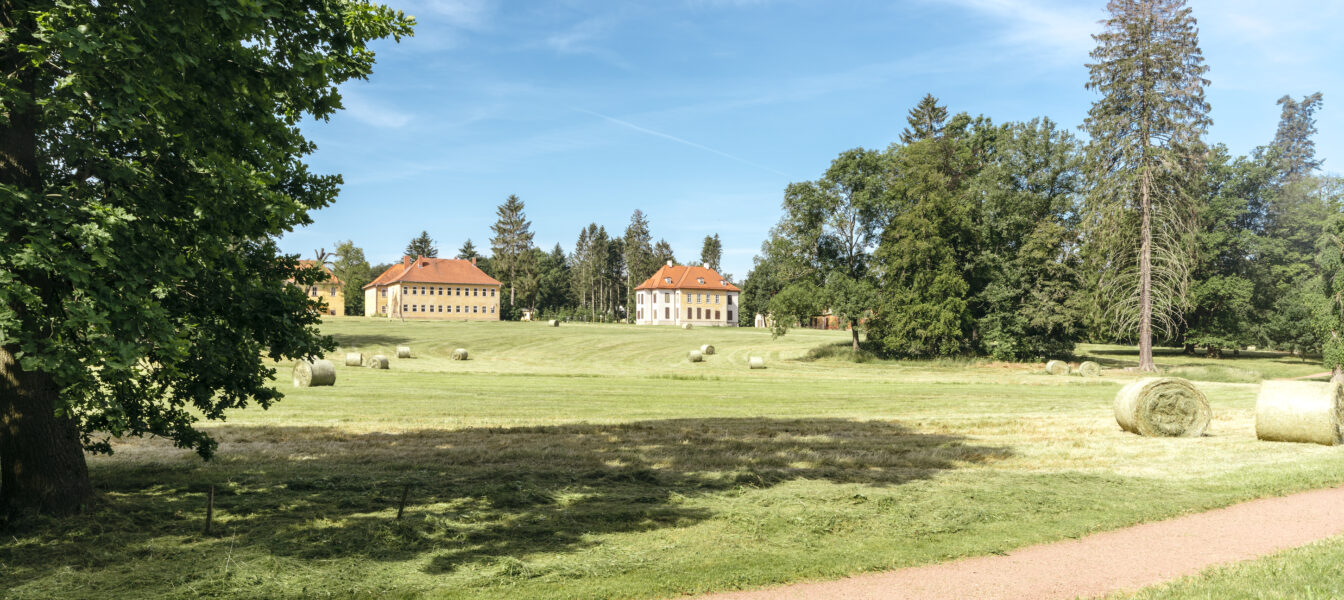
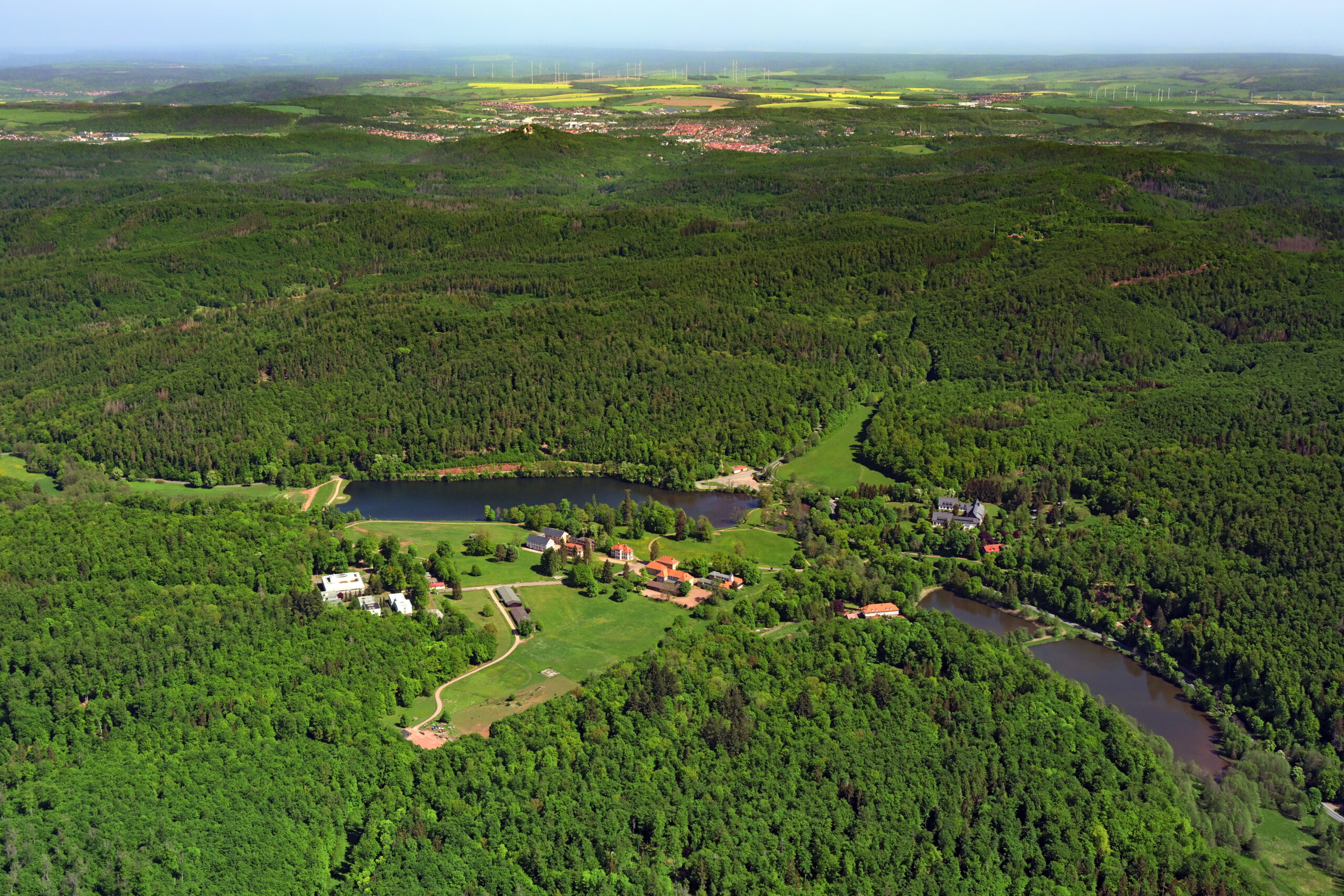
Eight kilometres south of Eisenach lie Wilhelmsthal Palace and Park in the River Elte Valley. The Elte was dammed in the early 18th century to form a lake, which remains a central feature of the grounds. The late‑18th‑century landscape park was redesigned by Prince Hermann von Pückler‑Muskau and Hermann Jäger.
At a glance
Address
Wilhelmsthal PAlace and Park
Wilhelmsthal 5
99834 Gerstungen, Wilhelmsthal
T: 03 69 61 – 70 2 2
Situated south of Eisenach, the palace complex is named after its builder, Duke Johann Wilhelm of Saxe‑Eisenach. The expansion of the hunting lodge into a summer residence was accompanied by the creation of a Baroque garden. From 1795, under Duke Carl August of Saxe‑Weimar‑Eisenach, the neglected site began to be transformed into a landscape garden, with numerous flower plantings and groups of exotic trees. In the mid‑19th century, Grand Duke Carl Alexander commissioned Prince Hermann von Pückler‑Muskau and the court gardener Hermann Jäger to renew the grounds.
In the 20th century, the palace served as a military hospital, children’s home, and youth camp. The structural alterations and neglect of the park during this time led to severe deterioration of the original design, which was eventually halted. The harmonious integration of palace and park into the surrounding countryside makes the ensemble a unique cultural monument.
Baroque Garden with Palace Axis and Garden Axis
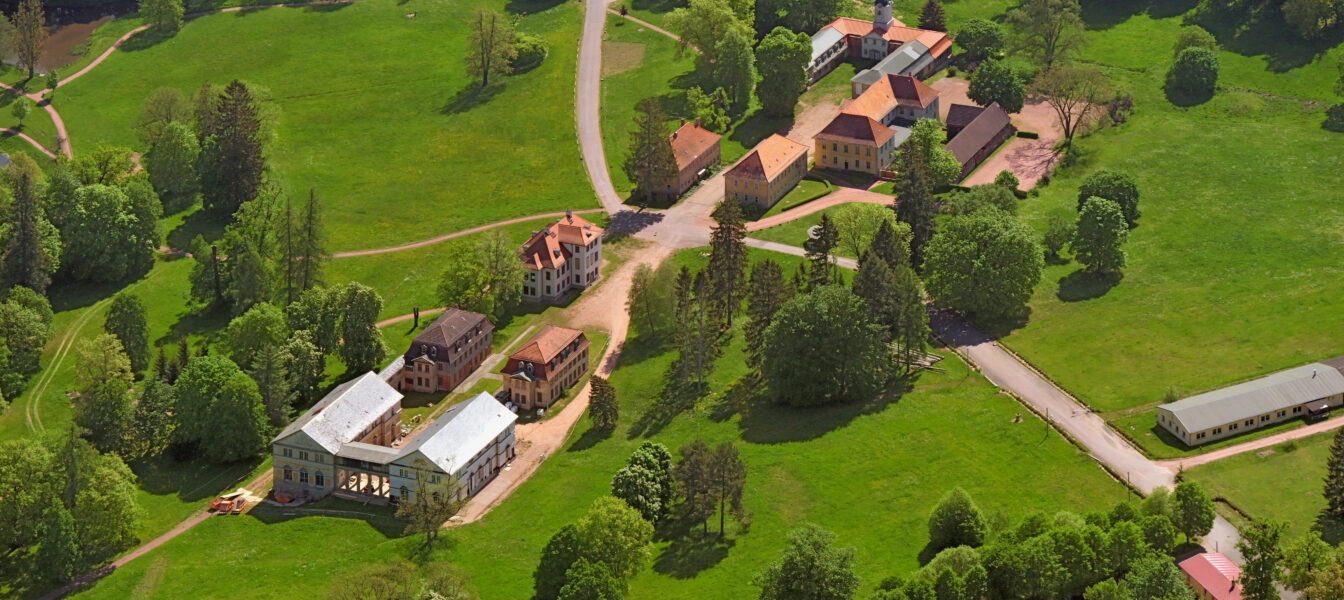
Since the 16th century, the area around the Hohe Sonne neighbourhood had been used by the Ernestine rulers as hunting grounds. The historical starting point of the palace complex is the corps de logis (main residential area of a Palace), also called the Old Palace, which replaced earlier hunting lodges in the early 18th century. South of the Old Palace, the “Upper Garden” was first laid out, to which a terraced pleasure garden was later added on the slope down towards the lake.
This garden axis, aligned with the palace building, intersected a north–south palace axis, along which, in addition to the main building, numerous other residential and service pavilions stood in symmetrical pairs.
In 1719, the present‑day Telemann Hall – later integrated into the New Palace – was built. Under Ernst August of Saxe‑Weimar‑Eisenach, Wilhelmsthal Palace was remodelled between 1743 and 1748 under the direction of architect Gottfried Heinrich Krohne. The palace axis was closed at its western end by an orangery, the garden axis was emphasised, and the formal layouts extended. As his predecessor had done, Ernst August made great use of the lake, commissioning boats and gondolas to be built in the Venetian style.
English Landscape Garden
After a long period of decline and only minimal maintenance under Duchess Anna Amalia, Wilhelmsthal Palace attracted the interest of the young Carl August from 1777 – initially, as before, for hunting. His wife, Duchess Luise, spent summers there each year despite the poor condition of the buildings. Economic, aesthetic, and philosophical considerations led to the decision to transform the Baroque garden into an English‑style landscape park with seamless transitions into the surrounding countryside.
In the 1790s, Carl August, together with Eisenach’s Building Counsellor Georg Christian Sartorius, developed ideas for a complete redesign: the lakeshore was given a more natural form, groups of trees and sightlines were established, and the Baroque sculpture was removed. Below the lake, a waterfall and bridges were constructed, and the picturesque Swiss House at the western edge of the woods was added.
Carl August also altered the buildings: opposite Banqueting Hall, erected in 1719, Sartorius built a matching structure, the two linked by a colonnade to form what became known as the New Palace. Pavilion buildings beyond this western terminus were removed, reorienting the complex towards the redesigned park. The axial focus on the Old Palace was replaced by the picturesque placement of the New Palace within the landscape, with its distinctive double façade formed by the linked gables of the two halls. Wilhelmsthal Palace then served regularly as the Weimar court’s summer residence and hosted distinguished guests.
Pückler
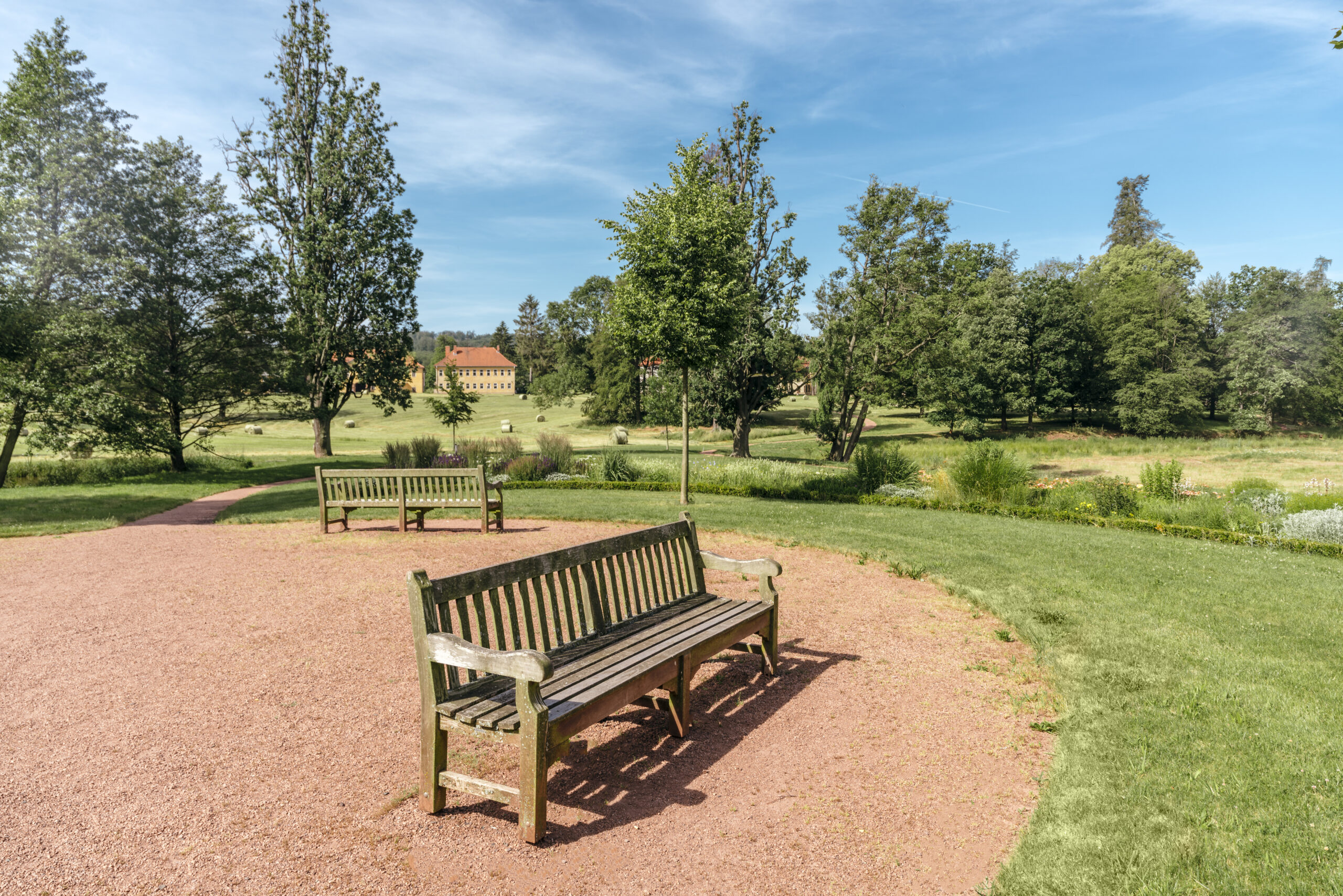
In the mid‑19th century, Grand Duke Carl Alexander ordered the park to be renewed, following plans by Prince Hermann von Pückler‑Muskau and the court garden inspector Hermann Jäger. Building on what was already there, they created new plantings and paths and ensured that the reshaped lake could be fully appreciated. “Wilhelmsthal Palace must give the impression that the former primeval forest (of which some trees still bear witness) has been cleared only to make space for pleasant dwellings with light surroundings, whereby a deep feeling for nature has carefully spared the finest trees…”, wrote Hermann Jäger in 1853. Since 2009, parts of the landscape park have been restored.