UNESCO World Heritage Site
The UNESCO World Heritage Convention
In order to protect and preserve cultural and natural heritage of ‘outstanding universal value’ for all humankind, UNESCO (the United Nations Educational, Scientific and Cultural Organisation) adopted the World Heritage Convention in 1972. To date, 193 countries worldwide have acceded to this international ‘Convention Concerning the Protection of the World’s Cultural and Natural Heritage’. It is thus UNESCO’s most successful programme and provides a global network. With World Heritage status, responsibility for the cultural heritage inscribed on the World Heritage List no longer rests solely with the individual state, but with humanity as a whole.
Criteria for inclusion on the World Heritage List
The basis for the inclusion of sites on the World Heritage List is that they fulfil the conditions of authenticity (genuineness of cultural properties) and integrity (integrity of cultural and natural properties). In addition, ten criteria have been developed to define the outstanding universal value (OUV) of a site. Criteria (I) to (VI) relate to cultural heritage sites, whilst (VII) to (X) relate to natural heritage sites.
The Thuringian Royal Residences are characterised by an exceptionally high degree of authenticity and integrity. They also have the potential to meet three of the inclusion criteria:
Criterion II – a significant convergence of human values
The need for cooperation gave rise to masterpieces of music, art, the natural sciences and the humanities within the Thuringian Residences, which found expression in architecture and garden design. Through dynastic alliances, these spread throughout Europe. There was particularly close interaction with Great Britain. The region’s complex political and administrative structures make the Thuringian residential landscape a precursor to federal systems.
Criterion III – Evidence of a culture
The Thuringian landscape of royal residences reflects the highly fragmented and polycentric structure of the Holy Roman Empire, which, from the early modern period until its dissolution in 1806, functioned as a political system ensuring legal certainty and maintaining peace at the heart of European powers. The main royal residences of the Thuringian small states, together with their administrative structures, have been preserved to this day and can be explored and experienced.
Criterion IV – Heritage of outstanding universal value
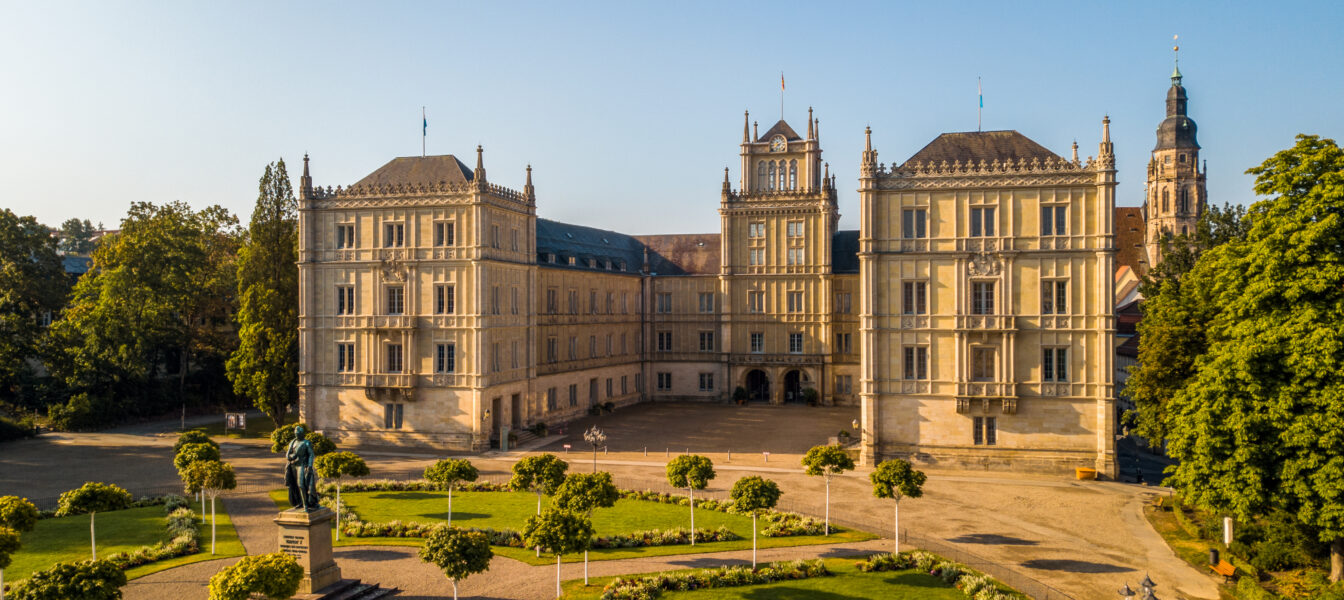
The Thuringian Residential Landscape is an outstanding example of a polycentric domain under the protection of the Holy Roman Empire. Its residences, diverse in both chronology and style, are characterised by the need to express the antiquity and status of their owners. They have shaped the cultural landscape of Thuringia in a unique and lasting way. The exceptionally high density of the Thuringian Residential Landscape has given rise to milestones in European palace architecture of the 17th, 18th and 19th centuries, such as Friedensstein Palace in Gotha, Weimar City Palace and Ehrenburg Palace in Coburg.