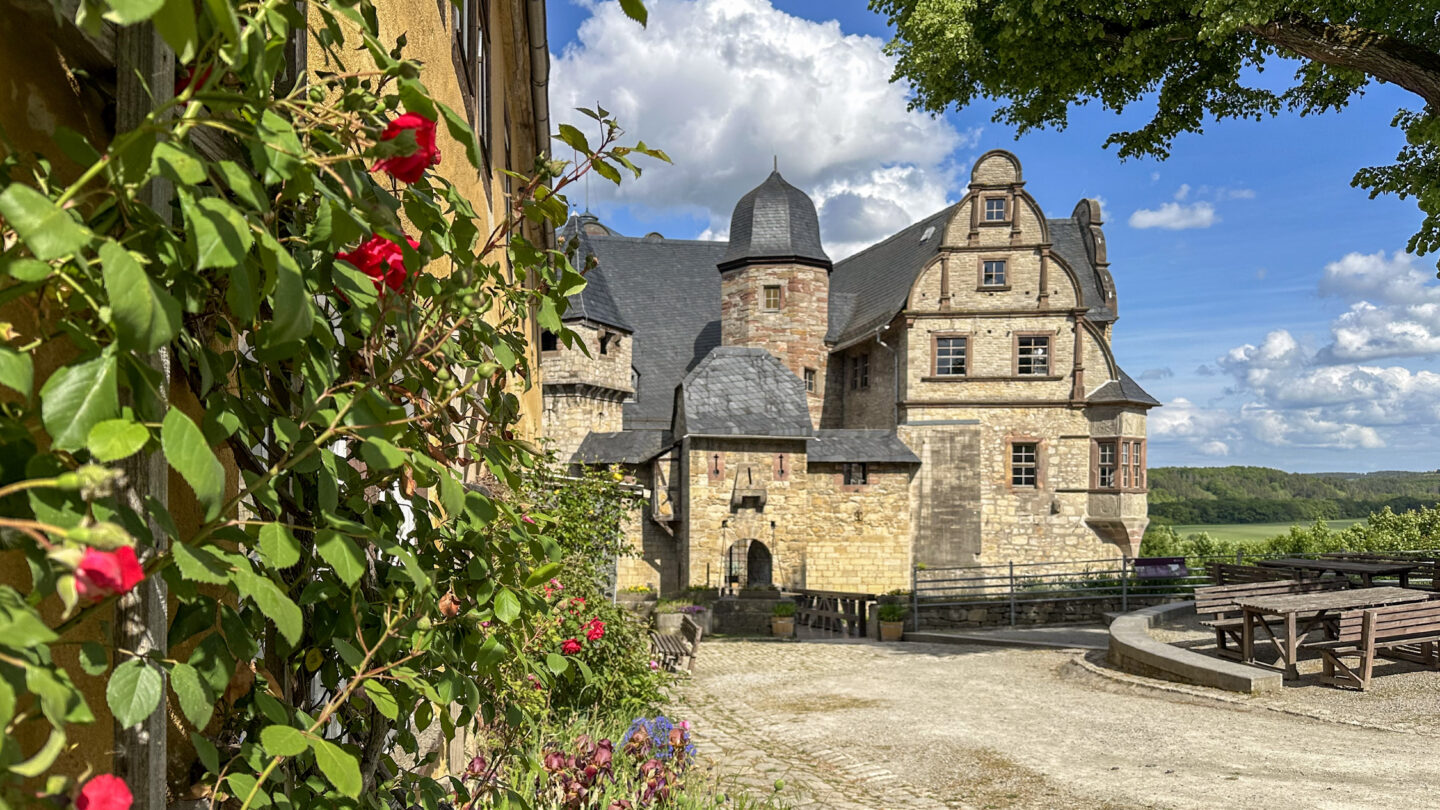
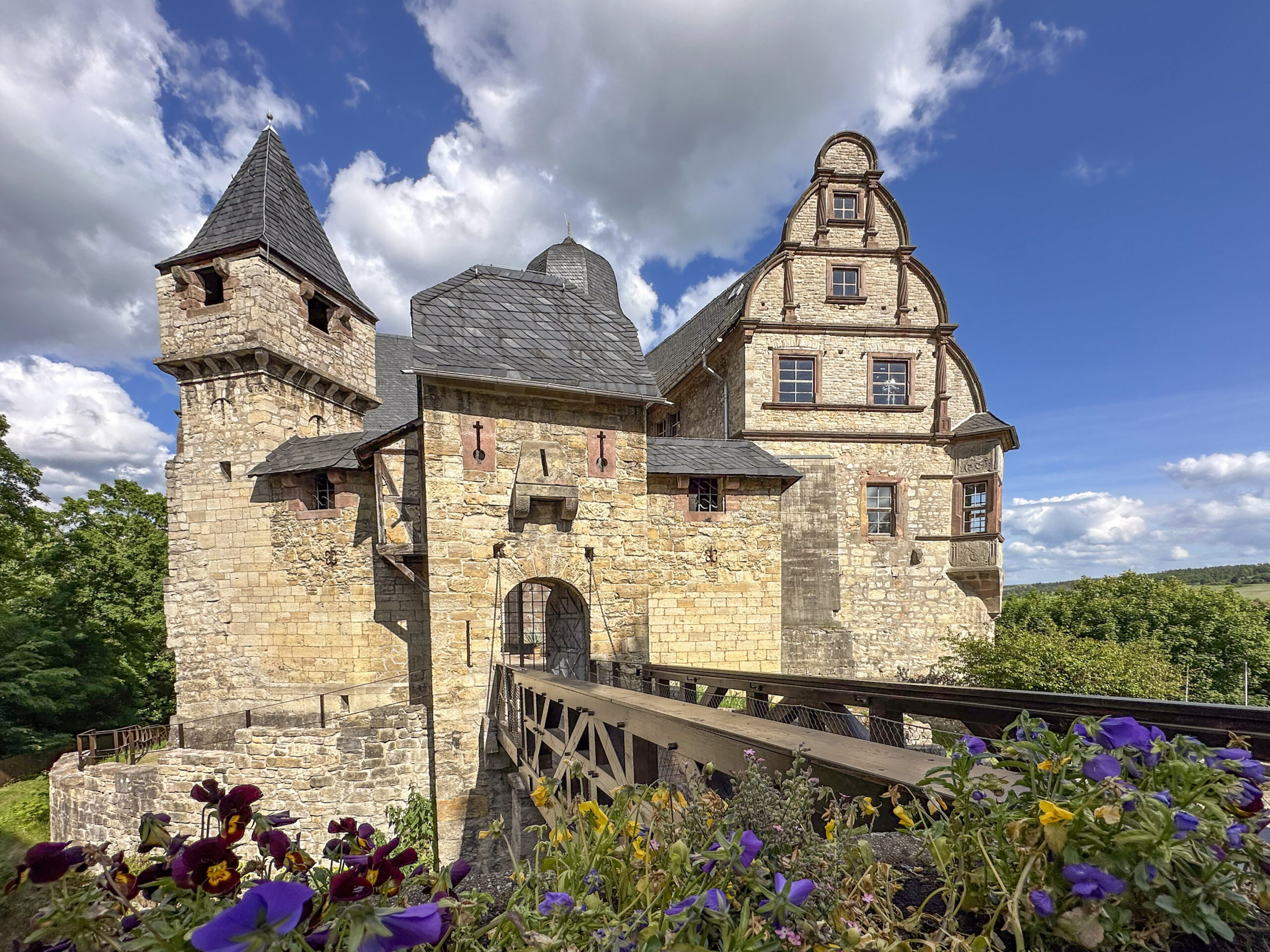
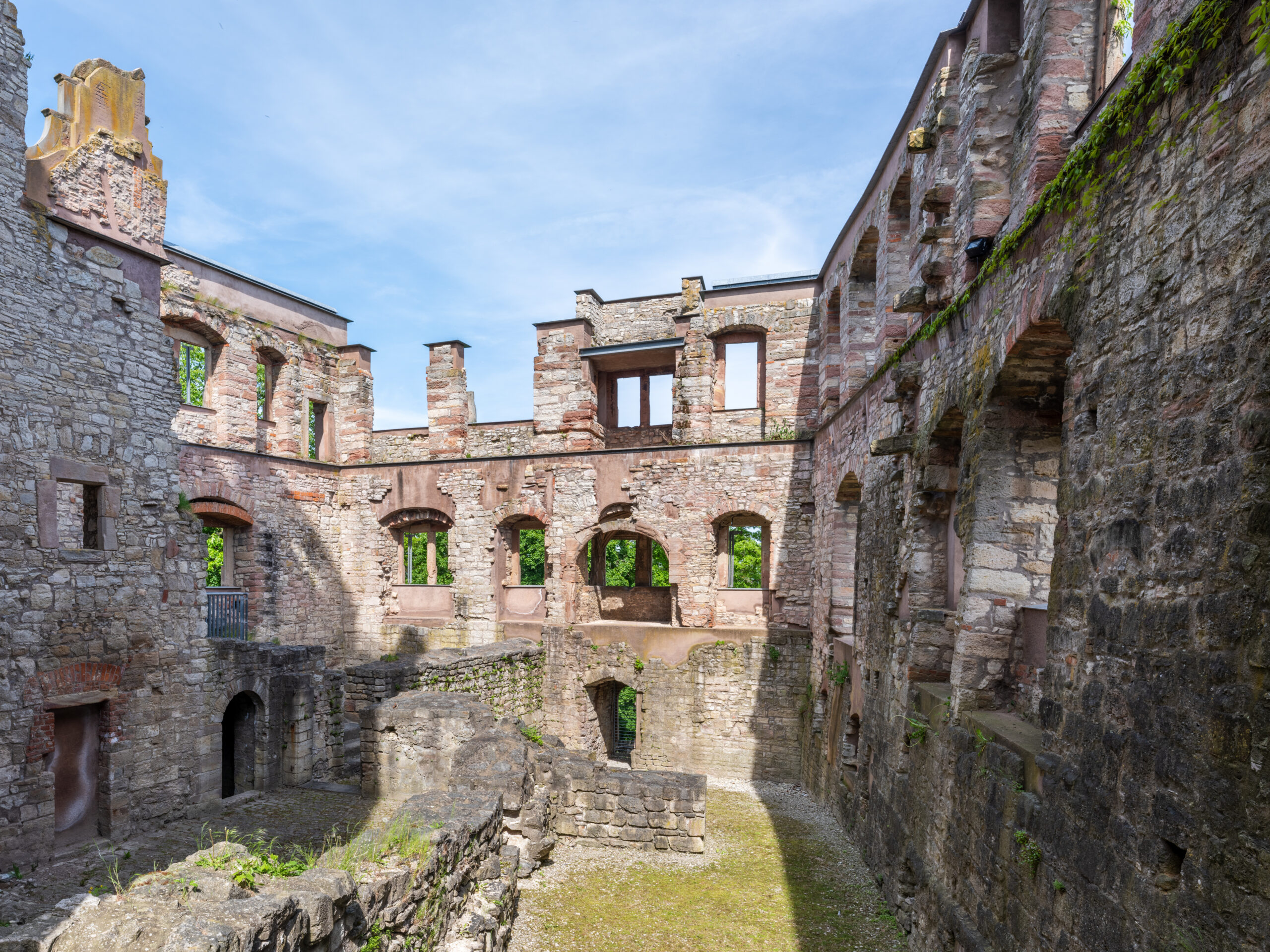
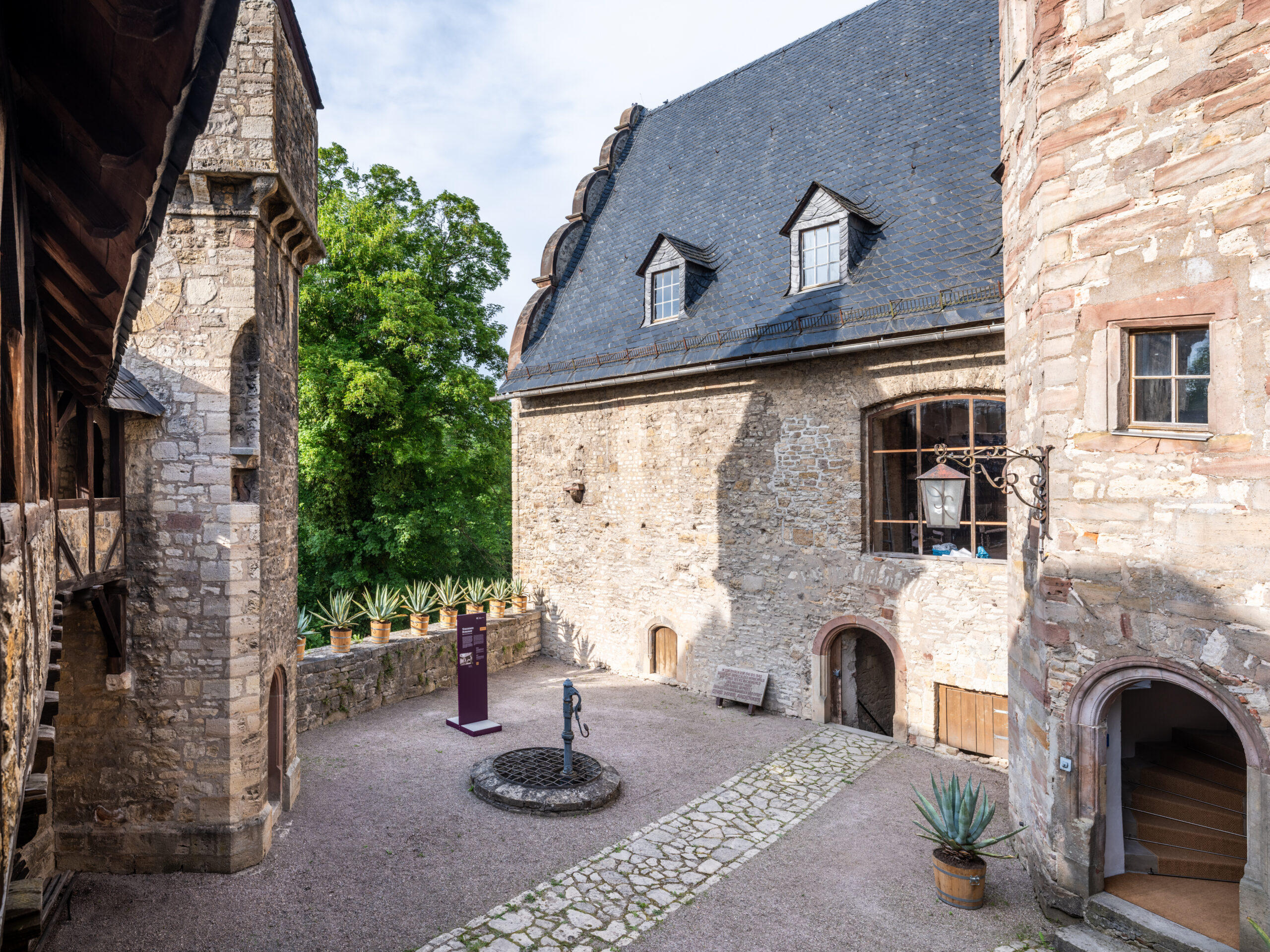
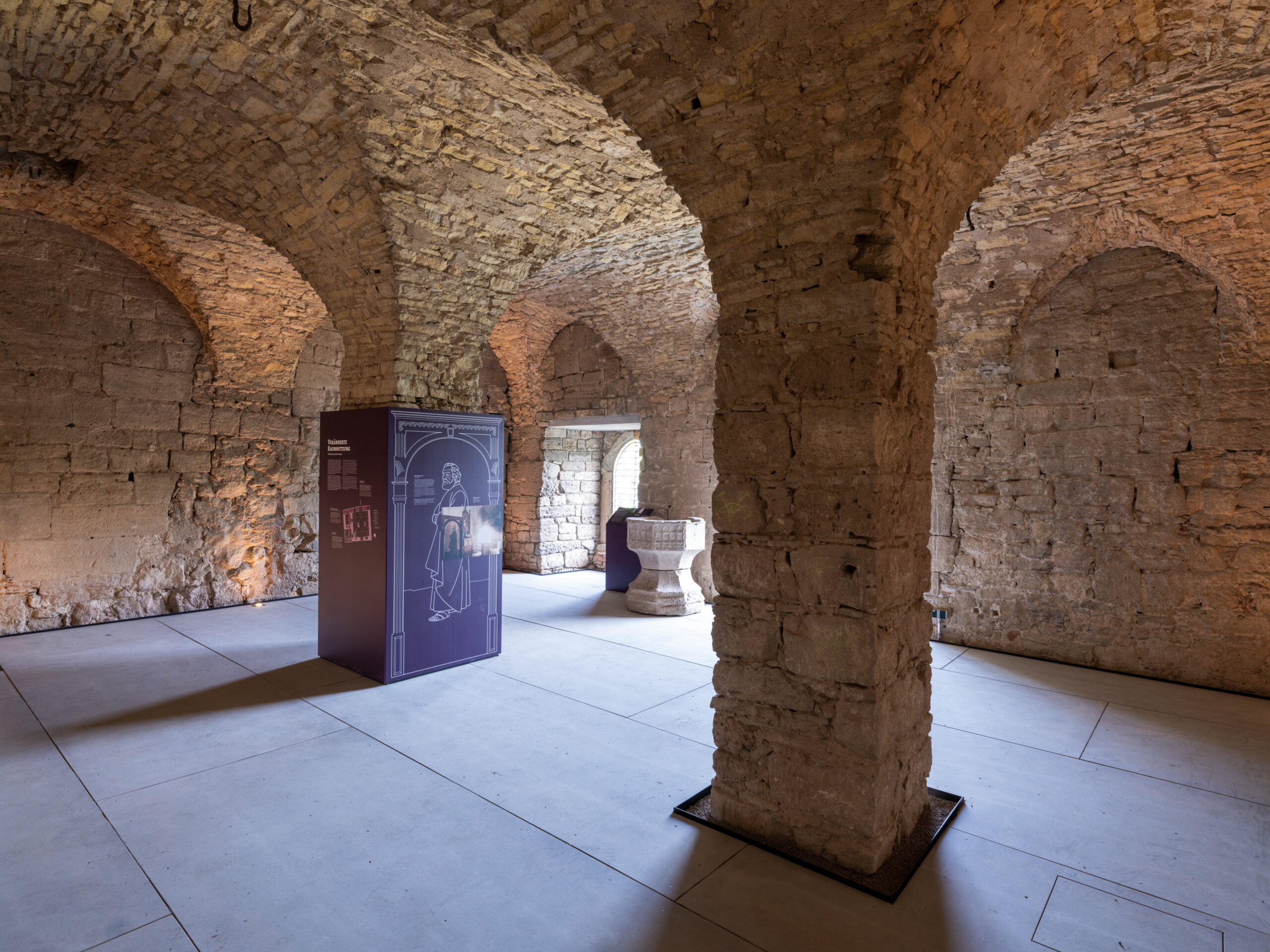
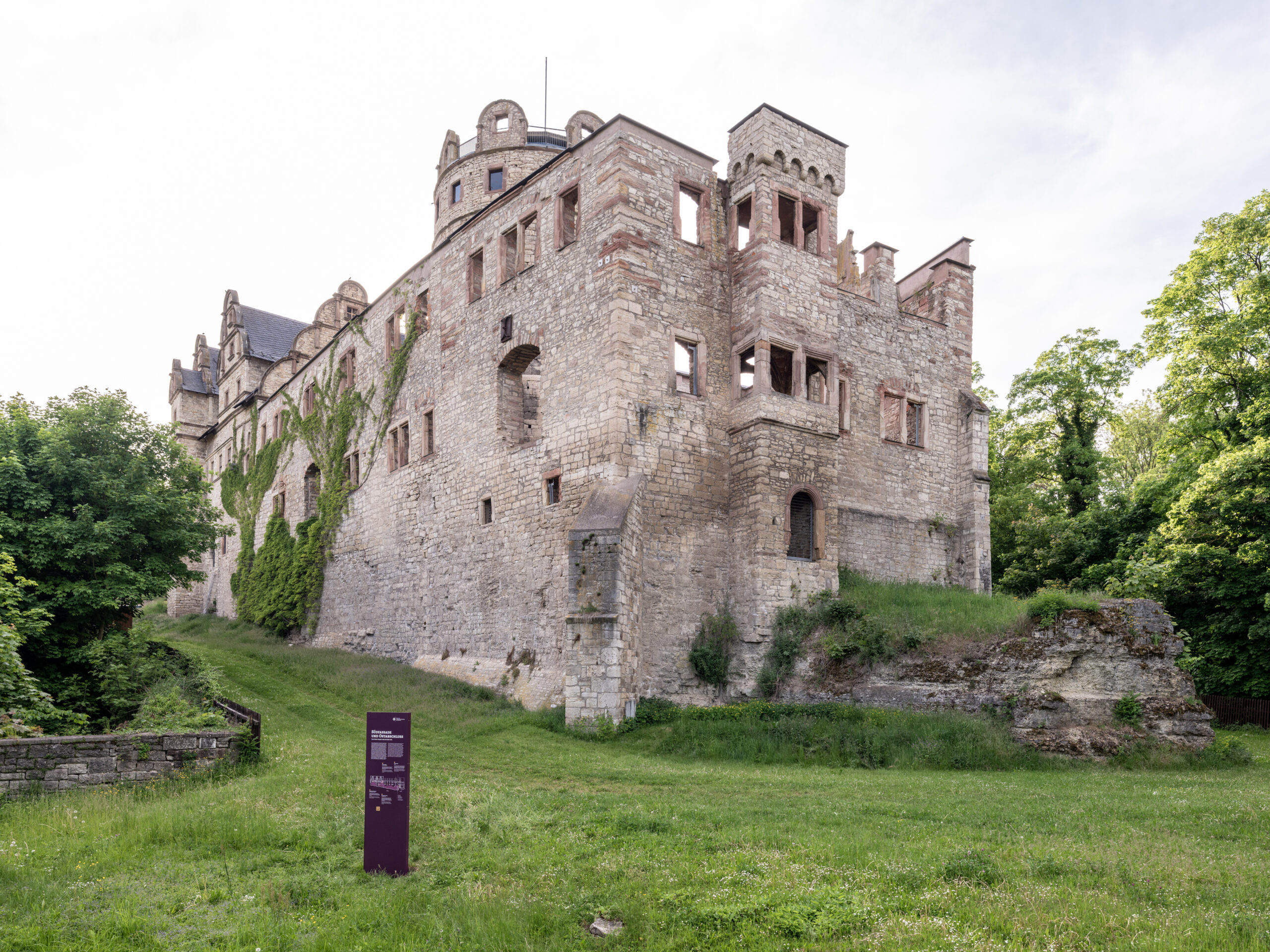
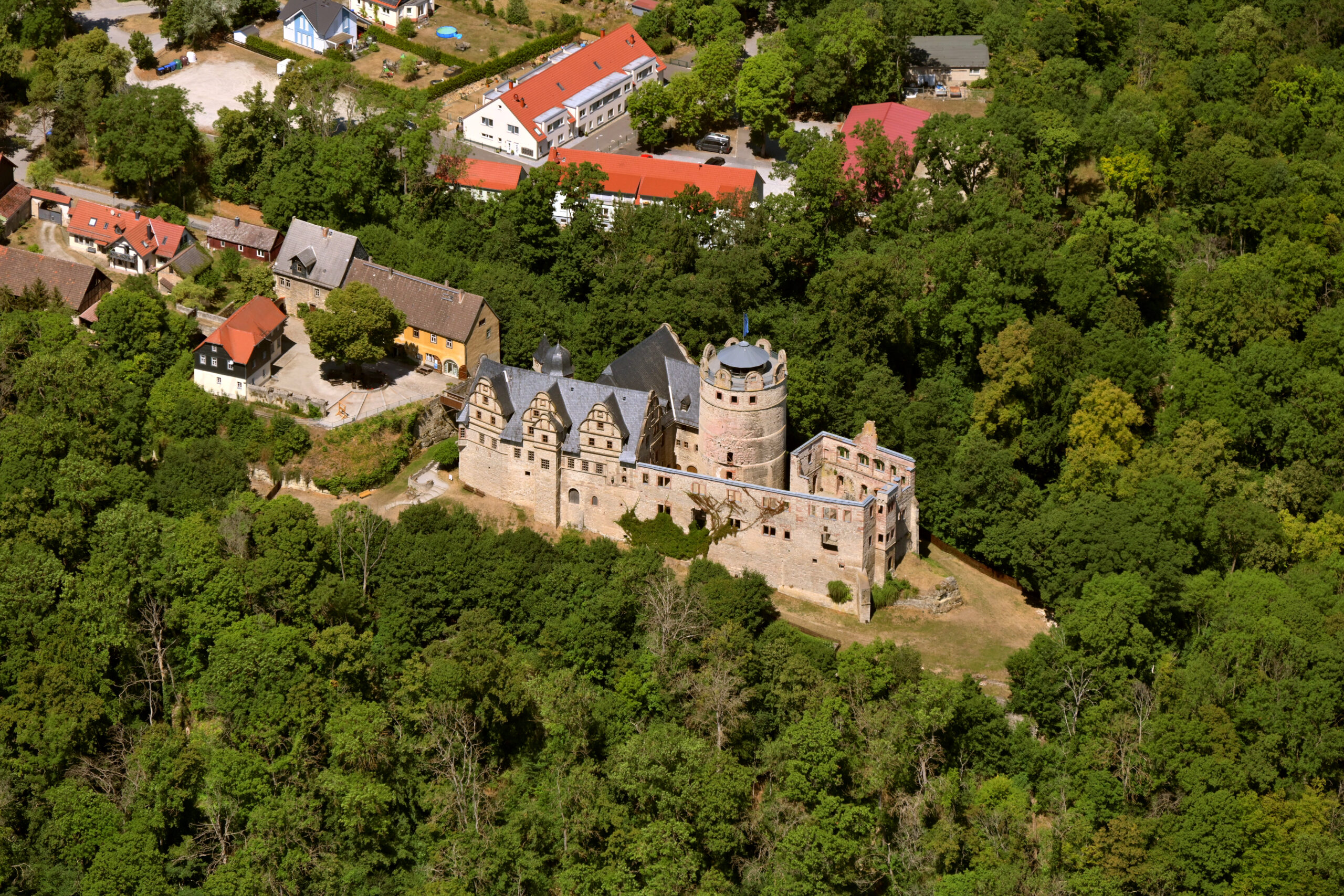
Surrounded by picturesque mountains and forests in the Weimarer Land region, visible from afar, lies Kranichfeld Upper Castle. It stands majestically on a rocky outcrop overlooking the town of Kranichfeld, known for its two castles. At first glance, the Renaissance castle appears to be completely intact. However, only the outer walls of the main castle have survived. The interior was destroyed in a fire in 1934. The exhibition tour takes visitors from the outer bailey to, amongst other places, the great hall, the ‘Thick Tower’, the chapel and the cellar. One of the castle’s curiosities is the so-called ‘Leckarsch’ on a bay window.
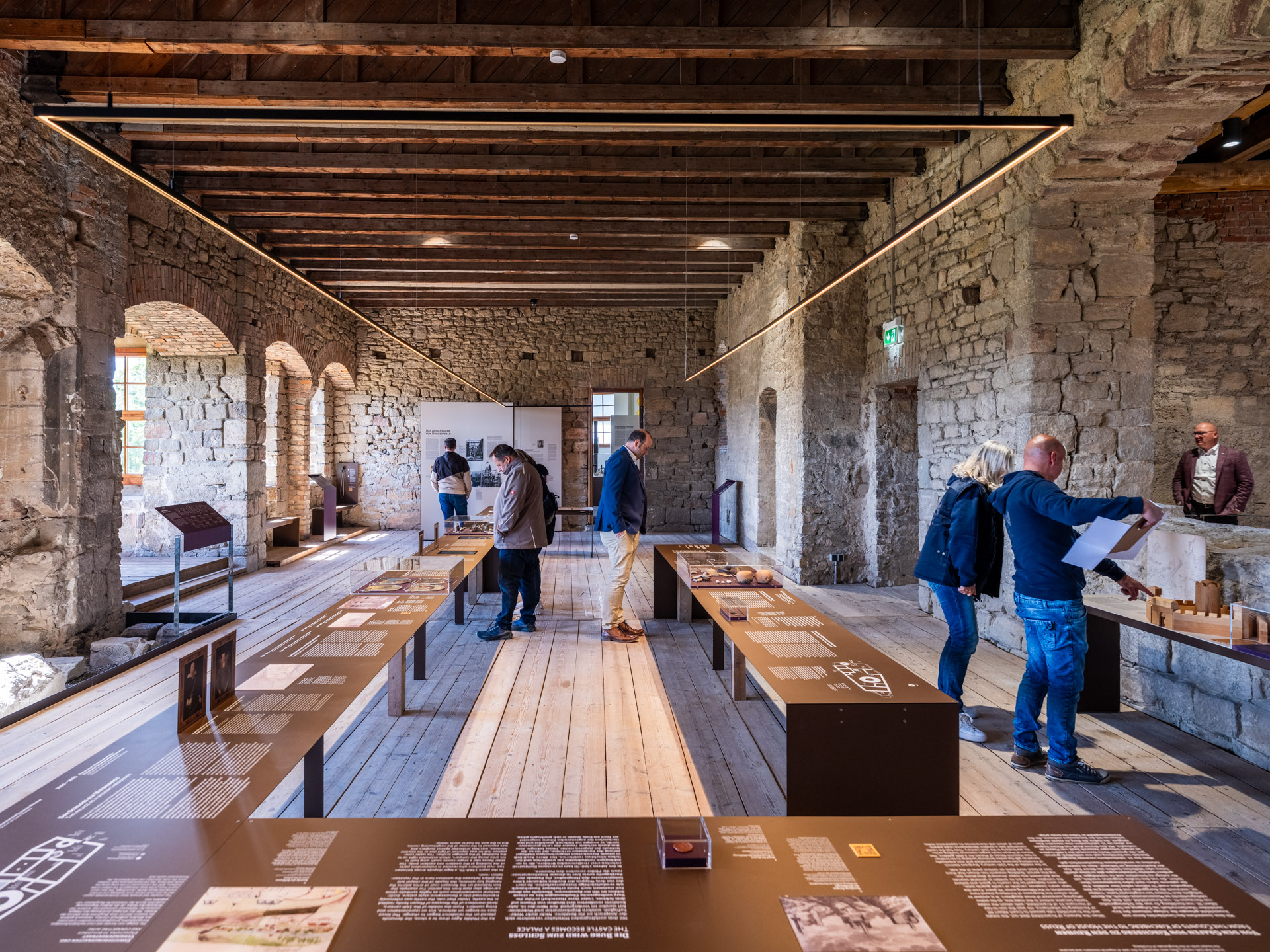
The Thuringian Castles and Gardens Foundation (STSG) has opened a new permanent exhibition at Kranichfeld Upper Castle. The multimedia exhibition offers insights into some 900 years of castle history, traces of which can still be seen at the historic site today and form the focus of the exhibition. The exhibition, held both indoors and outdoors on the grounds, explores the history of the palace in all its facets, from its construction as a medieval castle right up to the recent past.
They were all here – the lords of the House of Reuss, the Counts of Schwarzburg, and the House of Wettin. All those noble families that played a decisive role in the history of Thuringia during the early modern period once owned the Oberschloss Kranichfeld. The complex bears the name ‘Oberschloss’ (Upper Castle) to distinguish it from the ‘Unterschloss’ (Lower Castle), which was built later and is situated at a lower elevation. In the 1560s, the castle became the scene of a ‘neighbourly dispute’. At that time, two branches of the Reuss family shared the complex. The ‘elder lord’ resided in the eastern part, whilst the ‘younger lord’ lived in the western part. The dispute arose after the ‘elder lord’ had a new wing built (now part of the ruins). The younger lord then complained that the building was blocking his light. He claimed that one could now easily climb over the roof into the ‘finest rooms’ and eavesdrop on conversations. Furthermore, a side window had been built up to a vaulted chamber, ‘wherein the most secret matters are kept hidden’.
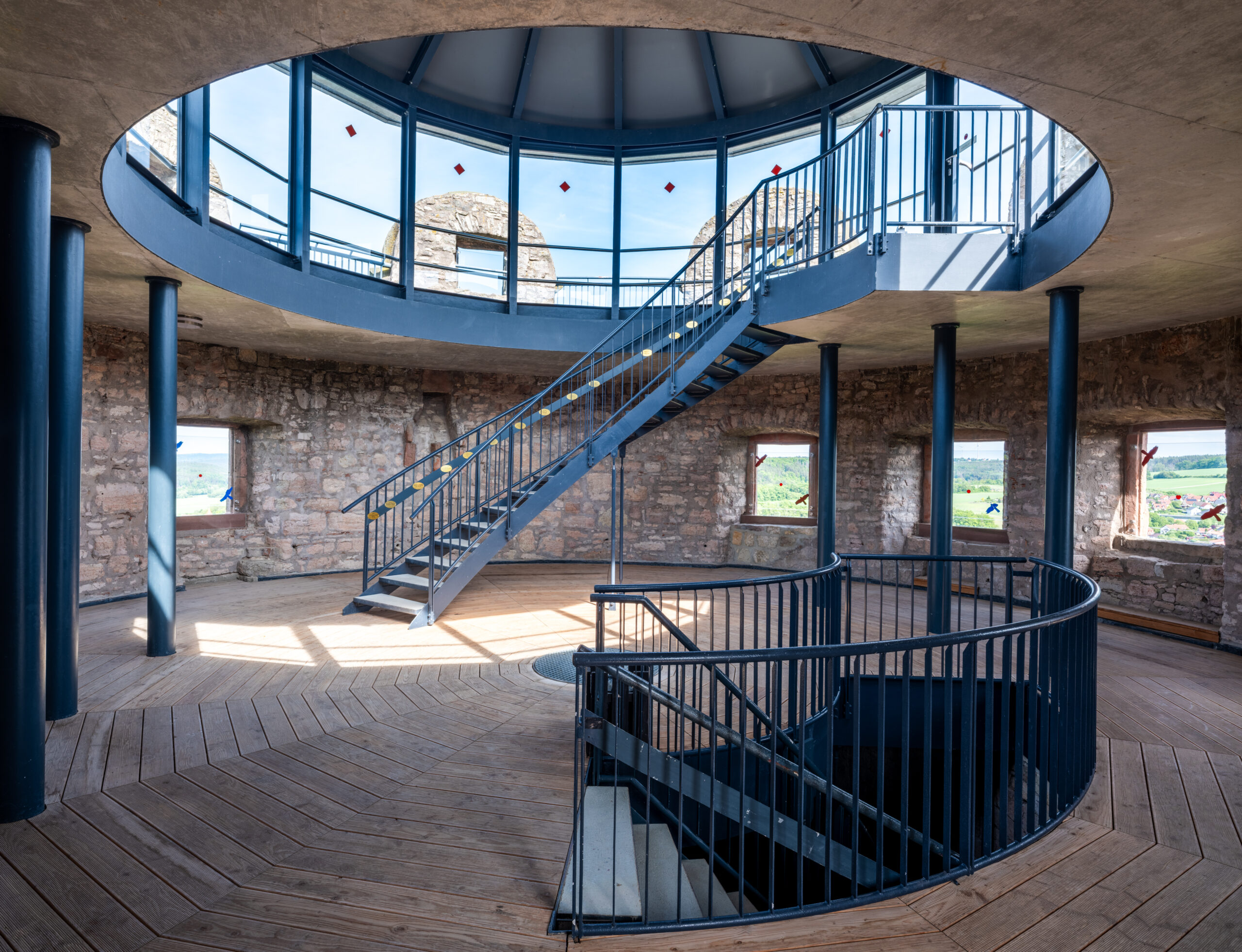
It was during this phase that the castle acquired its present appearance, which is still largely intact today. From an architectural-historical perspective, the building illustrates the evolution from a fortress to a castle. The majority of the masonry dates back to the 12th century. The chapel and the great hall, which are situated in today’s exhibition area, date from this period. The so-called ‘Thick Tower’ also dates back to the 12th century. In 1999, the ‘101 Steps Campaign’ was launched. Thanks to this fundraising campaign, a staircase was later installed in the imposing keep; in 2011, the tower was fitted with a dome and an accessible viewing platform. Today, visitors can enjoy the view over the Ilm Valley from the tower.
On a bay window at the south-west corner of the complex stands the castle’s most unusual curiosity – the so-called ‘Leckarsch’. The stone figure presents its bare behind to the viewer, accompanied by the inscription ‘Lick me in Mars’. The figure literally lives up to this, licking its own genitals. What seems curious or obscene today was nothing out of the ordinary in the 16th century. After the Reuss family were forced to pledge the castle as security in 1577, Kranichfeld changed hands several times. Under the Counts of Schwarzburg-Rudolstadt, the outer bailey in particular was extended.
An eventful history
In 1934, the complex was finally completely destroyed by fire. Shortly afterwards, the ‘Gesellschaft zur Förderung und Pflege deutscher Kulturdenkmale e.V.’ (Society for the Promotion and Preservation of German Cultural Monuments), founded by Heinrich Himmler, acquired the ruins. The plan was to establish an SS leadership school there. For the reconstruction of the castle, forced labourers were brought in from the Buchenwald concentration camp. From 1981 onwards, committed local residents took charge of the site and founded a friends’ association. In addition to an exhibition and information panels on the grounds detailing the site’s history, the Oberschloss has become an integral part of the cultural life of the town and the region.