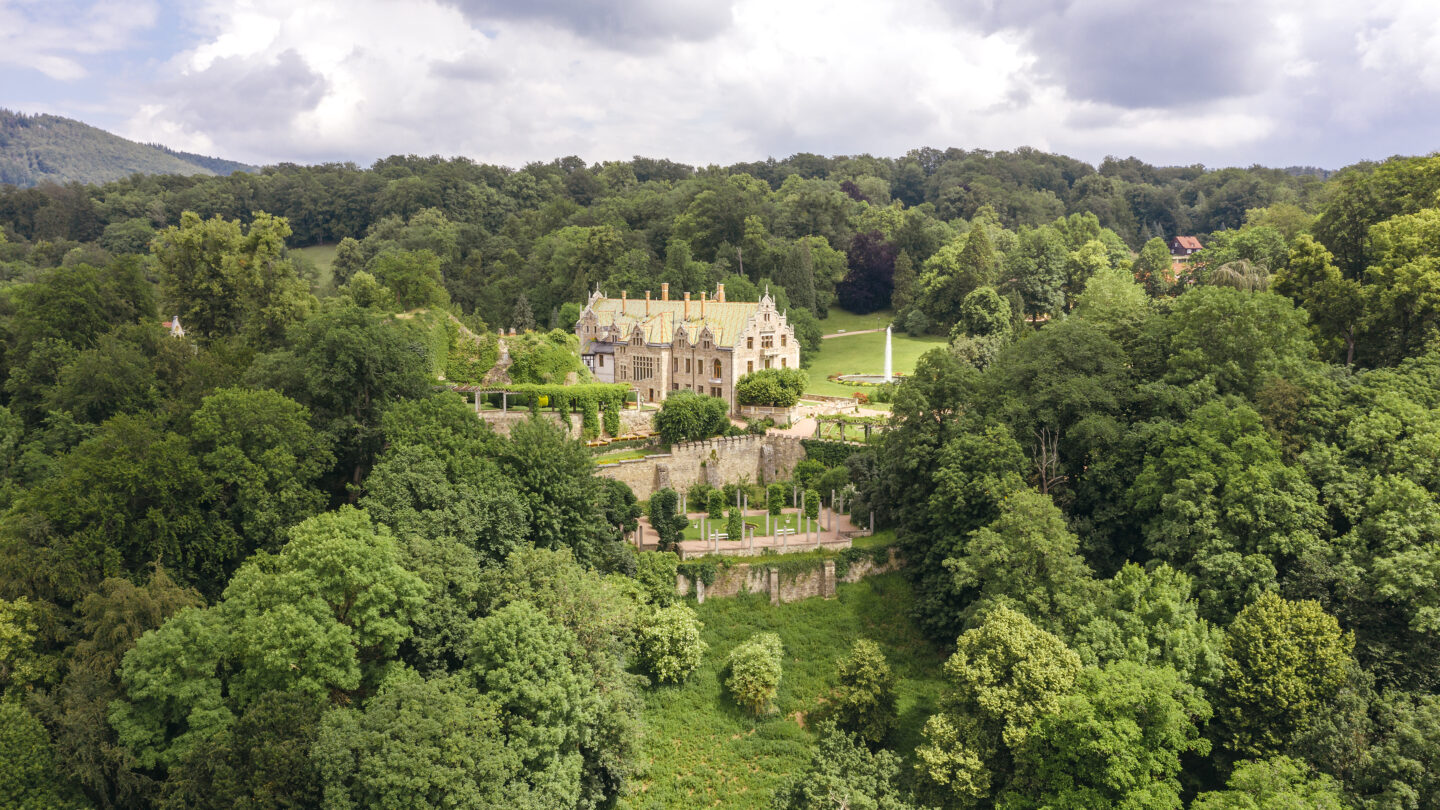
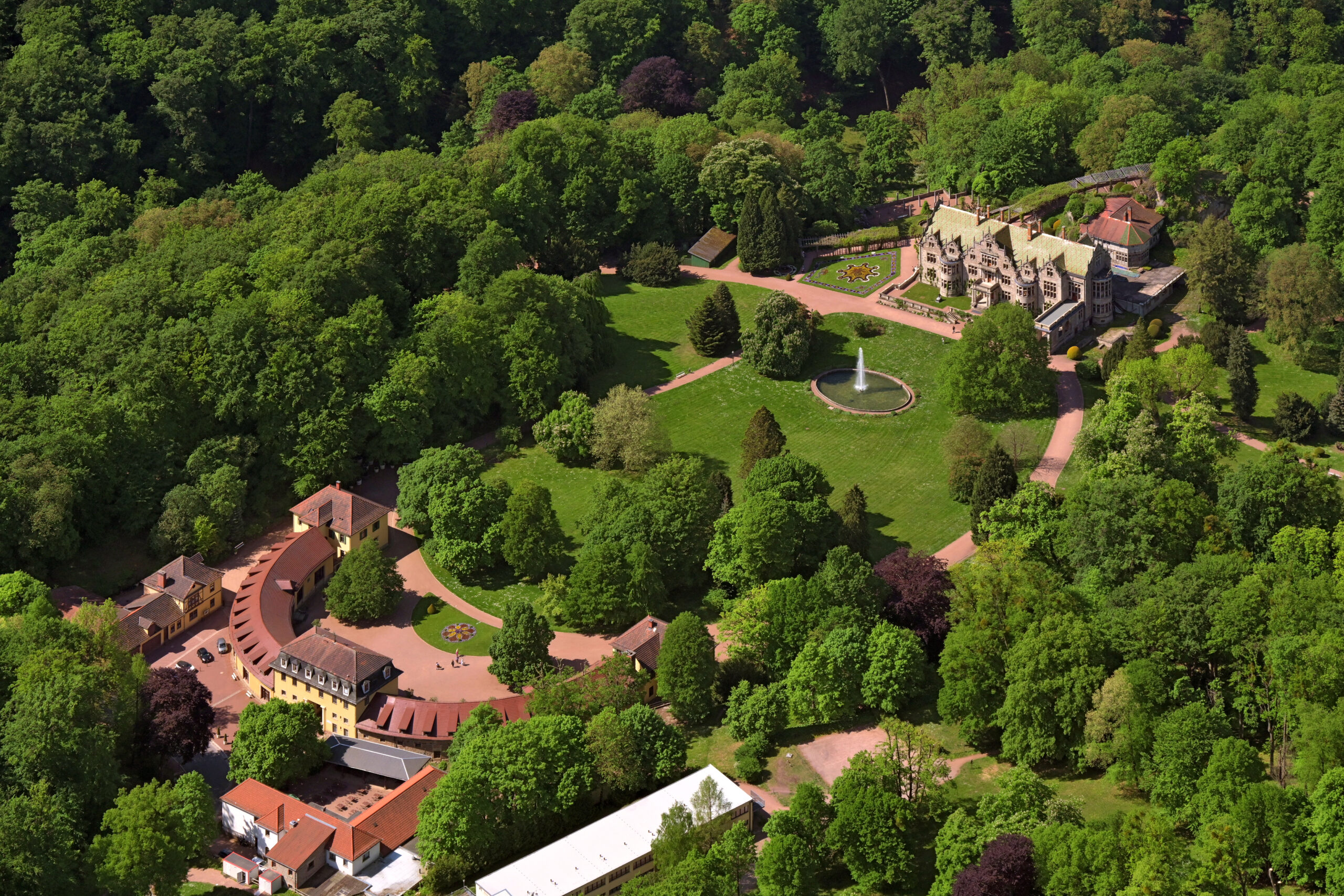
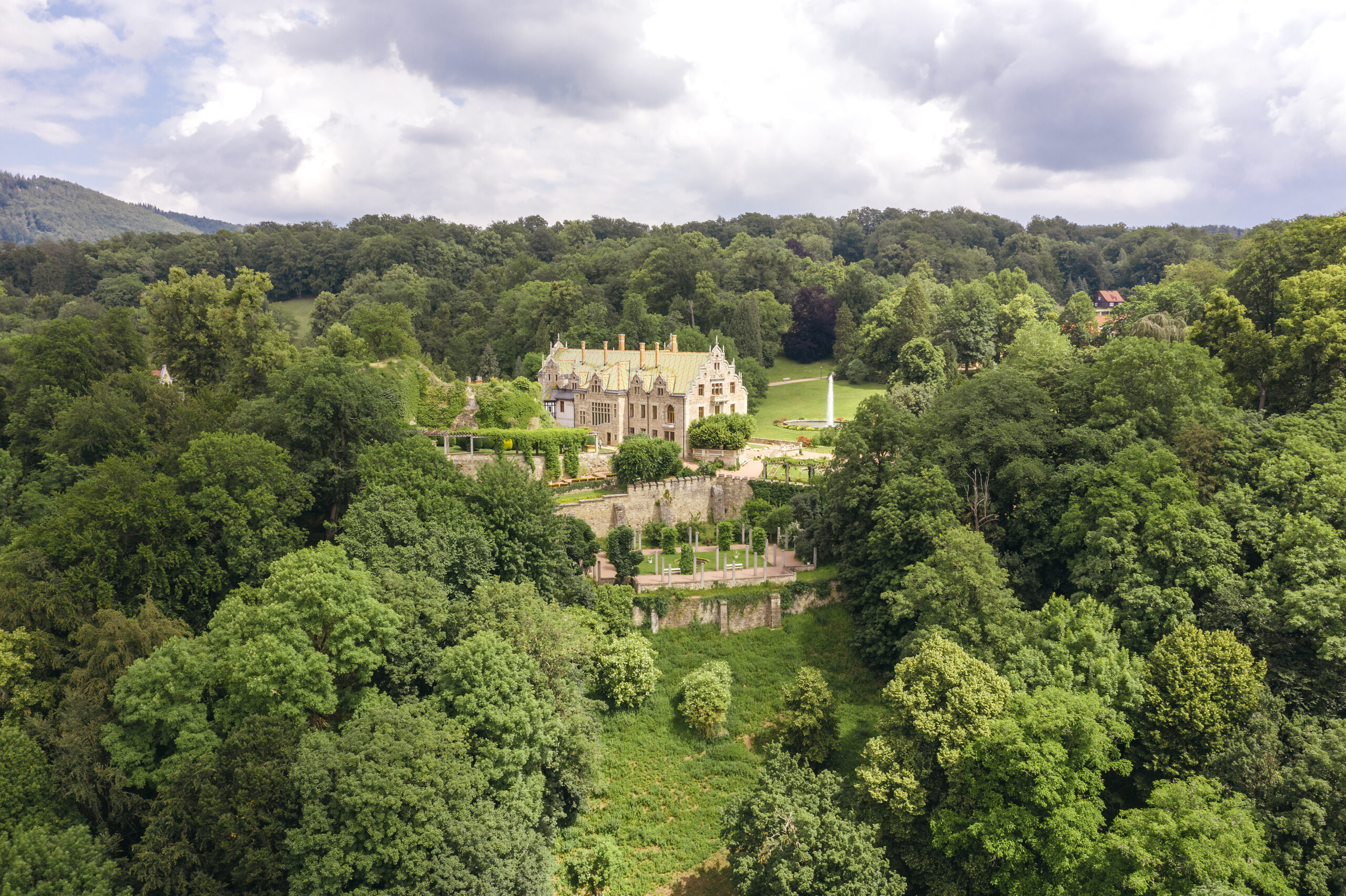
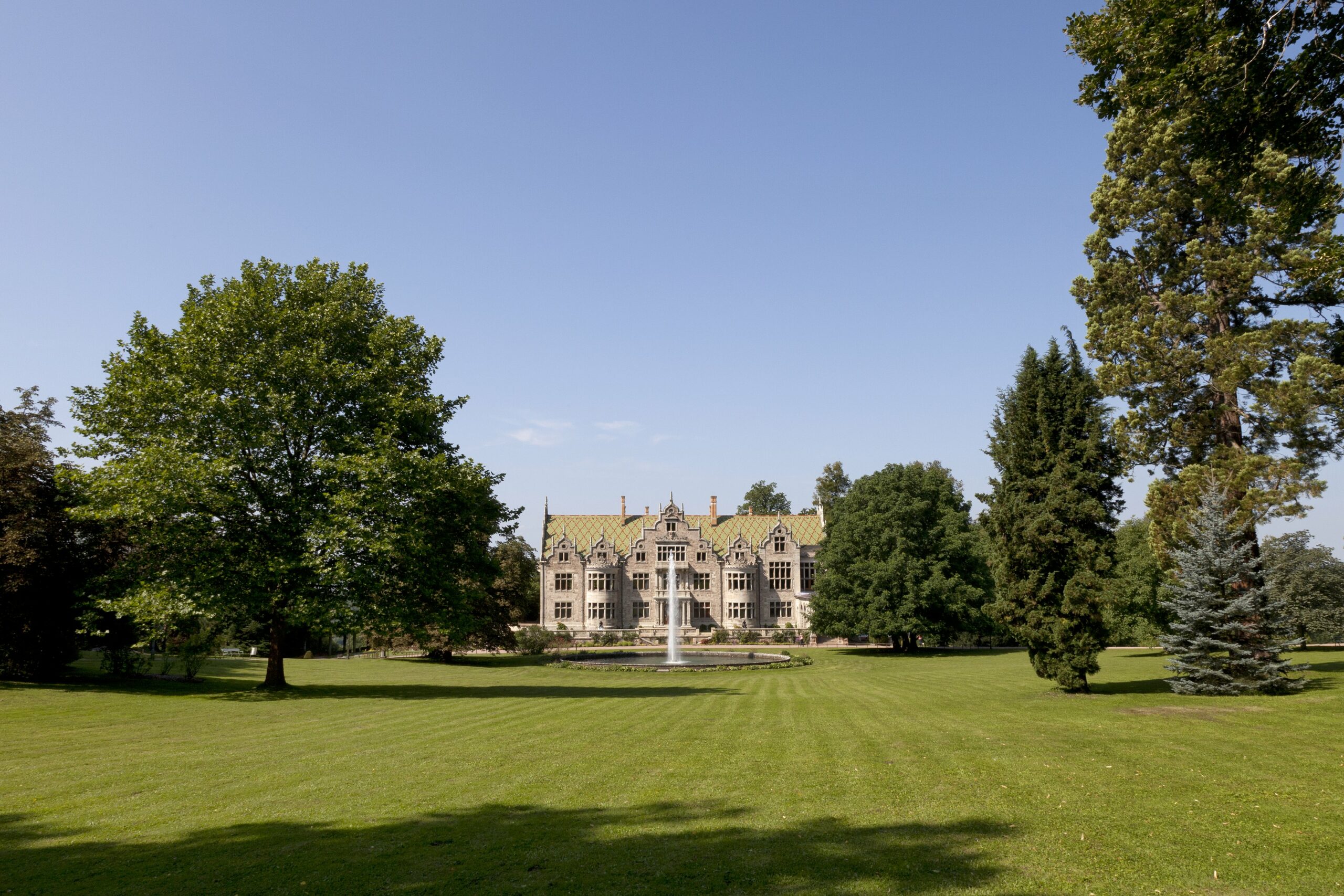
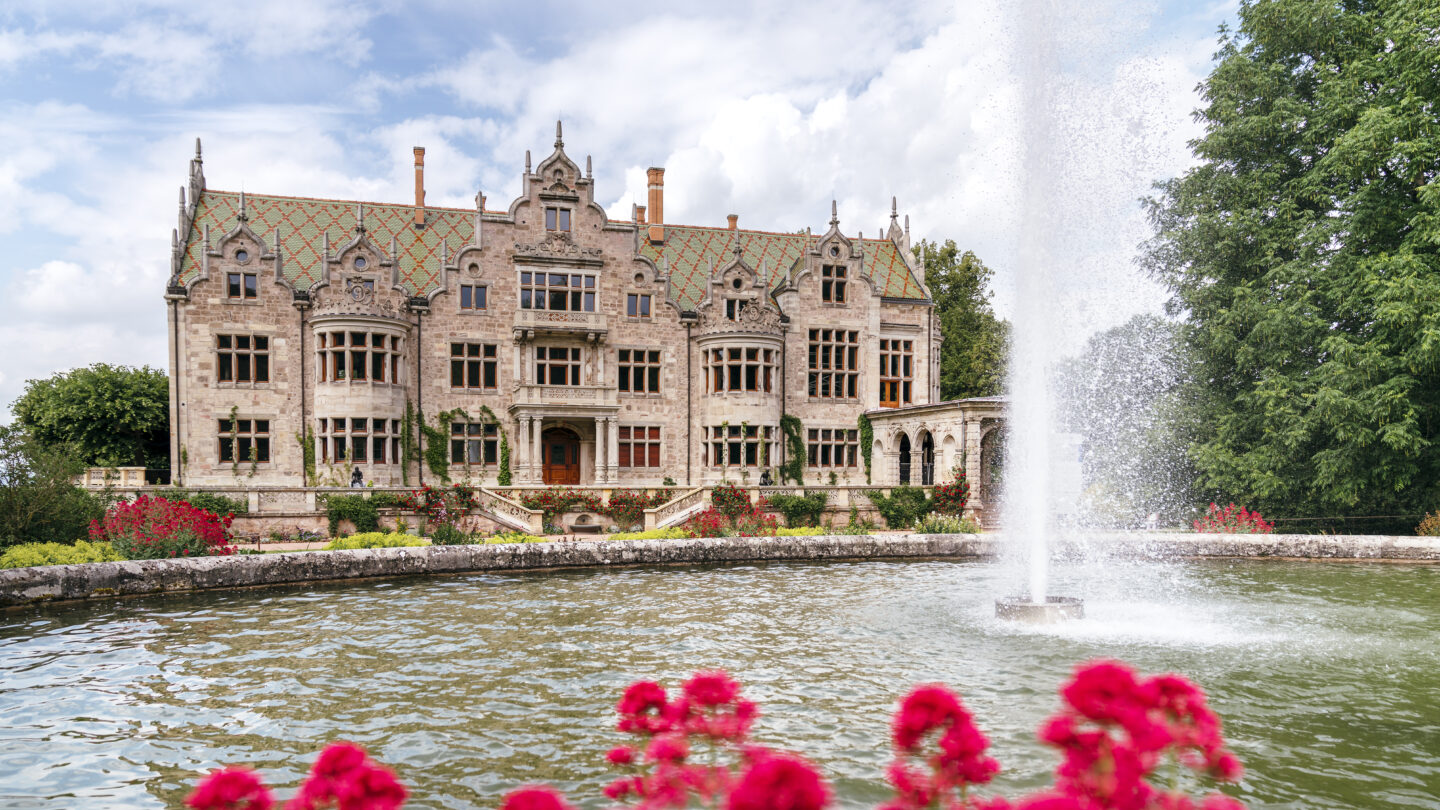
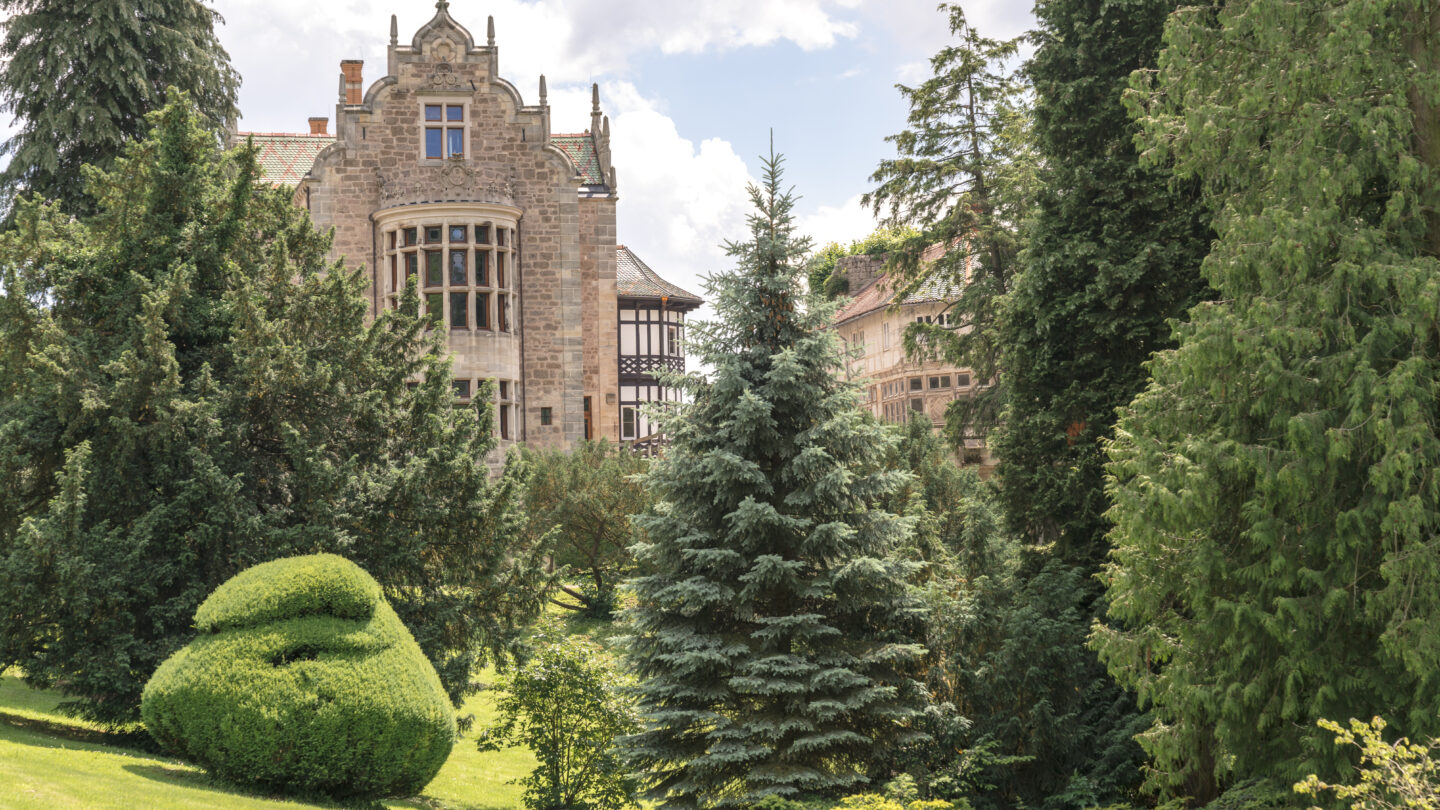
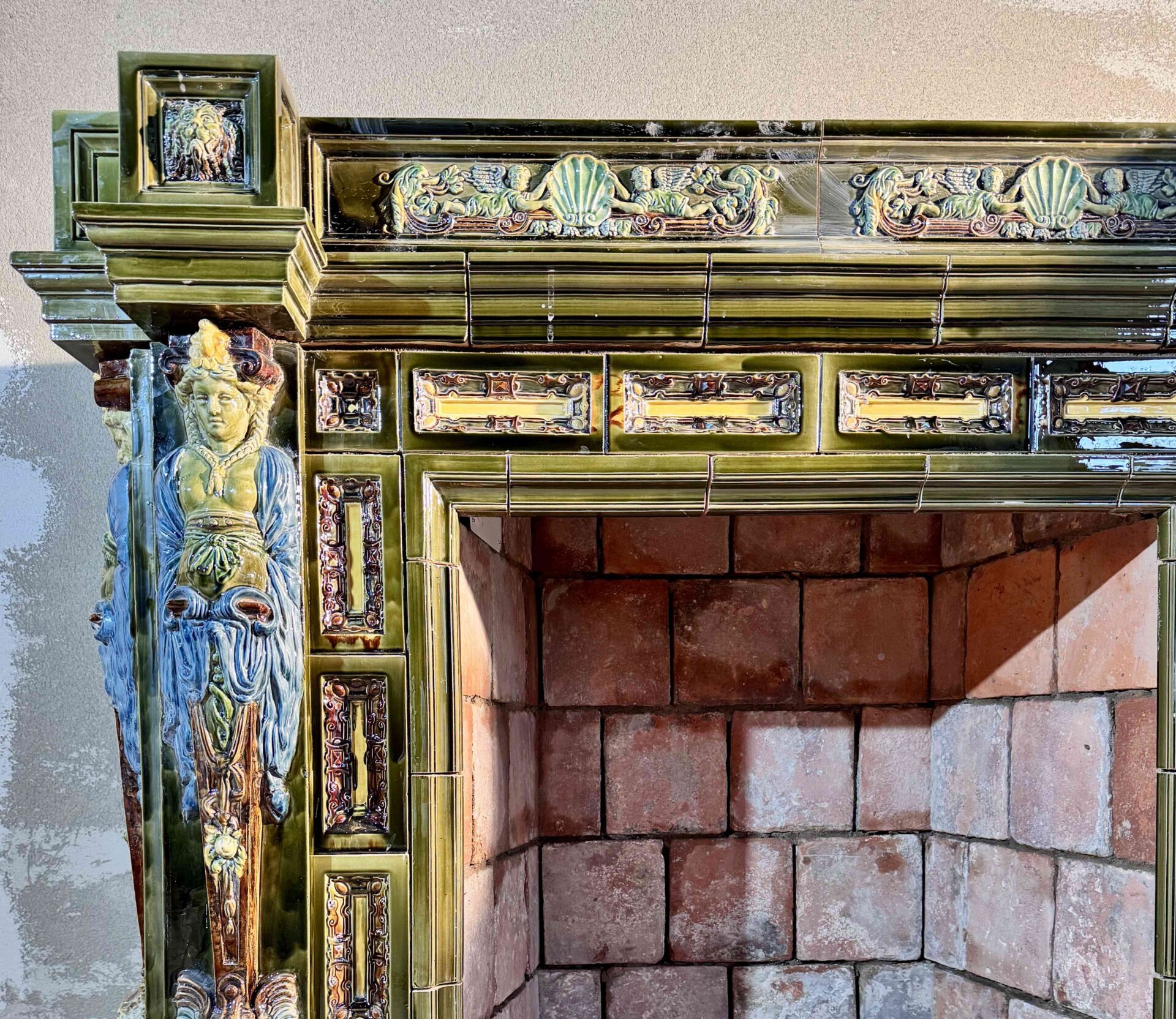
Altenstein Castle with its 160-hectare landscaped park is part of Bad Liebenstein, a spa town in Thuringia steeped in tradition. The park was laid out from 1798 around the baroque predecessor building of today’s castle. Under George II of Saxe-Meiningen, known as the Duke of Theatre, the castle was redesigned from 1888 to 1890 in the style of English country houses. Despite considerable losses due to a fire inside the building in 1982, Altenstein Castle is an architectural gem.
The park visibly reflects three major phases in the development of landscape garden design. The garden architecture of the early, sentimental landscape park has grown together with the large, spatial references of the first half of the 19th century and the detailed design with flowerbeds and sculptures in historicism to form a complete work of art. The garden artists Hermann Fürst von Pückler-Muskau, Eduard Petzold and Peter Joseph Lenné were involved in the design of the park.
Altenstein Castle is located just a few kilometres from Thuringia's oldest spa town, Bad Liebenstein. Built in the neo-Renaissance style, it once served as a summer residence for the Dukes of Saxe-Meiningen. The castle is surrounded by a picturesque landscaped park with a Chinese cottage, ornate carpet beds and vantage points overlooking the Werra Valley. None other than Prince Hermann von Pückler-Muskau was involved in the design of the park. Since 2017, the castle has been home to a memorial to Johannes Brahms, who visited the castle several times.
Castle complex
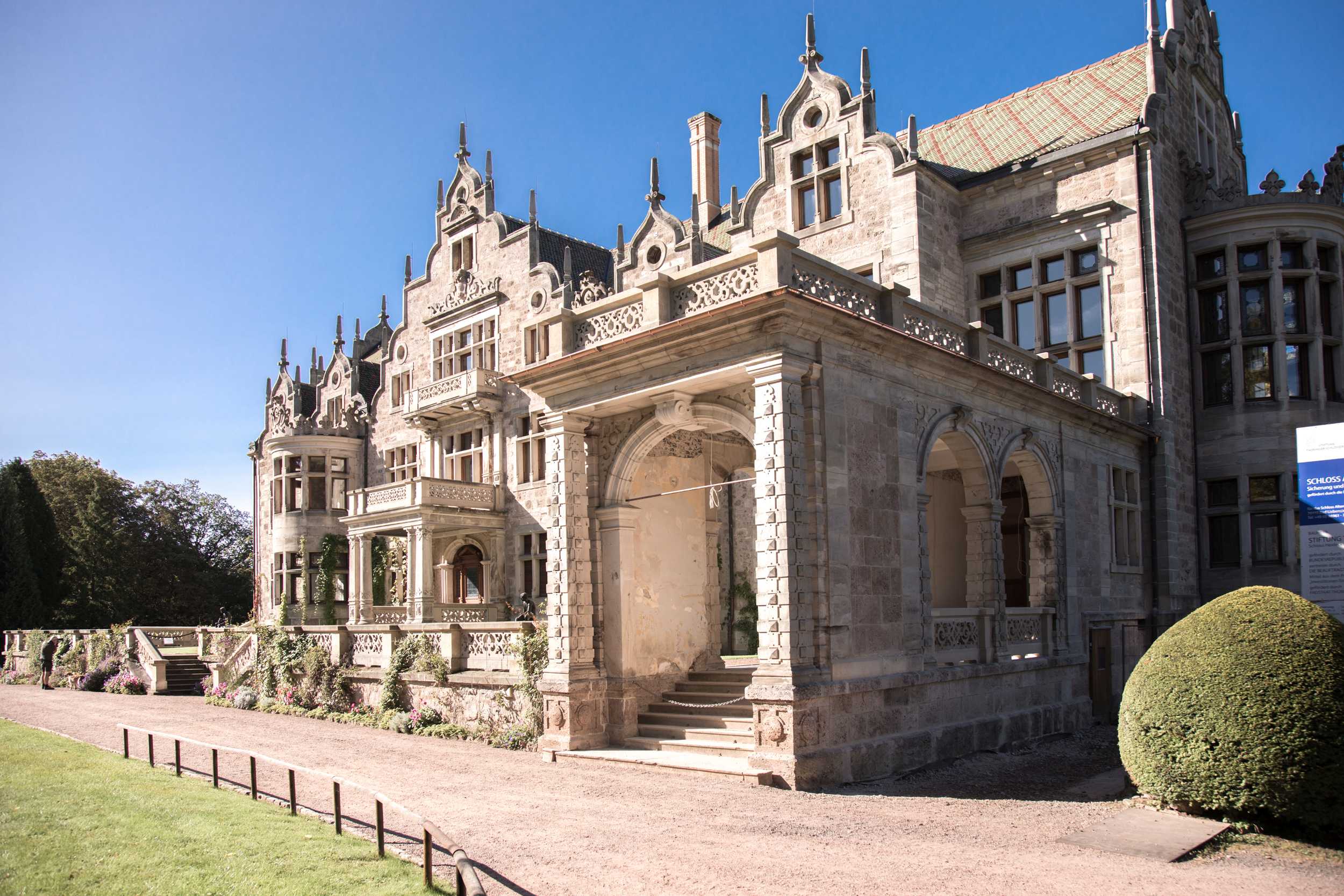
Altenstein Castle owes its present appearance to Duke Georg II of Saxe-Meiningen (1826-1914). Politically, his duchy played a rather subordinate role among the great European powers. Nevertheless, little Saxe-Meiningen achieved Europe-wide fame, as its art-loving ruler was to go down in history as the "theatre duke". George II directed plays, designed costumes and stage sets, wrote treatises on stage theatre and helped the Meiningen court orchestra to new fame. Within two years, he had the castle on the Altenstein fundamentally remodelled, which caused his court architect some headaches. The Duke, whose understanding of art was characterised by historicism, had clear ideas and strict specifications. The result was a building in the style of English manor houses - with curved gables, arched windows, semi-circular oriels, numerous chimneys and obelisk tops. In summer, the Altenstein often served as a residence for the ducal family and developed into a place of leisure. The duke invited intellectuals, artists and musicians there. These included the composer Johannes Brahms, who visited the Altenstein several times. He wrote to Clara Schumann in November 1894: "I wish (...) that you could sit here at my window, go out onto my balcony and then out into the marvellous park and forest. The most beautiful pheasants, deer and roe deer by the dozen walk with you."
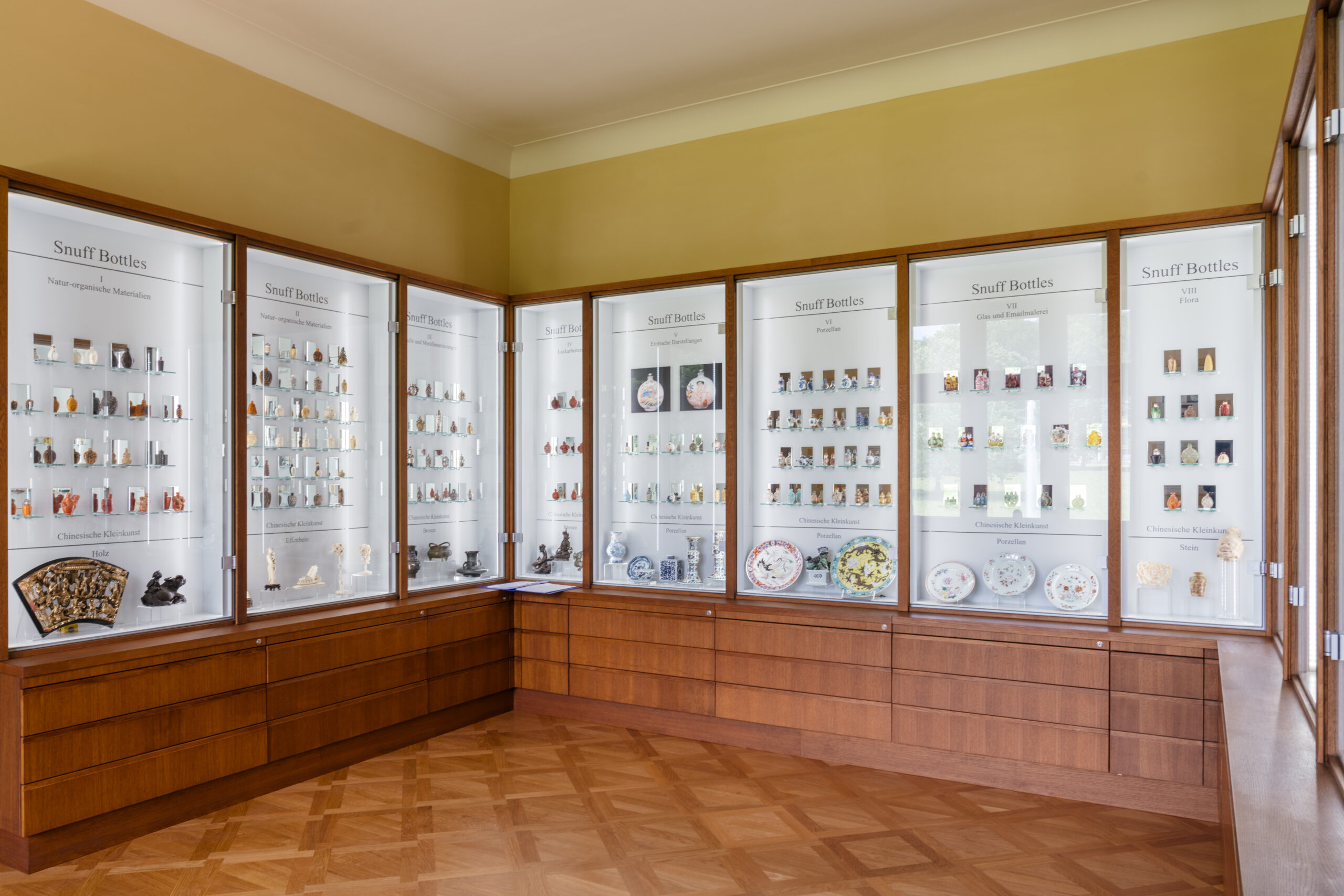
Brahms memorial and snuff bottles
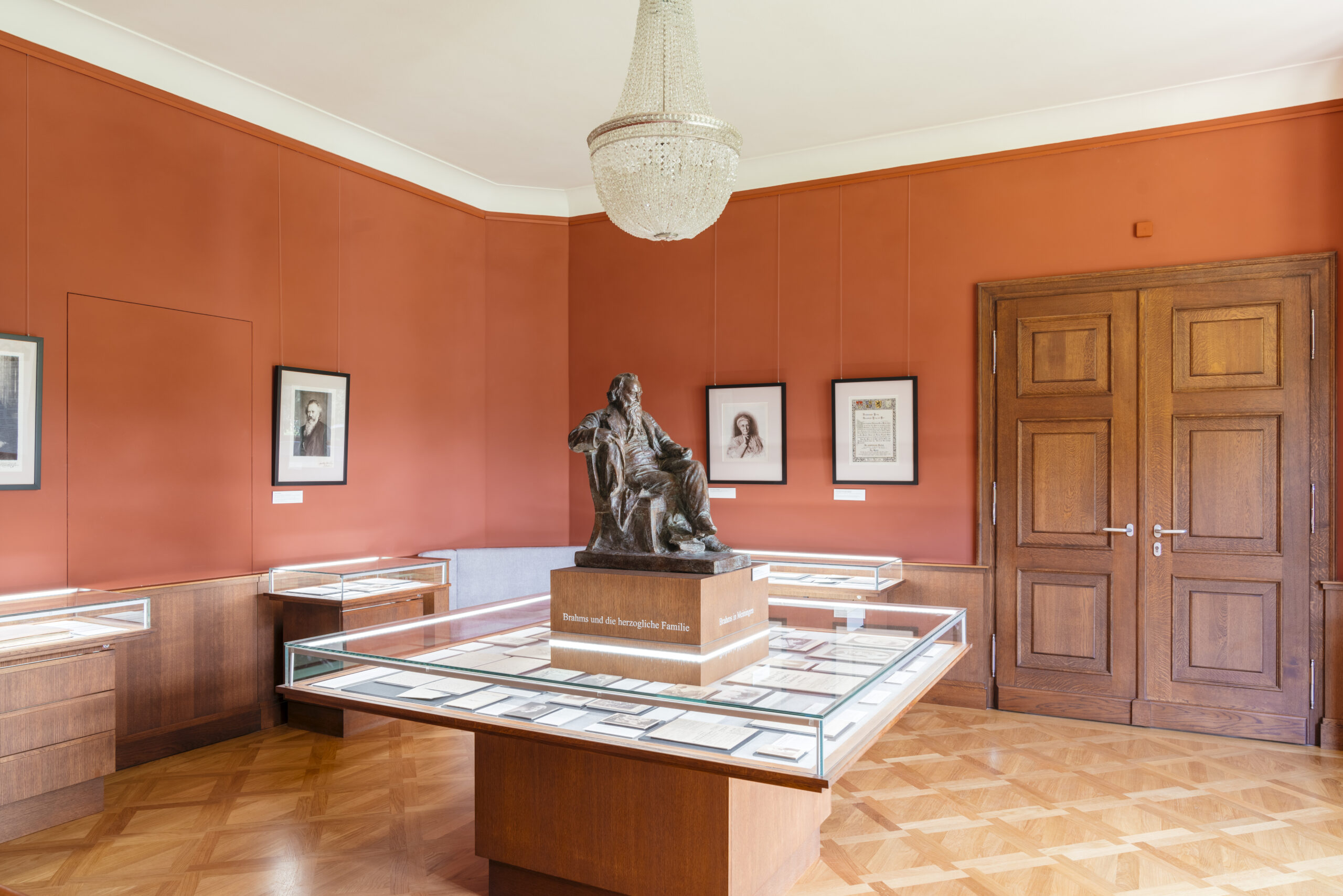
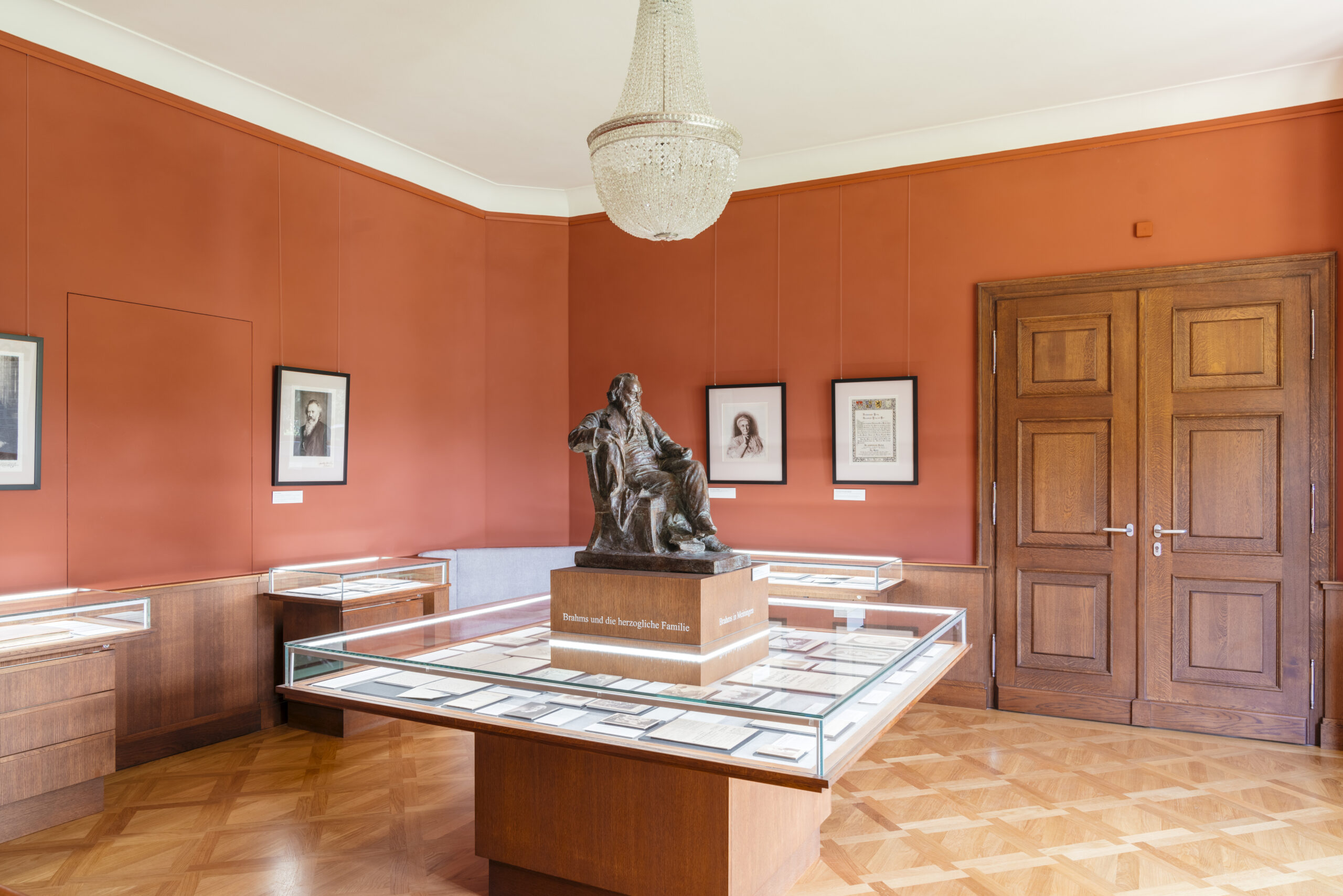
Today, Altenstein Castle is one of the few places that still has a direct connection to Brahms' life. This is why the Brahms Memorial Centre exhibits precious autographs, first prints and original paintings, among other things. After a fire in 1982 destroyed the historic interior of Altenstein Castle, the opening of the memorial is an important milestone on the way to the complete restoration of the castle.
Altenstein, Schloss Altenstein, Brahm's Gedenkstätte, 1. OGAltenstein, Schloss Altenstein, Chinesisches Kabinett, Snuf Bottles, 1. OG
The park: a "gem" of landscape architecture
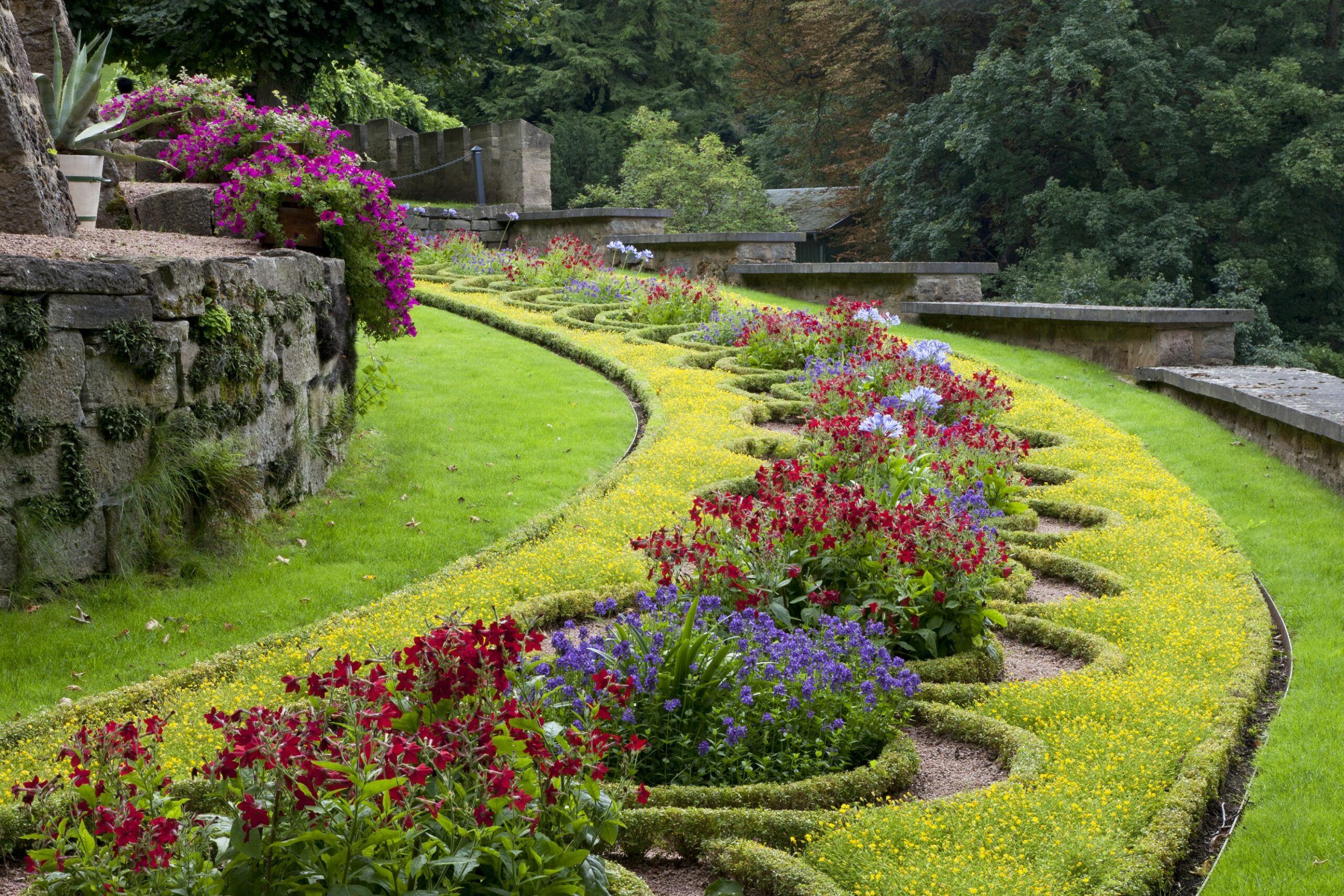
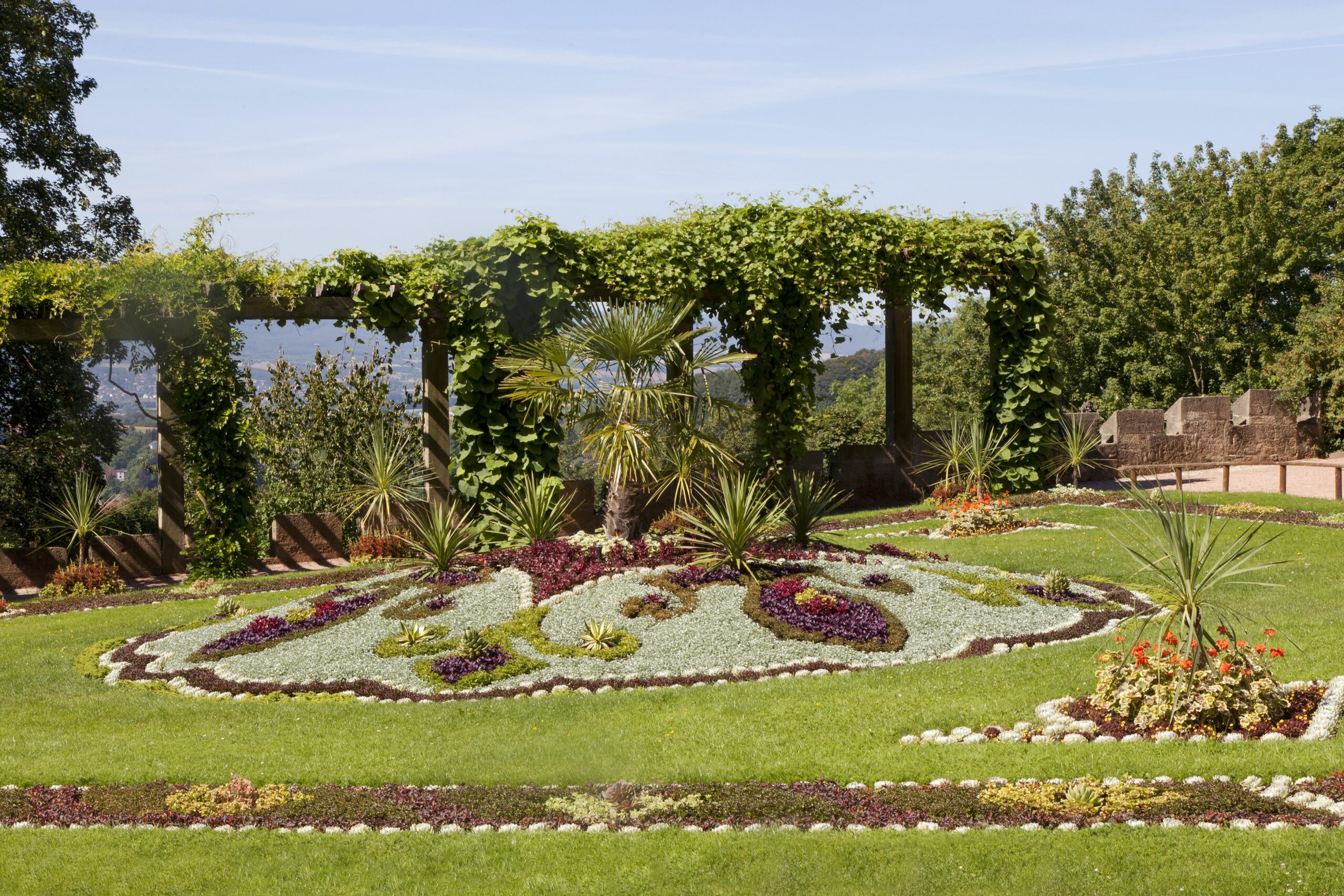
The beginnings of today's extensive park date back to George I of Saxe-Meiningen (1771-1803). The Duke made Altenstein his summer residence and began building a landscaped garden. In doing so, he laid the foundation stone for one of the largest historical parks in Thuringia. In 1853, the regional historian Georg Brückner wrote of the "gem of Thuringian forest nature". No wonder, famous landscape architects such as Prince Hermann von Pückler-Muskau and Peter Joseph Lenné had contributed important ideas to the design of the park. During his visits, Pückler-Muskau was enthusiastic about the "wonderful location, lush grassy areas, (...) abruptly falling rocks with terraced gardens", yet he could not avoid giving "advice about the park" - and so, among other things, large visual axes were created that open up views of the Werra Valley. The extensive park also attracts visitors with vantage points and park architecture such as the Morning Plateau, the Knight's Chapel and the Chinese Cottage. The Altenstein carpet bed and the knot bed can be found around the castle.
Below the park is the Altenstein Cave, which was discovered in 1799 during road construction work. Duke Georg I had an underground landscape park created here in 1800. This park has been open to the public again on guided tours since December 2023.
Garden architecture and freestanding rock formations
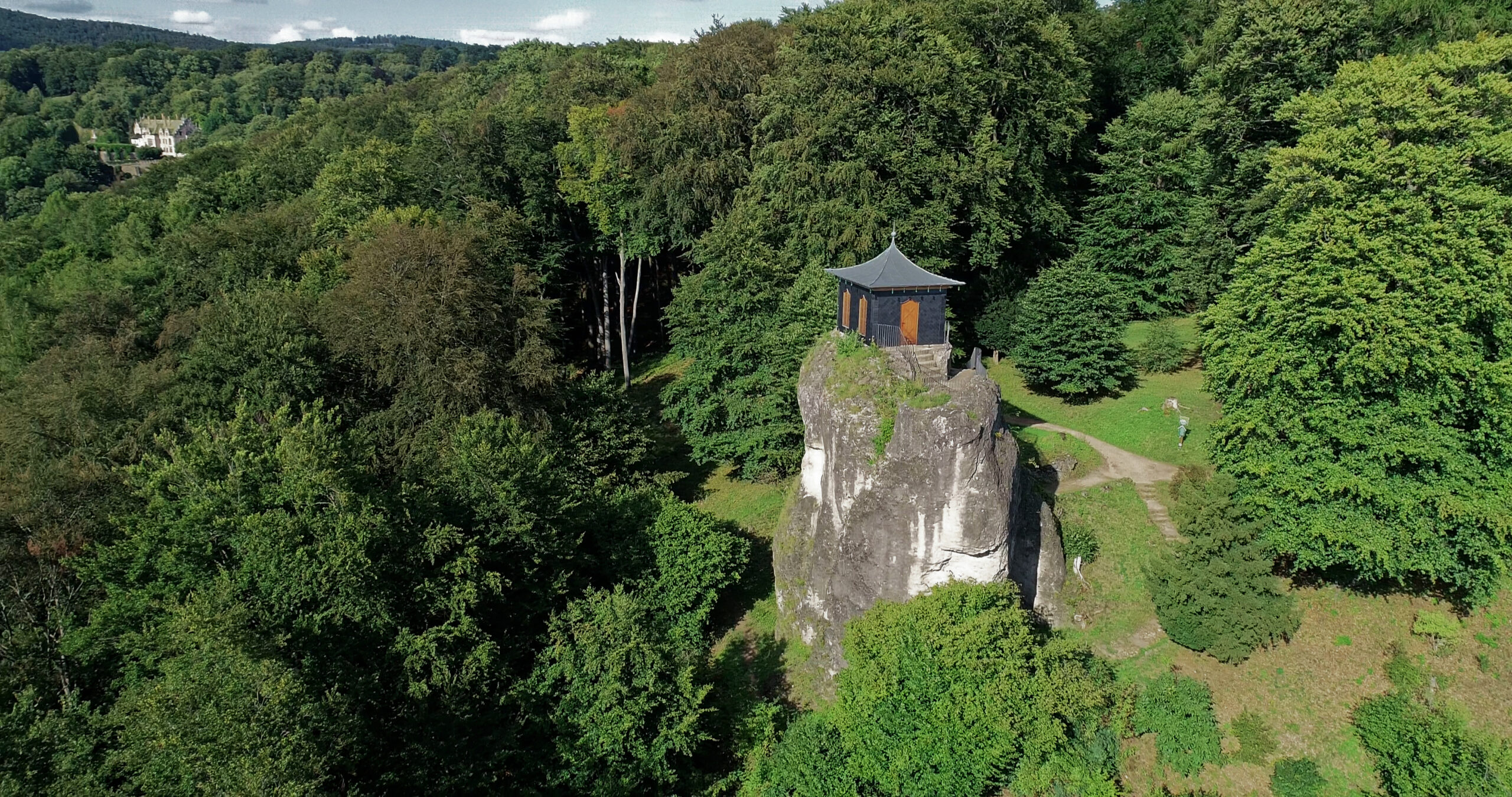
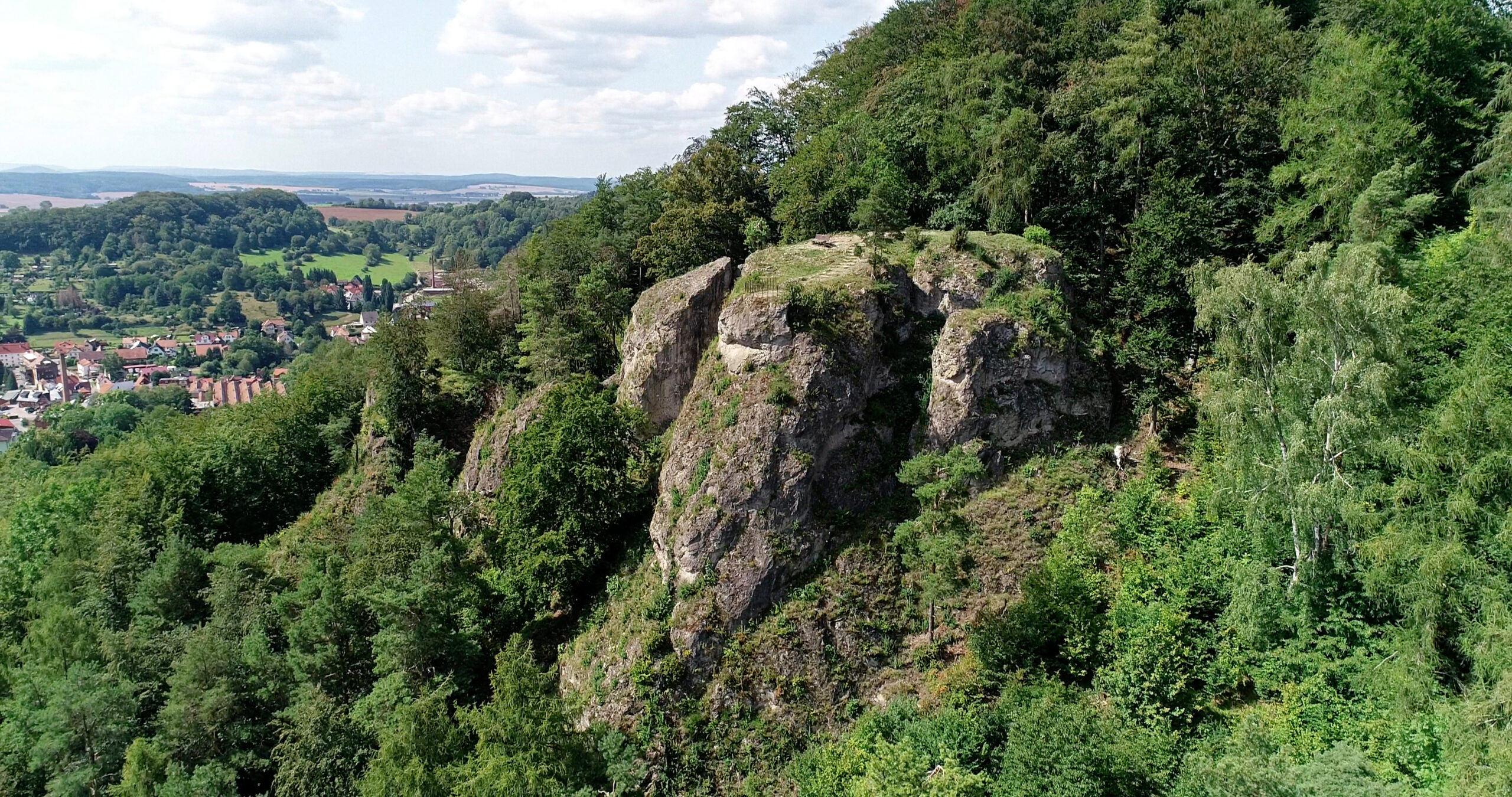
A special kind of landscape park characterises the surroundings of Altenstein Castle in Bad Liebenstein. Located at the western foothills of the Thuringian Forest halfway up the Rennsteig, the extraordinarily extensive mountain park offers sweeping views of the Werra Valley and as far as the Rhön. The paths follow the mountainous terrain, leading through natural forest areas and past rugged rock formations. Time and again, you will come across small architectural structures such as the Chinese Cottage, the Flower Basket Rock, the Knight's Chapel or the Devil's Bridge. They date back to around 1800, when the park was designed according to the then modern idea of a sentimental landscape park. Later, the famous garden artist Hermann Fürst von Pückler-Muskau provided inspiration for the redesign.
Altenstein Castle Park
The Altenstein Landscape Park is characterised by the artistic fusion of the garden design with the landscape-defining rock formations. Around 1800, Duke Georg I of Saxe-Meiningen surrounded his summer residence with numerous sentimental-romantic landscape scenes in keeping with the idealised ideas of garden art at the end of the 18th century, e.g. the Devil's Bridge, the Sennhütte, the Chinese Cottage and the Chinese Rotunda. Around the middle of the 19th century, three of the most famous German garden artists, Hermann Fürst von Pückler-Muskau, Carl Eduard Petzold and Peter Joseph Lenné, were active on the Altenstein and completed the park with targeted planting and a system of visual axes. The final design of the park dates back to George II from 1866. When the palace was remodelled in 1888-90, the palace terraces and inner park were intensively landscaped with flowerbeds and exotic trees and shrubs. The large carpet bed is planted every year according to historical models and is one of the attractions in the palace park.
Flower basket rock
The Flower Basket Rock was created in 1802/03 when Duke Georg I of Saxe-Meiningen had the ensemble built in honour of his late mother Charlotte Amalie. He used an 18 metre high rock needle for this purpose, the top of which was given a small walk-on platform with a large stone flower basket. At the foot of the rock, under a grotto-like vault, the Griffin Bench was created with a bust of Charlotte Amalie on the backrest. Around the same time, other small architectural structures were also erected in the park, such as the Knights' Chapel, the Chinese Cottage and the Devil's Bridge.
The Altenstein griffin bench was modelled on ancient benches in Pompeii, a popular destination for European aristocrats around 1800. Semi-circular stone benches with griffins on their cheeks became popular furnishings in landscape gardens north of the Alps. Duke George I used the motif in the ancient sense as a place of remembrance.
Sandstone was used as the material for the flower basket and gryphon bench.
Park administration Altenstein 4 | Kavaliershaus 36448 Bad Liebenstein T: 03 69 61 – 738064 e-mail
Adventures in Altenstein Park with the explorer rucksack and Bruno the dragon
Bruno the dragon is looking for his sister in one of the most beautiful landscape parks in Germany. Grab your explorer rucksack at the visitor centre and accompany him on his search! He will pass impressive rocks, ancient ruins and a majestic castle. Compass, binoculars, musical instruments and more will be used on this adventure.
For whom? Children between the ages of 6 and 10, accompanied by an adult
Where? Around Altenstein Castle, Bad Liebenstein
How: Borrow an explorer rucksack from the visitor centre and get started
Listen in the garden – audio guide by children for children
The new children’s audio guide “Hör mal im Garten Altenstein” invites you to take a stroll through Altenstein Castle Park with the castle park cat. The castle park cat takes all interested parties on a one-hour tour of the inner and outer park. The cat has ruled over this large garden kingdom for 49 years. At 12 stations, dragons, ghosts and a cheeky little deer also have lots of interesting facts to tell about the historic park.
The audio guide was created as part of a holiday course. Ten participants aged between 10 and 17 lend their voices to the castle park cat and co. They guide young and old through the largest landscape park in Thuringia with its imposing rock formations, small park buildings and many great viewpoints. The children and young people chose the most exciting stations in the park themselves and realised the project as part of a week-long workshop. This included writing the dialogues, recording the texts, recording the sounds and directing the sound editing.
The project is a joint production of the Sparkassen-Kulturstiftung Hessen-Thüringen, the Wartburg-Sparkasse, the Thüringer Landesmedienanstalt, Wartburg-Radio 96,5, the Jugendkunstschule Wartburgkreis e. V. and the Stiftung Thüringer Schlösser und Gärten.
About the “Listen!” project
The “Hör mal” project is a co-operation between schools, the Sparkassen-Kulturstiftung Hessen-Thüringen, the Thuringian State Media Authority (TLM) and various institutions as sponsors of historical gardens. In many places in Thuringia, children and young people produce audio guides for children in a garden in their town. The aim is to deepen topics learnt in class and consolidate the knowledge acquired by the pupils. The school as a place of learning is expanded and the garden is established as a place of knowledge transfer. This project intensifies the bond between the pupils and their home town.
Exhibition 2026 | Light in the Park
Light in the park. New paintings by Patrick Larkin